Some links in this article are affiliate links and may earn UK Barn Finds a commission.
Some old motoring names have disappeared almost completely.
Pratt’s is different.
Go to enough automobilia auctions, rummage through enough old garages or spend enough time looking at vintage enamel signs and sooner or later you are likely to encounter that name.
PRATT’S.
Usually in enormous lettering.
Often against a bright yellow background.
And despite the brand disappearing from British petrol forecourts many decades ago, those old signs remain instantly recognisable.
We recently picked up two of them.
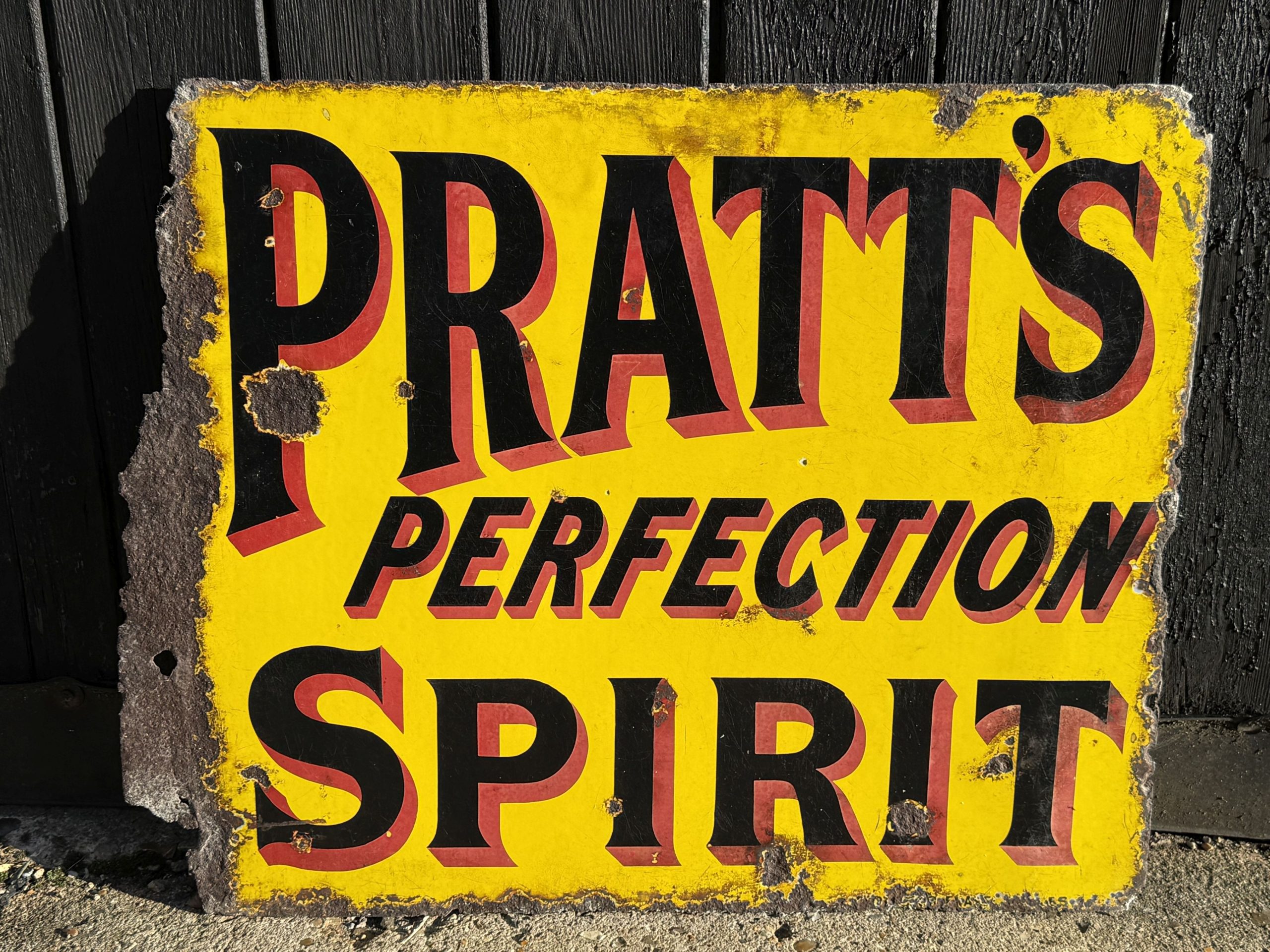
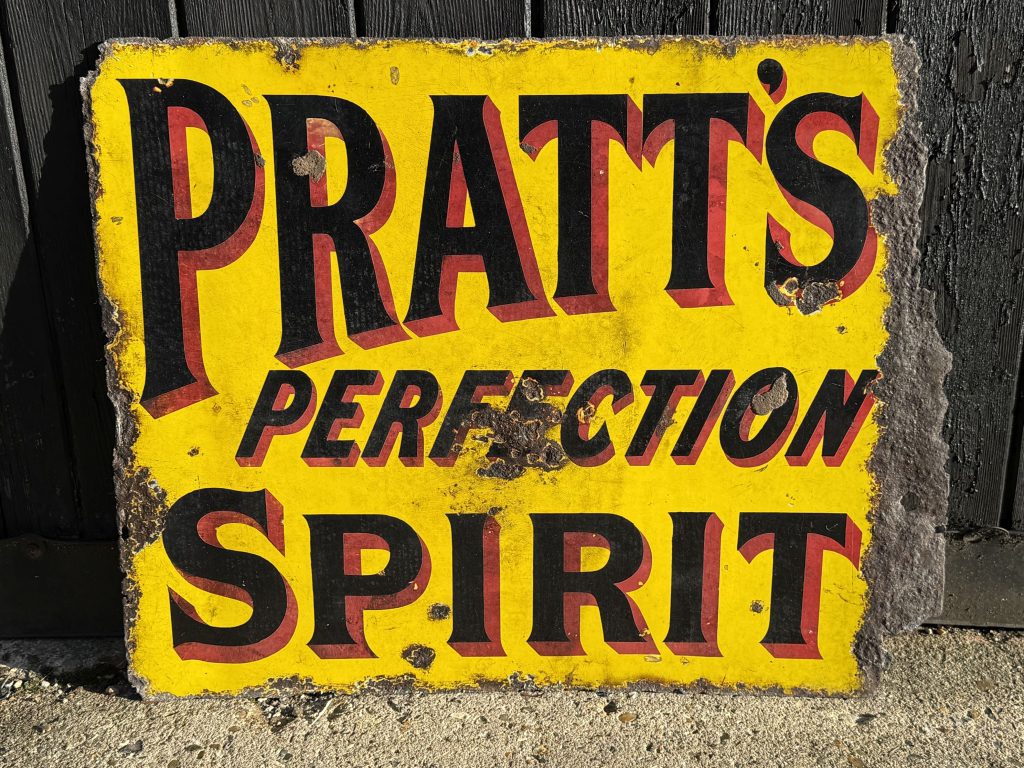
One is a double-sided Pratt’s Perfection Spirit enamel sign, with the coloured area measuring approximately 52cm by 46cm.
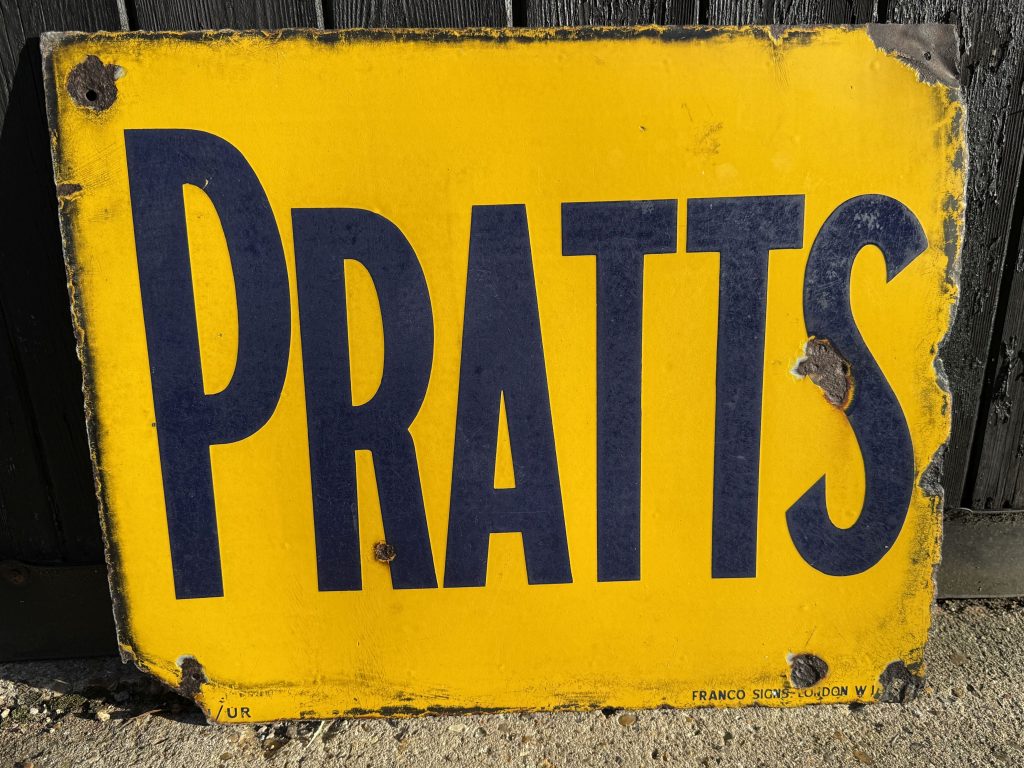
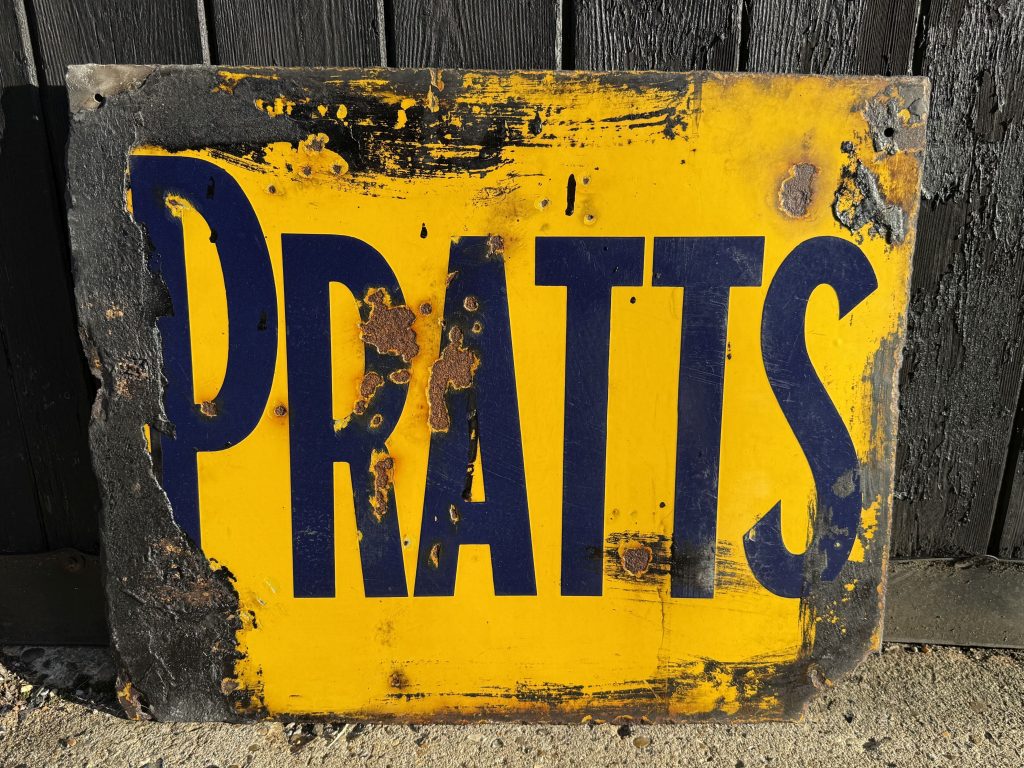
The other is another double-sided Pratt’s sign, approximately 56cm by 46cm, carrying little more than that enormous brand name.
Neither is remotely pristine.
They have corrosion, enamel loss, scars and plenty of evidence of a long life.
But perhaps that is part of why we like them.
And once we started looking into the history of Pratt’s, it became obvious why so many of these old signs once existed in the first place.
What Exactly Was Pratt’s?
Pratt’s was one of the most important names in the early British petrol trade.
The brand belonged to the Anglo-American Oil Company, which established itself in Britain in 1888 as the first overseas affiliate of John D. Rockefeller’s Standard Oil organisation.
The Pratt’s name came from Charles Pratt, the American oil pioneer whose business had become part of Standard Oil.
By 1896, Anglo-American was advertising Pratt’s Petroleum in Britain.
As the motor car developed, the company began selling the product motorists really needed.
Motor spirit.
Or, as we would simply call it today:
Petrol.
What Was Pratt’s Perfection Spirit?
The wording sounds wonderfully elaborate now.
Pratt’s Perfection Motor Spirit.
But it was petrol.
More specifically, it was one of Anglo-American’s branded grades of motor fuel, promoted to the rapidly growing number of people using internal-combustion vehicles.
Period records show Pratt’s Perfection being distributed around Britain in the years before petrol stations as we recognise them became commonplace.
Early motorists often bought fuel in two-gallon cans.
Those cans could be collected from motor agents and other retailers, carried to the vehicle and emptied into the fuel tank.
Period recollections from people who worked around the trade describe Pratt’s Perfection Spirit being supplied in green two-gallon cans.
There were other Pratt’s fuels too.
Over the years the range included products aimed at different uses and markets, including Standard Spirit, Commercial Spirit, High Test, Ethyl petrol and various oils and lubricants.
Pratt’s was not simply one product.
It became a whole family of fuels and motoring products associated with the rapidly expanding motor trade.
If you fancy seeing what has survived, you can browse old Pratt’s signs, petrol cans and automobilia currently on eBay here:
By that point there were around 3,500 agents around the country selling the company’s products.
Think about that number for a moment.
Three and a half thousand outlets.
That is an enormous physical presence for a motoring product at a time when the car itself was still a relative novelty.
And every one of those sellers needed motorists to know what was available.
Which brings us back to the signs.
Branding Mattered
We sometimes think of branding as a modern obsession.
It certainly wasn’t.
Those early oil companies understood it extremely well.
A motorist travelling through an unfamiliar town needed to recognise where fuel was available and, importantly, which fuel was being sold.
There was no smartphone showing the cheapest petrol within five miles.
There were no illuminated supermarket price boards.
Instead there were names, colours, signs, cans, globes and advertisements.
Pratt’s needed motorists to recognise Pratt’s.
Shell needed them to recognise Shell.
BP needed them to recognise BP.
The result was some wonderfully bold advertising.
Our Pratt’s Perfection Spirit sign is a perfect example.
Bright yellow background.
Huge black letters.
Red shadowing.
Almost nothing subtle about it whatsoever.
It was designed to be noticed.
And it still works more than a century later.
Why Are There So Many Different Pratt’s Signs?
Because the brand was everywhere and because it sold far more than one product.
The Science Museum collection includes period enamel advertising for Pratt’s Motor Spirit, Pratt’s Motor Oil and Pratt’s Perfection Motor Spirit.
Other surviving material advertises Pratt’s High Test, Pratt’s Ethyl and various oils and lubricants.
There are rectangular wall signs.
Double-sided hanging signs.
Flanged signs intended to project from buildings.
Pump signage.
Petrol cans.
Oil cans.
Maps.
Ashtrays.
Dealer material.
Advertising novelties.
Even different typefaces and colour schemes can turn up.
Our second sign is wonderfully simple.
It just says:
PRATTS
Huge dark-blue lettering on yellow.
That is all it needed to say.
By the time somebody saw it, the brand itself was doing most of the work.
One Of Ours Was Made By Franco Signs
Our larger Pratt’s sign measures approximately 56cm by 46cm and is double-sided.
Along the bottom of one face is a surviving maker’s mark:
FRANCO SIGNS – LONDON
That little detail is exactly the sort of thing worth looking for on old enamel signs.
Manufacturers’ names, addresses, printing marks and small codes can all help identify different versions and sometimes assist with dating.
The Franco name also appears on other surviving period enamel advertising.
But just as importantly, it reminds us that these were manufactured advertising objects.
Somebody commissioned them.
Somebody designed the lettering.
Somebody produced them in quantity.
And somebody hung them outside garages and fuel agents all over Britain.
Petrol Before The Modern Filling Station
The world these signs belonged to looked very different from the modern petrol station.
Before roadside pumps became widespread, motorists commonly bought petrol in sealed cans.
Fuel could be obtained from all sorts of businesses, including motor agents and shops that today we would never associate with filling a car.
Anglo-American understood early that distribution was everything.
After the First World War, the company installed what it describes as Britain’s first kerbside petrol pump at Hale in Cheshire.
The familiar roadside filling station then developed rapidly during the 1920s.
Pratt’s branding followed the motorist through that transition.
From two-gallon cans to pumps.
From agents and cycle shops to garages and dedicated filling stations.
And throughout it all, those signs told you what was being sold.
The Pratt’s Road Maps Were Advertising Too
There was another clever way of putting the brand directly into motorists’ hands.
Maps.
Anglo-American produced Pratt’s road maps and atlases from the early years of motoring.
The idea was brilliant.
Give the motorist something genuinely useful for travelling around Britain, while making sure Pratt’s Perfection Motor Spirit was staring back at them every time they opened it.
Early examples appeared in the first decade of the 20th century.
By the late 1920s, Pratt’s motoring atlases were depicting the increasingly familiar world of roadside filling stations.
It is another reminder that petrol companies were not simply competing on the liquid inside the can.
They were competing to become part of the motorist’s life.
Brand Loyalty Versus The Cheapest Pump
That feels particularly interesting today.
Of course fuel companies still spend enormous amounts building brands.
But ask plenty of modern drivers how they decide where to fill up and one answer will dominate:
Price.
Which petrol station is cheapest?
Which supermarket has knocked another penny off a litre?
Which app says there is cheaper diesel two miles further down the road?
Early petrol advertising feels different.
Companies sold trust.
Performance.
Consistency.
Modernity.
Quality.
Pratt’s even chose the word Perfection.
That is not shy branding.
The company wanted motorists to associate its name with a product they could depend on.
Whether every driver was quite as loyal as the advertising departments hoped is another matter.
Price mattered then too.
But the extraordinary amount of surviving branded material shows how seriously the oil companies took the battle for recognition.
From Pratt’s To Esso
If Pratt’s was so widespread, where did it go?
The answer is hiding in a name everybody still recognises.
Esso.
The Anglo-American Oil Company was associated with Standard Oil of New Jersey.
The Esso name was introduced in the United States during the 1920s and arrived in Britain in 1934.
Within roughly a year, Anglo-American had changed its British fuel brand names over to Esso.
Pratt’s disappeared from petrol branding.
The name did survive for longer on lubricant products, continuing into the 1950s.
So those old Pratt’s signs represent more than a forgotten petrol company.
They are part of the direct ancestry of one of the most recognisable fuel brands still operating today.
Why Do Pratt’s Signs Turn Up So Often?
Quite simply, because there must once have been a lot of them.
Thousands of agents sold the company’s products.
Garages displayed them.
Petrol retailers displayed them.
Signs hung from buildings.
Others were fixed to walls.
Advertising appeared on pumps, cans and delivery vehicles.
Most disappeared.
They rusted away.
Premises were demolished.
Garages were modernised.
Old signs were pulled down and thrown into skips.
But enough survived that Pratt’s remains one of those names we encounter surprisingly regularly at automobilia sales.
That does not make every Pratt’s sign common.
Some designs are considerably scarcer than others.
But it does mean there is a wonderfully broad collecting field.
Condition Is Everything – Almost
This is where old signs become fascinating.
Two nominally identical signs can produce wildly different reactions from collectors.
Condition matters enormously.
Strong original gloss matters.
Bright colours matter.
Clean lettering matters.
Intact edges matter.
The amount of enamel loss matters.
Previous restoration matters.
Whether a double-sided sign is equally good on both faces matters.
And originality matters enormously.
A crisp sign retaining most of its original enamel can be a very different proposition from one which has lost large areas to corrosion.
Our signs are firmly at the well-used end of the scale.
They have suffered.
The Pratt’s Perfection Spirit sign has substantial enamel loss around its edges and elsewhere.
The larger PRATTS sign is also scarred, chipped and corroded, with one face noticeably rougher than the other.
They have clearly not spent the last century wrapped in cotton wool.
But Rough Doesn’t Mean Worthless
This is perhaps the most important point for anyone clearing an old garage.
Please don’t look at a rusty old enamel sign and automatically assume it is scrap.
Condition may drastically affect its value.
But poor condition does not necessarily remove all value.
Brand matters.
Rarity matters.
Design matters.
Age matters.
Size matters.
Whether it is single or double-sided matters.
The subject matter matters.
And sometimes collectors simply like the appearance of something that has genuinely spent decades outdoors.
A rough original can still be preferable to a shiny modern reproduction.
Recent auction results show just how widely Pratt’s signs can vary in value.
In the same sale, a much larger Pratt’s Perfection Spirit enamel sign measuring 52 inches by 18 inches sold for £350.
Another double-sided Pratt’s Motor Spirit sign, measuring 53cm by 46cm and showing enamel loss, damage and discolouration, sold through Burstow & Hewett in November 2022 for a £150 hammer price.
And a 36-inch-square Pratt’s Ethyl Petrol enamel sign sold through Mathewsons in October 2024 for £560.
Those figures are not valuations for our signs.
They simply illustrate how much the exact design, condition, size, originality and sale circumstances can matter.
The phrase we keep coming back to with automobilia is:
Don’t throw it away before you know what it is.
Old Petroliana Is About More Than Enamel Signs
Signs tend to grab the headlines because they look fantastic hanging on a workshop wall.
But they are only part of the surviving Pratt’s story.
Collectors also look for old petrol cans.
Oil cans.
Pourers.
Pump globes and pump plates.
Maps and road atlases.
Advertising cards.
Ashtrays.
Badges.
Price boards.
Dealer material.
Receipts.
Promotional items.
Even apparently mundane packaging can become interesting once most examples have disappeared.
If you want to disappear down the same rabbit hole we did, have a look at the Pratt’s petroliana and old garage memorabilia currently on eBay here:
Sometimes the names we no longer recognise tell the best stories.
Affiliate Disclosure
When you click on links to various merchants on this site and make a purchase, we may earn a commission. Our affiliate partnerships include, but are not limited to, the eBay Partner Network and Amazon.
Join our newsletter
Get the best barn finds, projects and classic temptations direct to your inbox.
Related Posts
Discover More Classic Car Stories
Stay updated with the latest barn finds, auction news, and classic car adventures in our 'News & Waffle' section. Dive into rare discoveries, behind-the-scenes stories, and expert insights into the world of classic cars. Whether you’re a seasoned enthusiast or simply intrigued by the tales behind these treasures, this is your hub for all things classic and captivating.
This Vanden Plas Princess auction result proves that first impressions don’t always tell the whole story. When this rather lovely 1968 Vanden Plas Princess 1300 was called into the auction room at Anglia Car Auctions, things didn’t quite go according to plan. Instead of driving in under its own power, it had to be pushed. [&...
Some old garage signs need no introduction. Shell. Castrol. Esso. Dunlop. Then there are the names which were once familiar to motorists all over Britain but have quietly slipped out of everyday memory. Dagenite is one of them. We recently picked up this wonderfully worn, double-sided enamel sign measuring approximately 51cm by 38.5cm. One side [&...
Every barn find starts with a question. Will it run? That is usually somewhere in our minds from the moment somebody first contacts us about an old car that has been sitting in a garage, barn, shed or garden for years. Sometimes decades. We might know when it was last taxed. We might know when [&...