Some links in this article are affiliate links and may earn UK Barn Finds a commission.
Some old garage signs need no introduction.
Shell. Castrol. Esso. Dunlop.
Then there are the names which were once familiar to motorists all over Britain but have quietly slipped out of everyday memory.
Dagenite is one of them.
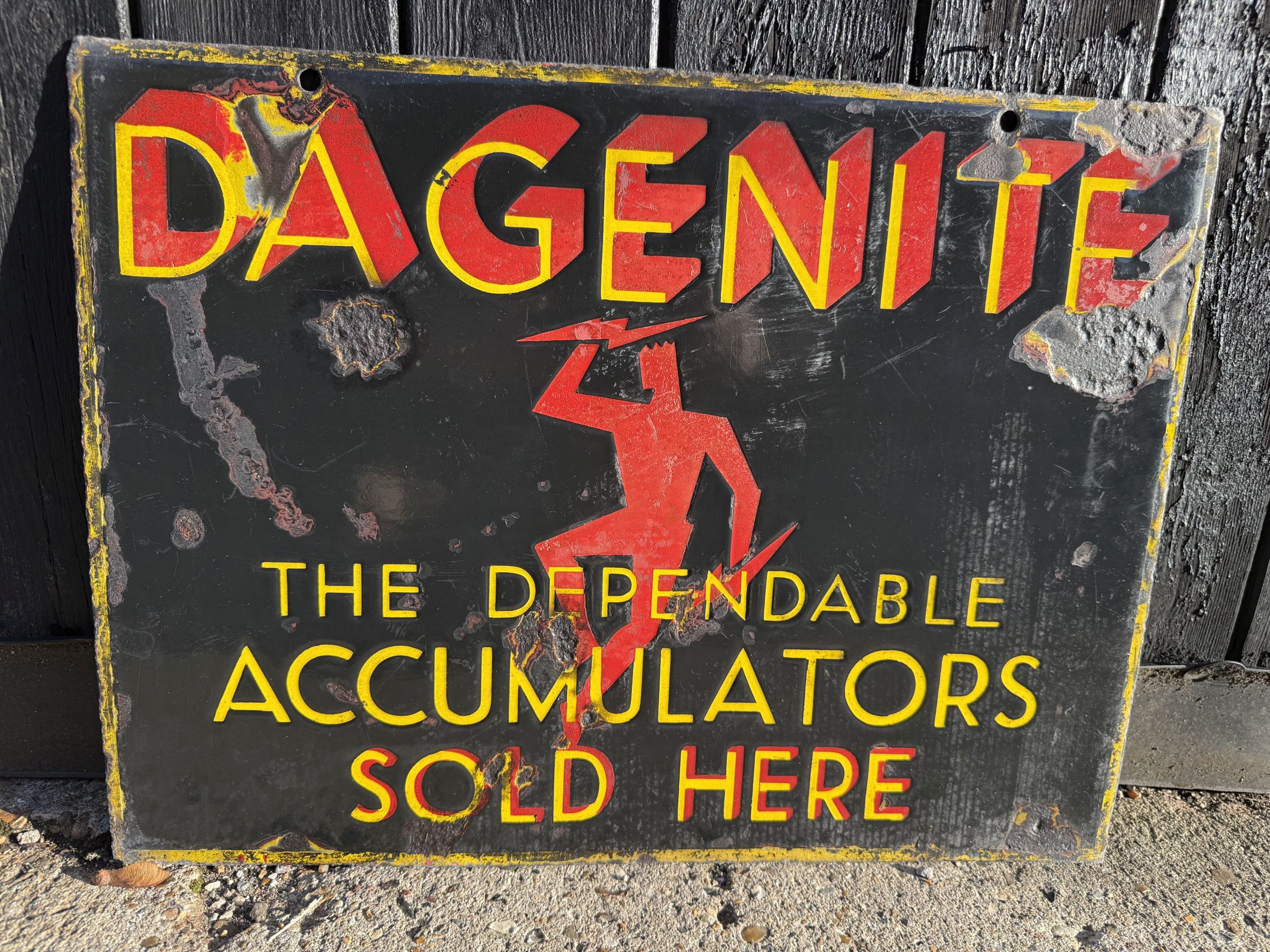
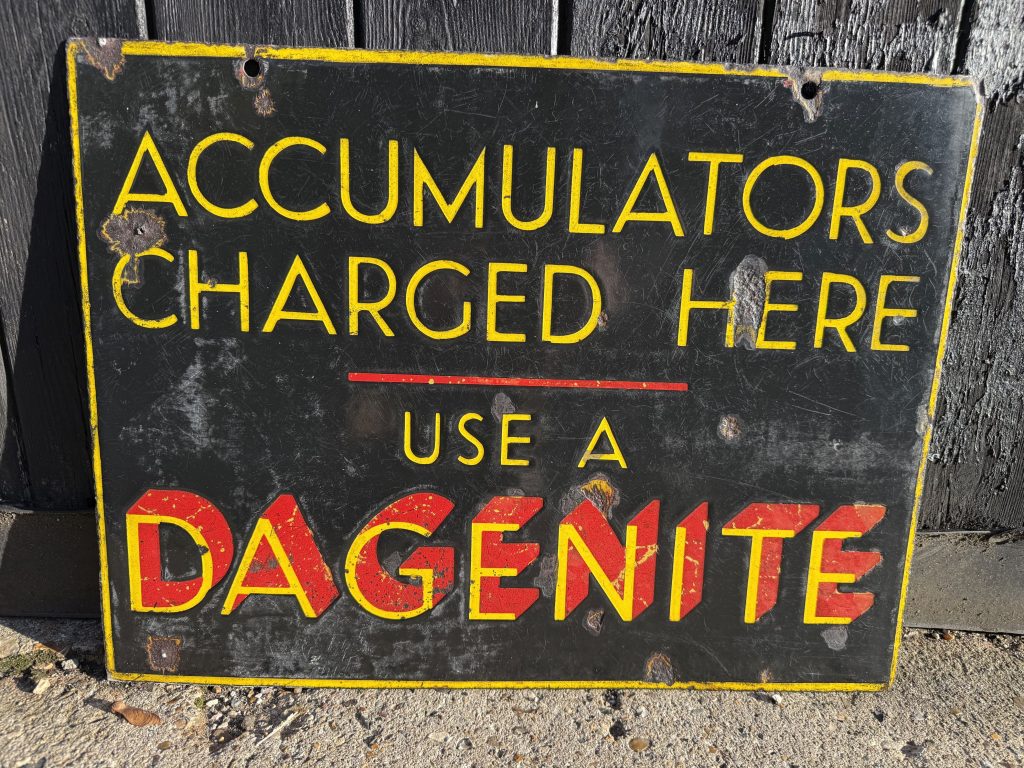
We recently picked up this wonderfully worn, double-sided enamel sign measuring approximately 51cm by 38.5cm.
One side reads:
DAGENITE – THE DEPENDABLE ACCUMULATORS – SOLD HERE
Turn it over and the message changes to:
ACCUMULATORS CHARGED HERE – USE A DAGENITE
It is a lovely surviving piece of old garage advertising.
But what exactly was a Dagenite accumulator, who made them, and why did garages need a sign telling motorists that they could have one charged?
Once we started digging, the story went back much further than we expected.
What Was A Dagenite Accumulator?
In modern language, an accumulator is simply a rechargeable battery.
For motorists of the period, that usually meant a lead-acid storage battery carrying out much the same basic jobs a conventional 12-volt car battery performs today: storing electrical energy and supplying it when required.
Early automotive accumulators became increasingly important as electric lighting and, crucially, electric starting systems became commonplace.
By 1932, trade publications were listing Dagenite among the established manufacturers of accumulators used for starting, lighting and ignition.
So if you discover an old Dagenite battery, battery box, catalogue, charging equipment or dealer sign in a garage or workshop, you are looking at something directly connected with the development of the electrical systems we now take for granted in cars.
And there is still plenty of Dagenite material out there.
You can browse old Dagenite signs, batteries and automobilia currently on eBay here:
The history behind the name is particularly interesting.
Battery manufacturer Pritchett & Gold established important works at Dagenham Dock in the early part of the 20th century.
Historical research into the area records that the company marketed its accumulators under the Dagenite name, derived from its Dagenham manufacturing base.
Pritchett & Gold itself had deep roots in electrical storage.
Its history became intertwined with the Electrical Power Storage Company, an extraordinarily important early battery business established in 1882.
The Institution of Engineering and Technology records that EPS was among the pioneers of commercial accumulator manufacture, supplying storage batteries for everything from lighting installations to major buildings.
Through mergers and acquisitions, that battery-making expertise became part of Pritchett & Gold and EPS.
Then in 1922, the Chloride Electrical Storage Company acquired a controlling interest in Pritchett & Gold.
So behind the rather cheerful Dagenite advertising was some serious electrical engineering history.
At First, ‘Dagenite’ Was Even The Battery Case Material
One of the more fascinating things we found is that the Dagenite name was being used very specifically in the 1920s.
A 1924 advert for Peto & Radford batteries described Dagenite as a special composition manufactured at the company’s Dagenham Dock works.
It was moulded into a one-piece battery container designed to be acid-proof, leak-proof and extremely difficult to break.
That was a significant improvement over batteries which relied on separate ebonite cells housed inside wooden containers.
The advertising specifically promoted the fact that the one-piece Dagenite case avoided leaking batteries and rotting wooden battery boxes.
Over time, Dagenite became much more than the name of the casing material.
It developed into a battery brand in its own right.
‘The Dependable Accumulator’
By the early 1930s, the wording on our old sign was already firmly established.
Period Dagenite advertisements carried the slogan:
The Dependable Accumulator
Exactly the same words appear on the front of our sign.
One 1931 advertisement from the National Accumulator Company promoted Dagenite accumulators with a clever feature called the Tell Tale.
This used coloured floats to indicate the state of charge and help warn the owner when recharging was necessary.
The advert talked about interlocking grid plates, acid-proof glands and terminals designed to minimise mistakes.
Dagenite was clearly being sold as something dependable and technically advanced rather than simply a cheap replacement battery.
The same advertising also proudly described the product as British made.
Dagenite Wasn’t Just For Cars
This is where the history becomes even more interesting.
Dagenite accumulators were also widely sold for wireless sets.
Before mains electricity reached every home, many valve radios relied on batteries.
A rechargeable low-tension accumulator supplied part of the set’s electrical requirements, while high-tension batteries supplied the much higher voltage needed elsewhere in the radio.
Those rechargeable accumulators had to be taken somewhere to be recharged.
That might be a radio shop, electrical dealer, ironmonger or other local business equipped to provide the service.
Period Dagenite advertising specifically promoted its accumulators through both Dagenite service stations and radio dealers.
So the word “accumulator” could have meant something familiar not just to a motorist, but to somebody carrying the family radio battery down to the local shop.
So Why Does Our Sign Say ‘Accumulators Charged Here’?
Turn our sign over and arguably the most interesting part appears.
ACCUMULATORS CHARGED HERE
That simple wording transports you straight back into a very different motoring world.
Modern drivers generally buy a battery already charged, fit it and largely forget about it until years later when it eventually becomes reluctant to start the car.
Older batteries demanded much more attention.
Electrolyte levels had to be monitored.
Charging systems were less sophisticated.
And a flat or poorly charged accumulator could require specialist attention.
Businesses selling batteries therefore also offered charging services.
The sign did two jobs at once.
One face told passing customers that the premises sold Dagenite accumulators.
The reverse told them that batteries could be charged there.
Because it is double-sided, it was presumably intended to be visible to people approaching from either direction, rather than being screwed flat against a wall.
It is not difficult to picture it hanging outside an old garage or electrical dealer.
Dagenite And The Motor Industry
Dagenite had some impressive automotive connections too.
The Rolls-Royce experimental archives contain extensive correspondence concerning Dagenite batteries during the 1930s.
That includes Dagenite accumulators being supplied for testing and batteries intended for Rolls-Royce and Bentley applications.
One particularly evocative piece of correspondence from 1935 concerns supplying a Dagenite accumulator for E.R. Hall’s Bentley for the Ulster TT.
This wasn’t simply a brand sitting on the shelf of a local accessory shop.
Its products were being evaluated and used at the very top end of the British motor industry.
The association continued.
Later Dagenite literature claimed lengthy use by Rolls-Royce, while the company developed batteries for passenger cars, commercial vehicles and other applications.
In 1955, for example, trade reporting referred to new Dagenite battery ranges intended separately for goods vehicles and passenger vehicles.
What Did A Dagenite Battery Actually Look Like?
Like most long-lived battery brands, the design changed considerably over the decades.
Early accumulators could look very different from a modern car battery.
By the 1960s, however, Dagenite was still innovating.
One particularly interesting design was the Dagenite Easifil.
Instead of motorists having to remove individual filler caps and peer into each cell, the Easifil used indicators and a central filling arrangement intended to make checking and topping up the electrolyte much simpler.
That sounds quaint today, but anyone who remembers routinely checking the water level in conventional batteries will immediately understand the attraction.
The modern maintenance-free battery has hidden an entire little servicing ritual that once formed part of normal car ownership.
Dagenite Survived Into The Television Advertising Age
The Dagenite name survived long enough to reach an entirely different generation of motorists.
By the mid-1970s it was being advertised on British television.
That longevity is probably part of the reason old Dagenite material still triggers recognition.
Someone interested in pre-war motoring might remember the early accumulator advertising.
Someone else may associate Dagenite with the batteries fitted to cars during the 1950s and 1960s.
And another generation may remember seeing the name advertised on television.
It is one of those brands that quietly spans a surprisingly large chunk of British motoring history.
Why Old Dagenite Signs Are So Appealing
Our sign is certainly not perfect.
Far from it.
There is enamel loss.
There are areas of corrosion.
The edges show plenty of age and both faces carry the scars of a long working life.
But, to us, that is a large part of the appeal.
This doesn’t look like a reproduction made to decorate a modern garage.
It looks like something that actually did the job it advertises.
At approximately 51cm by 38.5cm it is also a useful size, and being double-sided makes it much more interesting than a simple flat wall sign.
The graphics help enormously too.
Black background.
Strong yellow lettering.
Red Dagenite branding.
And that fantastic period figure in the centre.
It is unmistakably from another era.
People Still Collect Dagenite Automobilia
Dagenite may no longer be one of the first names modern British motorists think of when buying a car battery, but collectors certainly haven’t forgotten it.
Old Dagenite enamel signs, advertising material, battery boxes, tins, literature and other garage memorabilia continue to appear at specialist sales.
At an Anglia Car Auctions automobilia sale in January 2025, for example, a Dagenite Batteries enamel sign sold for £288 including premium.
That does not mean every Dagenite sign is worth that amount.
Condition, age, design, size, originality and rarity can all make an enormous difference.
But it does demonstrate something we see again and again with old garage memorabilia.
A name which seems obscure to one person can be exactly what another collector has been hunting for.
If you want to see what is currently being offered, have a rummage through Dagenite signs and vintage battery memorabilia on eBay here:
This is one of the reasons we enjoy researching old signs like this.
The sign itself tells one story.
But somewhere out there, there will still be old garages, workshops, shops and sheds containing the things the sign once advertised.
Perhaps an unused Dagenite accumulator.
An old battery case.
Dealer literature.
A price list.
A service-station display.
Battery-charging equipment.
Boxes, labels, tools or other advertising material.
To somebody clearing an old workshop, these things can look like rubbish.
They aren’t necessarily.
Old garage stock has a habit of becoming surprisingly collectable once enough of it has disappeared.
If you find something with an unfamiliar old motoring name on it, don’t automatically throw it away because you don’t recognise the brand.
Have a look first.
Clearing An Old Garage, Workshop Or Dealership?
We are always interested in old motoring material.
Cars and motorcycles are obviously a huge part of what we do, but we also like the things that once surrounded them.
Old enamel signs.
Petroliana.
Battery and electrical equipment.
New-old-stock parts.
Tools.
Dealer displays.
Workshop equipment.
Oil cans.
Advertising material.
Brochures and catalogues.
Even apparently insignificant boxes of old garage stock can contain things that collectors now actively seek.
If you are clearing an old garage, workshop, dealership, filling station, shed or collection, you don’t need to identify everything before getting in touch.
In fact, we’d rather see things before they are cleaned, restored or thrown away.
A few photographs are usually enough to start with.
Because sometimes the rusty old sign hanging on the wall is only the beginning of the story.
Affiliate Disclosure
When you click on links to various merchants on this site and make a purchase, we may earn a commission. Our affiliate partnerships include, but are not limited to, the eBay Partner Network and Amazon.
Join our newsletter
Get the best barn finds, projects and classic temptations direct to your inbox.
Related Posts
Discover More Classic Car Stories
Stay updated with the latest barn finds, auction news, and classic car adventures in our 'News & Waffle' section. Dive into rare discoveries, behind-the-scenes stories, and expert insights into the world of classic cars. Whether you’re a seasoned enthusiast or simply intrigued by the tales behind these treasures, this is your hub for all things classic and captivating.
This Vanden Plas Princess auction result proves that first impressions don’t always tell the whole story. When this rather lovely 1968 Vanden Plas Princess 1300 was called into the auction room at Anglia Car Auctions, things didn’t quite go according to plan. Instead of driving in under its own power, it had to be pushed. [&...
Every barn find starts with a question. Will it run? That is usually somewhere in our minds from the moment somebody first contacts us about an old car that has been sitting in a garage, barn, shed or garden for years. Sometimes decades. We might know when it was last taxed. We might know when [&...
This Porsche Cayman S auction result raises a question that would have sounded rather strange a few years ago. When did Porsches get this cheap? Because we’re not talking about a tired old Porsche 924 that’s been sitting in somebody’s garden for 20 years. This is a 2008 Porsche Cayman S. A proper mid-engined, six-cylinder [&...