This Vanden Plas Princess auction result proves that first impressions don’t always tell the whole story.
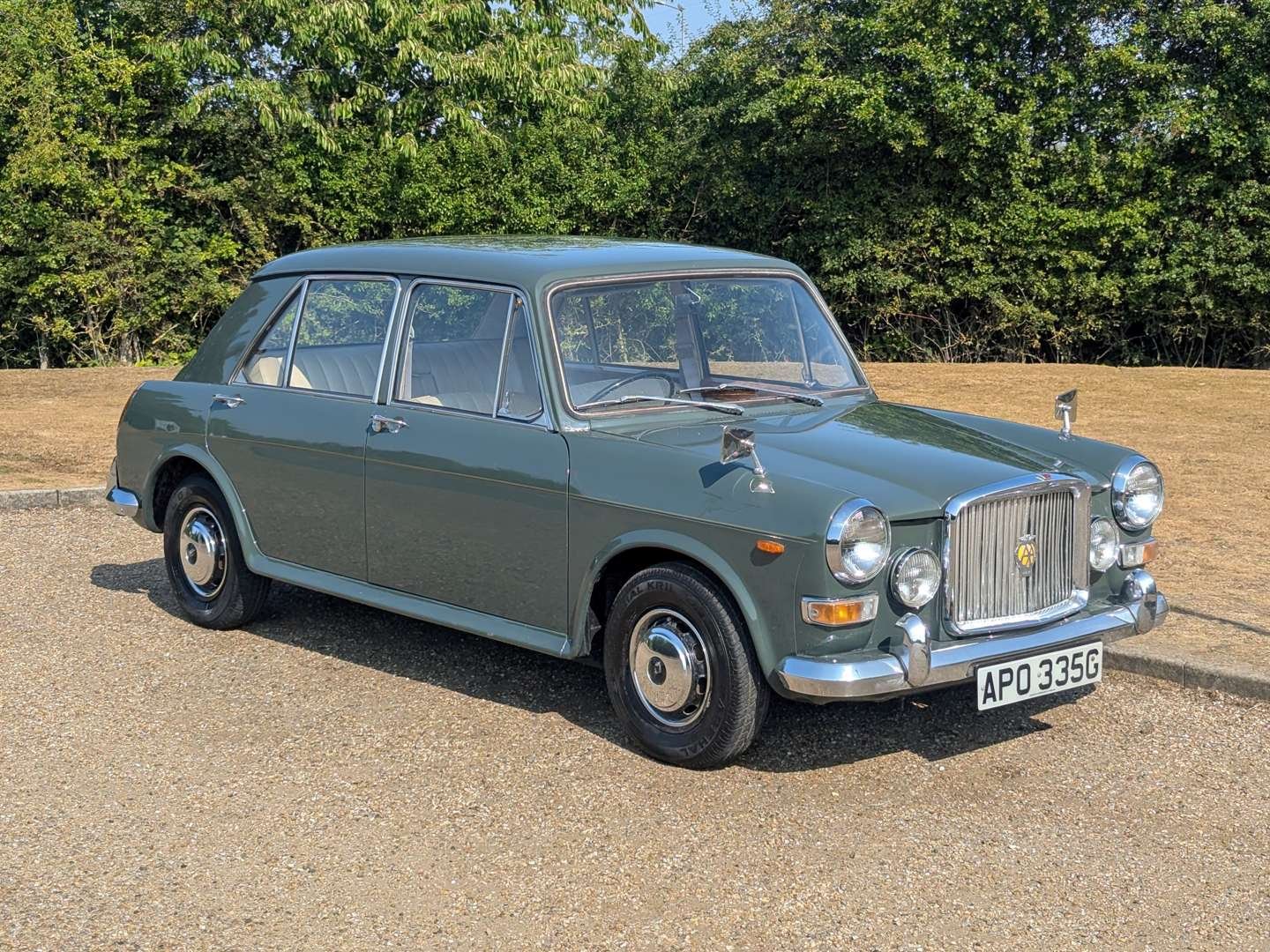
When this rather lovely 1968 Vanden Plas Princess 1300 was called into the auction room at Anglia Car Auctions, things didn’t quite go according to plan.
Instead of driving in under its own power, it had to be pushed.
Not exactly the grand entrance you’d expect from a Princess!
But here’s the interesting bit.
The bidding certainly didn’t grind to a halt.
And many of those bidding were actually standing in the room.
So what did they see in this little British luxury saloon?
A Princess With Stage Fright
According to what we were told at the auction, the Vanden Plas had been driving perfectly well beforehand.
When its turn came to enter the saleroom, however, it wasn’t playing ball.
A lack of fuel was suspected.
That’s certainly a possibility, although we can’t say for certain what caused the problem.
And there’s quite a difference between a car temporarily refusing to start and one suffering from a serious mechanical fault.
But from a bidder’s point of view, there’s still an awkward question.
Would you put your hand up for a car that had just been pushed into the auction room?
A Rather Special Little Austin
To understand the appeal of this car, we need to go back to the 1960s.
The Vanden Plas Princess 1300 was essentially a luxury interpretation of the BMC ADO16 family.
That might not sound particularly glamorous.
After all, the same basic family included the Austin 1100, Morris 1100, MG 1100, Riley Kestrel and Wolseley 1100.
These were the sort of cars you could find on ordinary British streets throughout the 1960s and 1970s.
But the Vanden Plas was something rather different.
It took the clever engineering of the ADO16 and wrapped it in an unexpectedly luxurious package.
Small Car, Big Ambitions
The original ADO16 arrived in 1962, with engineering led by Alec Issigonis.
Like the Mini, it used a transverse engine driving the front wheels.
This arrangement allowed a remarkably spacious interior for such a compact car.
Hydrolastic suspension helped give the range a comfortable ride.
The result was a family car that made very efficient use of its dimensions.
But Vanden Plas saw another opportunity.
Why not take all that space and comfort and create something resembling a miniature luxury saloon?
And that’s exactly what happened.
The Baby Rolls-Royce
The Vanden Plas Princess 1100 appeared in 1963.
It was built with a level of interior luxury that seemed almost absurd in a car of this size.
Leather upholstery.
Walnut veneer.
Deep carpeting.
Fold-down picnic tables.
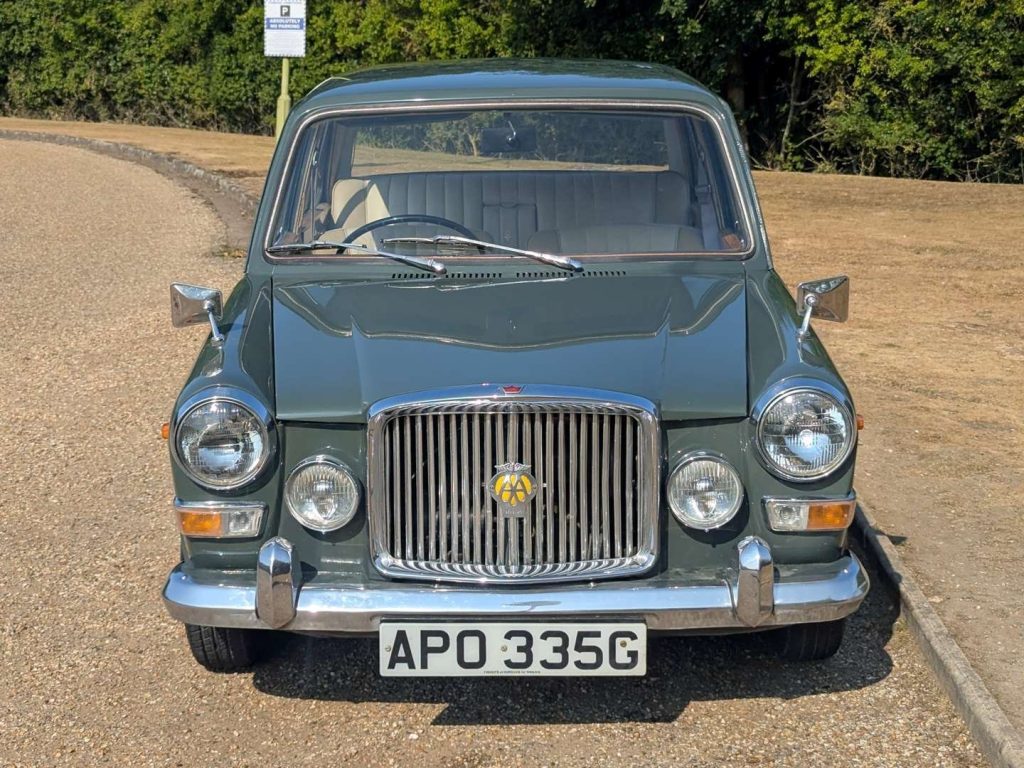
And a distinctive upright grille that gave the little saloon an unexpectedly grand appearance.
It was the sort of equipment you’d associate with a much larger and more expensive motor car.
Which explains why these cars are so often described as miniature Rolls-Royces.
Of course, they weren’t actually Rolls-Royces.
But you can understand the comparison.
The 1300 Arrived
In 1967, the Princess gained the larger 1275cc A-series engine.
That made it a little more relaxed to drive, particularly with passengers aboard.
This 1968 example is therefore an early Princess 1300.
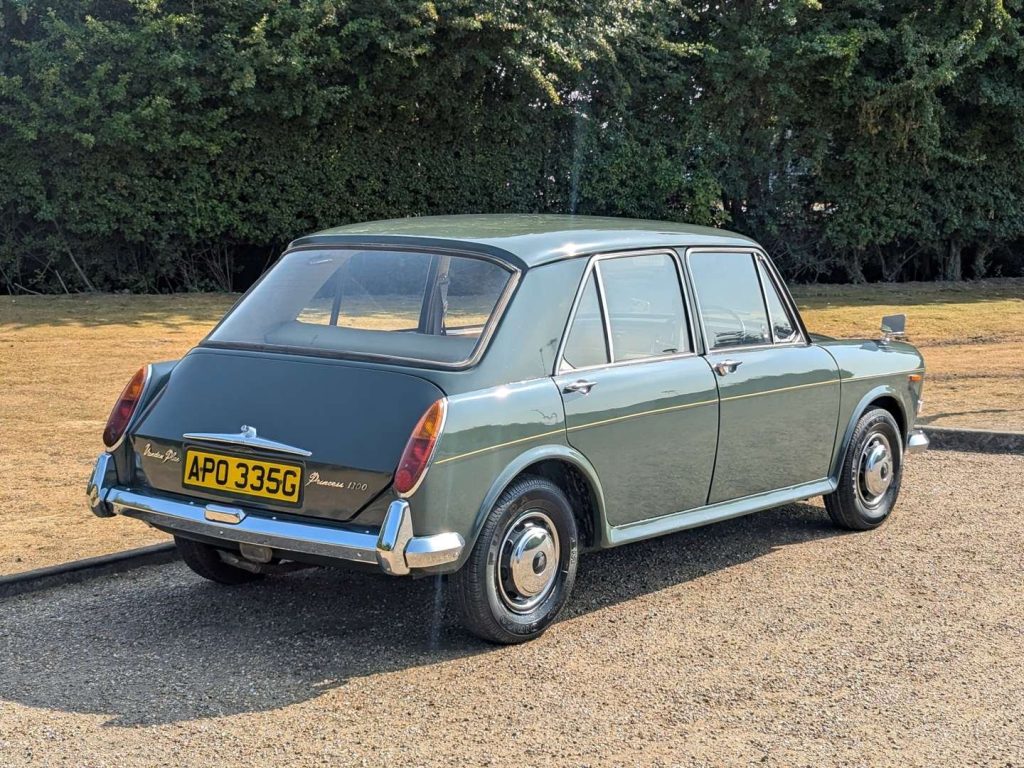
It has the familiar compact four-door body, traditional Vanden Plas grille and beautifully appointed interior.
And there’s something rather charming about a car that combines such modest mechanical origins with such an ambitious specification.
Sherwood Green and Champagne Beige
This particular example was finished in Sherwood Green.
It’s a colour that suits the shape beautifully.
Inside was a Champagne Beige interior, providing exactly the sort of traditional British luxury atmosphere you’d expect.
The combination is wonderfully period.
There’s nothing aggressive or sporting about it.
This is a car designed to make its occupants feel rather important, even if the engine under the bonnet is closely related to the one in an Austin 1300.
And we think that’s a large part of its charm.
An Interesting History
The auction catalogue revealed something else about this Princess.
It had once formed part of Jaguar Land Rover’s Heritage Collection.
That’s a rather interesting addition to the history of a small Vanden Plas.
It doesn’t automatically make the car more valuable, but it certainly adds to its story.
The vendor acquired it in 2019 and had recently recommissioned it before the auction.
According to the seller, it was a good, reliable car that drove very well.
The seller also described it as surviving in largely original condition.
What About the Bodywork?
Anyone familiar with the ADO16 family will know that corrosion is something to take seriously.
These cars can suffer in numerous areas, and a shiny exterior doesn’t necessarily tell you what’s happening underneath.
In this case, the vendor described the underside as very good and solid, without patches.
The front wings were also reported to be new.
Those are encouraging claims, although naturally we’d still want to inspect the structure ourselves before buying.
Condition is particularly important with cars like this because restoration costs can quickly exceed their market value.
Mileage and Paperwork
The odometer was showing 17,089 miles.
That figure shouldn’t automatically be taken as the car’s total lifetime mileage without supporting evidence.
The V5C was present and indicated five former keepers.
There were also some previous MoT certificates and receipts.
Its last recorded MoT in the catalogue had been passed without advisories in 2018.
As a 1968 vehicle, it was eligible for historic-vehicle MoT exemption, subject to the applicable requirements.
So there was plenty to consider beyond the attractive paintwork and luxurious interior.
One Important Paperwork Detail
There was also an administrative point worth noting.
ACA explained that the car had been exported to Ireland in 2019 but had not been registered there, remaining on its English plates.
A NOVA certificate had been applied for, but the process had not been completed at the time of the catalogue description.
The auction house warned that the buyer might have to wait for the paperwork.
That’s the sort of detail we’d always want to understand before bidding.
An appealing classic is one thing.
Being able to register and use it without unexpected complications is another.
Then Came the Auction
ACA guided the Princess at £4,000–£6,000.
That seems a reasonable indication of the sort of money the auction house expected it to attract.
But the unexpected entrance added a little drama.
Instead of arriving under its own power, the car had to be pushed into the saleroom.
And you can imagine the reaction.
Was something seriously wrong?
Had it simply run out of fuel?
Would the problem affect the bidding?
For anyone watching online, it might have created a moment of doubt.
But the people in the room had something else going for them.
The Room Bidders Had Seen It
This is what makes the result particularly interesting.
Much of the bidding came from people physically present at the auction.
They’d had the opportunity to look over the car before it entered the room.
They could examine the bodywork.
Look at the interior.
Assess the general condition.
And form their own opinions about what it was worth.
That doesn’t mean they knew exactly why it had stopped running.
Nor does it guarantee the car was fault-free.
But it does mean they weren’t necessarily judging it solely on that awkward entrance.
And clearly, there was still plenty of interest.
Would You Have Kept Bidding?
Imagine being there.
You’ve seen the Princess beforehand.
You like the colour.
You appreciate the interior.
You’ve read about its interesting history.
You know it has been recommissioned.
Then, just as it’s about to be sold, it has to be pushed into the room.
Would that change your mind?
Would you lower your maximum bid?
Or would you trust what you’d already seen and carry on?
That’s exactly the question this auction raises.
Watch the Bidding Unfold
Here’s the moment the Princess made its unexpected entrance at Anglia Car Auctions.
The bidding is particularly interesting because so much of the competition came from people in the room.
Have a guess before watching.
The estimate was £4,000–£6,000.
Did the awkward arrival affect the result?
Watch the full auction play out below:
£5,300 Hammer
The hammer finally fell at:
£5,300.
Including the buyer’s premium, that brought the total to £5,724.
So despite having to be pushed into the auction room, the Princess sold comfortably within its £4,000–£6,000 estimate.
And perhaps even more interestingly, the winning bidder was in the room.
Somebody who’d had the opportunity to inspect the car decided it was worth £5,300.
The awkward entrance hadn’t put them off.
What Does That Tell Us?
We wouldn’t suggest that this result proves mechanical problems don’t matter.
They certainly do.
Nor can we say that the car definitely ran out of fuel.
That remained a possible explanation rather than a confirmed diagnosis.
But what the auction does demonstrate is that buyers can look beyond a single incident when they like the car in front of them.
And in this case, there was plenty to like.
An attractive specification.
A lovely period colour combination.
An interesting history.
And the charm of one of Britain’s most unusual small luxury cars.
Are Vanden Plas Princesses Undervalued?
That’s another interesting question.
The Vanden Plas Princess 1300 offers much of the character associated with larger British luxury saloons.
Leather and wood.
Traditional styling.
An interior that feels considerably more expensive than the car’s modest dimensions suggest.
Yet it remains relatively affordable compared with many established classics.
Part of that comes down to its ADO16 origins.
Mechanically, it’s still closely related to the Austin and Morris 1100/1300 family.
And perhaps some buyers struggle to see past that.
But we’d argue that this is precisely what makes it so interesting.
Luxury Without the Size
Not everyone wants a huge classic saloon.
A Rolls-Royce or Bentley might provide a wonderful sense of occasion, but they’re substantial cars to store, maintain and manoeuvre.
The Vanden Plas delivers a little of that atmosphere in a much more manageable package.
You can enjoy the leather and walnut without needing a particularly large garage.
And the mechanical simplicity of the A-series engine has its own appeal.
It’s a rather appealing combination.
The Importance of Condition
As with so many British classics from this era, though, condition is everything.
A beautifully preserved or sympathetically maintained Princess can be a delightful car.
A badly corroded project could become a very expensive undertaking.
That’s why we’d always place more importance on the bodywork and structure than simply whether the engine starts immediately.
Mechanical problems can often be relatively straightforward to investigate.
Extensive structural corrosion is another matter entirely.
And that brings us neatly back to what happened in the auction room.
A Car Worth Looking Beyond the First Impression
The Princess didn’t make the entrance anyone expected.
But it had apparently been driving well beforehand.
And the room bidders had been able to see the car for themselves.
The bidding continued.
The price climbed.
And eventually somebody secured it for £5,300.
We don’t know whether the starting problem was subsequently traced to a lack of fuel or something else.
But the result suggests the successful bidder was sufficiently impressed by the car to accept that uncertainty.
A Very British Little Classic
There’s something rather appropriate about the whole episode.
A small British luxury saloon.
An unexpectedly undignified entrance.
A room full of enthusiasts.
And a healthy amount of bidding regardless.
The Vanden Plas Princess was always a slightly eccentric proposition.
A modest family-car platform dressed up with the sort of luxury normally reserved for something much grander.
Perhaps that’s why people still love them.
They have character.
And in the classic-car world, character counts for an awful lot.
Would You Have Paid £5,300?
We think the result is a fascinating one.
The Princess sold within its estimate, despite its little moment of stage fright.
And the winning bidder was somebody who’d been there to see it.
Of course, the new owner would still need to establish exactly why it had refused to drive into the room.
But if the problem really was something as simple as running out of fuel, that would make the whole episode rather amusing in hindsight.
Either way, the auction gave us a memorable result.
£5,300 hammer. £5,724 including premium.
For a 1968 Vanden Plas Princess 1300 that needed a helping hand to reach the auctioneer.
Would you have kept bidding?
Or would seeing it pushed into the room have been enough to make you put your hand down?
Join our newsletter
Get the best barn finds, projects and classic temptations direct to your inbox.
Related Posts
Discover More Classic Car Stories
Stay updated with the latest barn finds, auction news, and classic car adventures in our 'News & Waffle' section. Dive into rare discoveries, behind-the-scenes stories, and expert insights into the world of classic cars. Whether you’re a seasoned enthusiast or simply intrigued by the tales behind these treasures, this is your hub for all things classic and captivating.
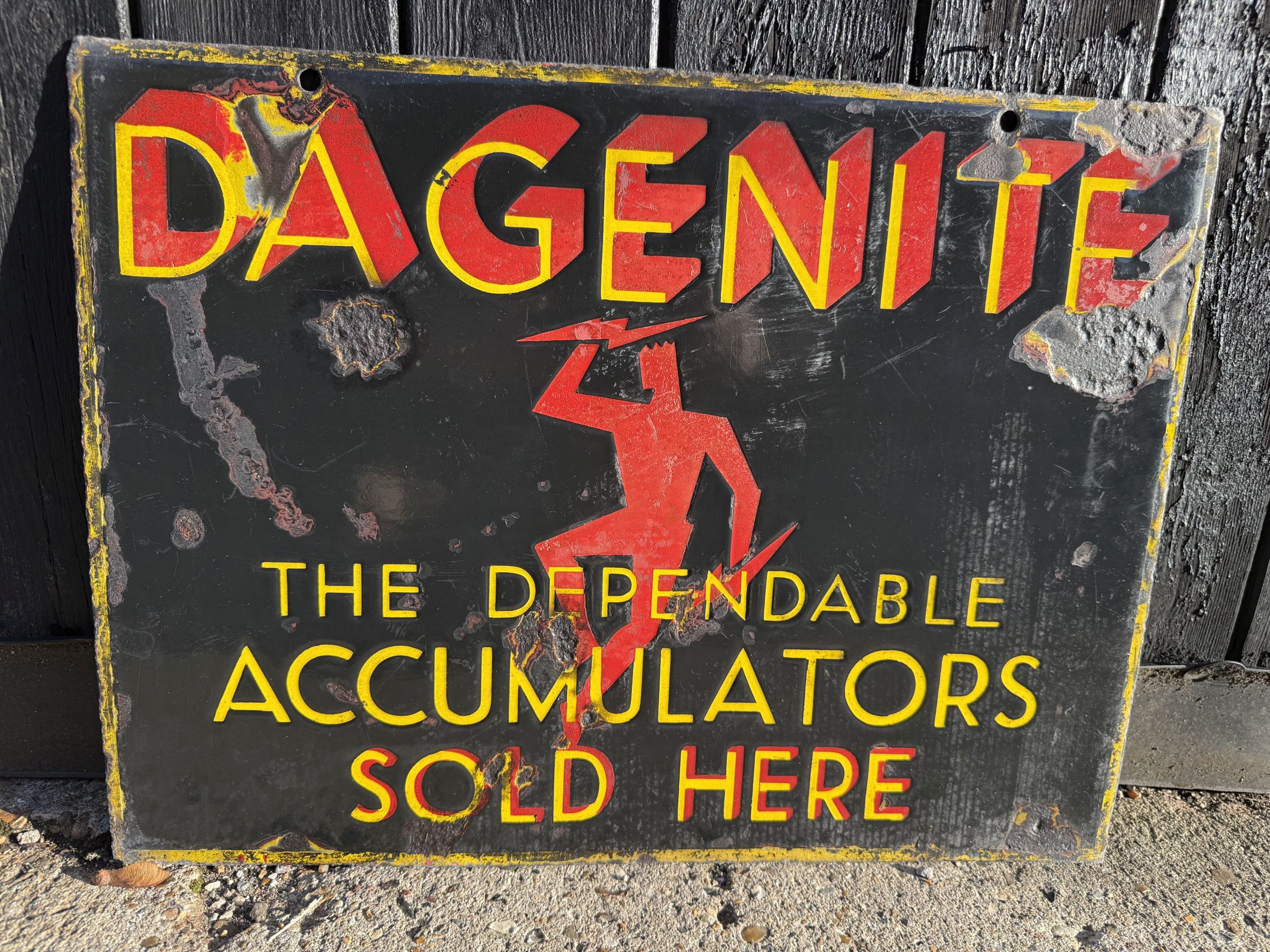
Some old garage signs need no introduction. Shell. Castrol. Esso. Dunlop. Then there are the names which were once familiar to motorists all over Britain but have quietly slipped out of everyday memory. Dagenite is one of them. We recently picked up this wonderfully worn, double-sided enamel sign measuring approximately 51cm by 38.5cm. One side [&...
Every barn find starts with a question. Will it run? That is usually somewhere in our minds from the moment somebody first contacts us about an old car that has been sitting in a garage, barn, shed or garden for years. Sometimes decades. We might know when it was last taxed. We might know when [&...
This Porsche Cayman S auction result raises a question that would have sounded rather strange a few years ago. When did Porsches get this cheap? Because we’re not talking about a tired old Porsche 924 that’s been sitting in somebody’s garden for 20 years. This is a 2008 Porsche Cayman S. A proper mid-engined, six-cylinder [&...