Imagine walking into a British hardware shop seventy years ago. Behind the counter are tins of polish, bottles of paraffin, boxes of screws, brushes, mousetraps and all manner of things that once seemed essential to everyday life.
And somewhere among them, perhaps, is a brightly coloured metal contraption bearing a name familiar to almost every motorist: Esso.
But it isn’t for putting oil in a car or maintaining an engine.
It’s for killing flies.
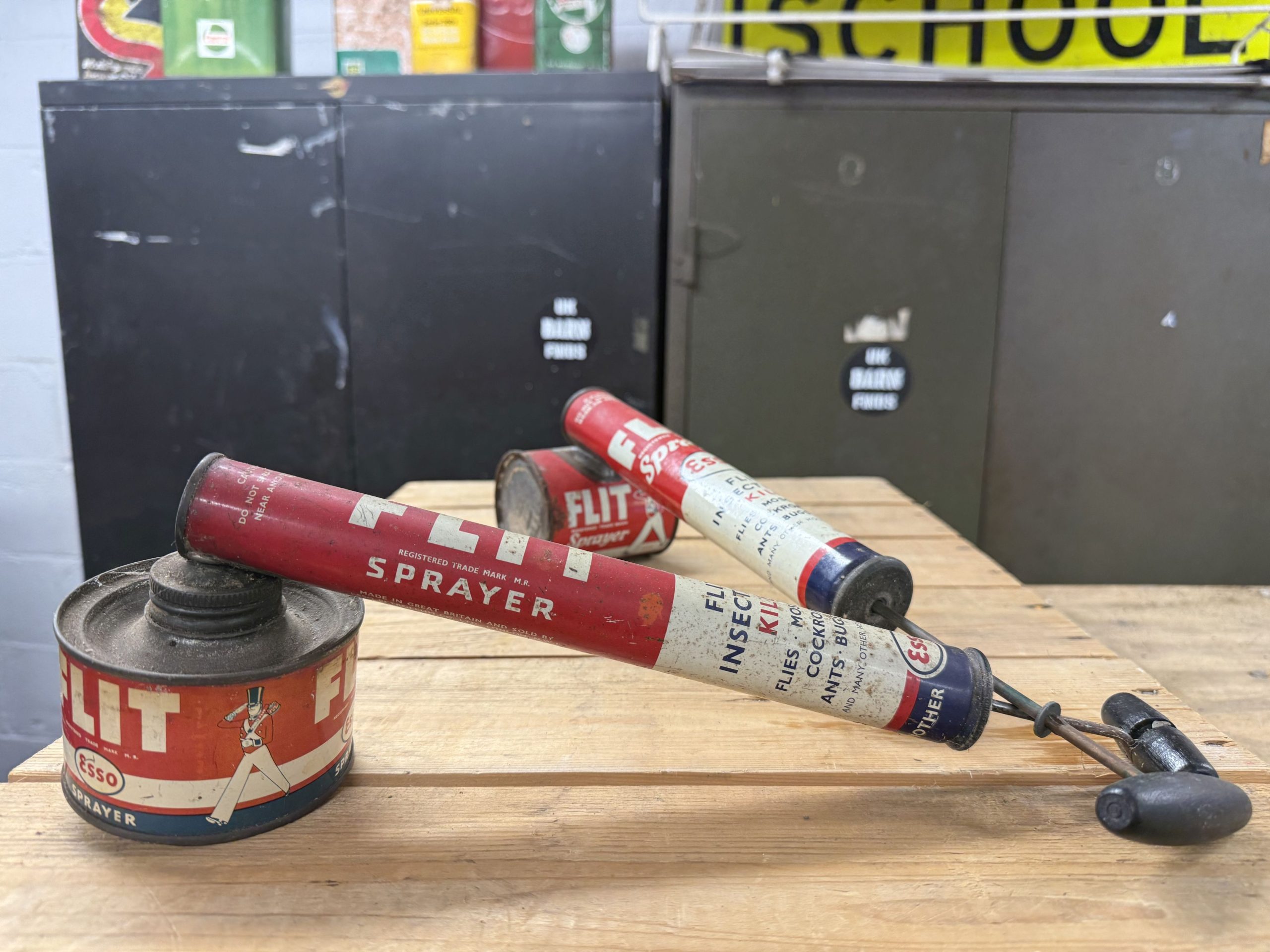
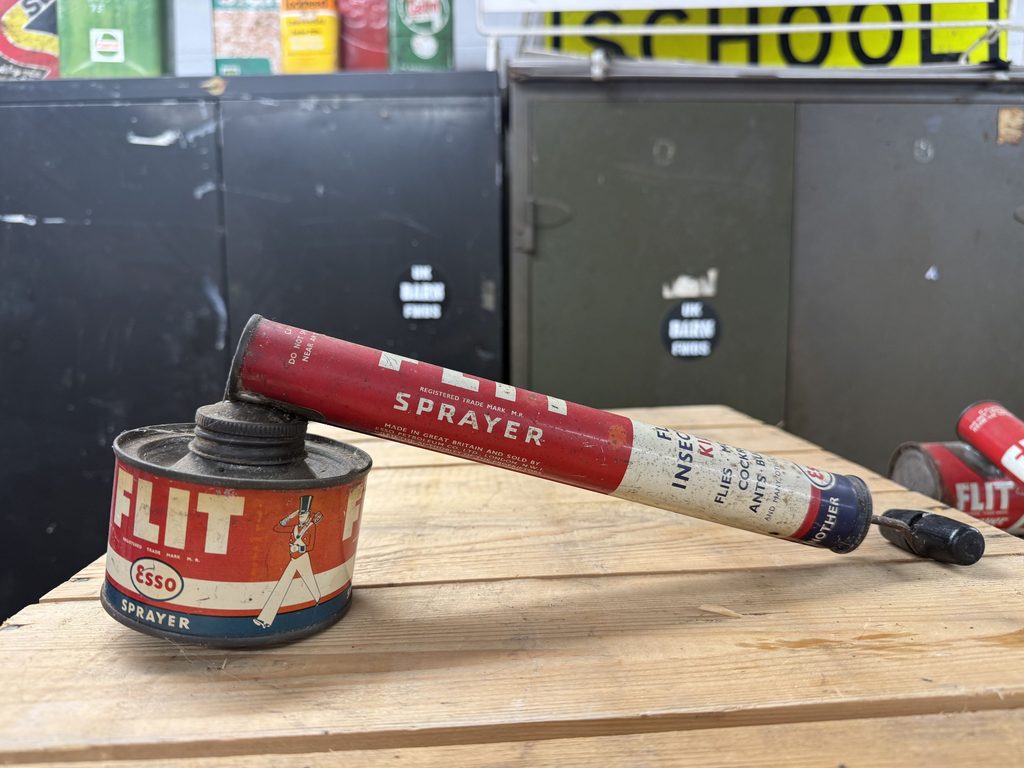
We’ve recently acquired two old Esso FLIT insecticide sprayers, and they have led us into a fascinating corner of British commercial history. It’s a story involving household pests, petroleum companies, forgotten products, famous advertising and the changing world of the British high street.
It also raises a question we’ve been unable to answer conclusively: where exactly would you have bought one?
What Was FLIT, and How Did It Work?
First, let’s clear up something that might puzzle younger readers.
FLIT was a liquid insecticide, not a powder. The familiar hand-operated sprayer was designed to turn that liquid into a fine mist.
And what did FLIT stand for? As far as we can establish, nothing. It wasn’t an acronym, but a brand name. The ordinary English word flit describes quick, light movement, making it a particularly appropriate name for a product intended to tackle flying insects.
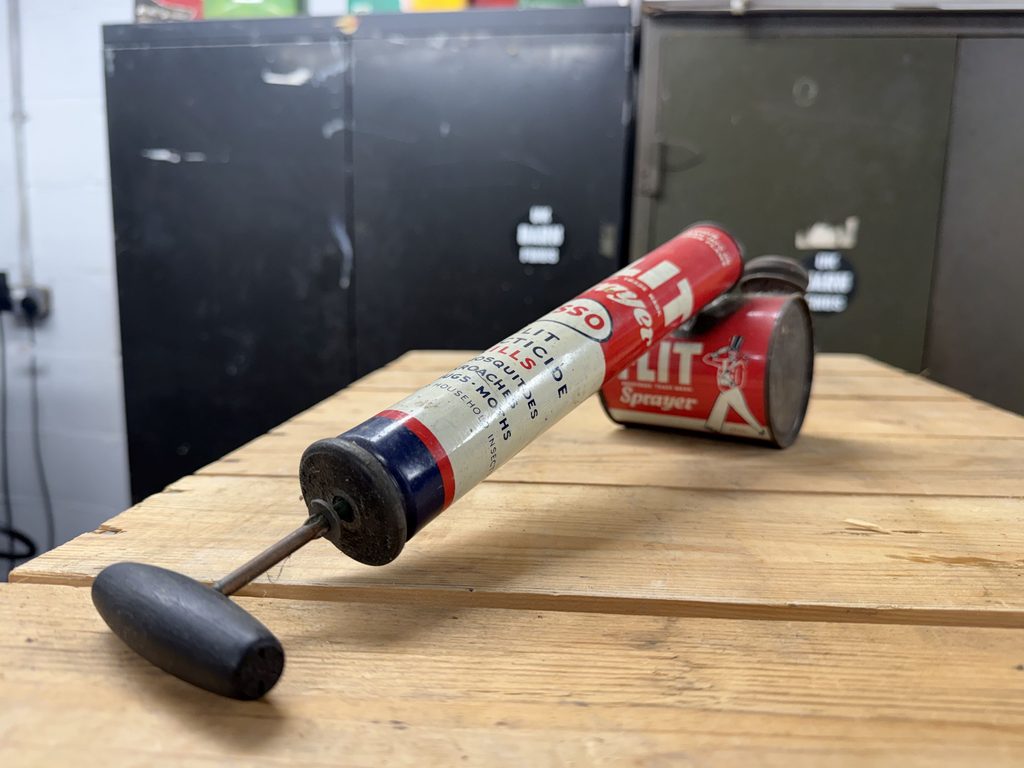
A round metal reservoir held the insecticide, while a plunger operated the spraying mechanism. The user worked the handle to disperse the liquid into the air or towards the insects they wanted to eliminate.
No batteries, no electricity and no disposable aerosol can. Just a reusable metal appliance and a supply of insecticide.
FLIT was introduced in America in 1923 by Standard Oil interests. According to the Science History Institute, the original formulation relied on mineral oil. DDT was incorporated into later versions during the late 1940s.
DDT, short for dichlorodiphenyltrichloroethane, was a powerful synthetic insecticide widely used from the 1940s onwards. Initially hailed as a breakthrough in pest control, it was later found to persist in the environment and cause serious harm to wildlife, leading to restrictions on its use.
That distinction matters because FLIT was sold over a long period, and its chemical composition changed.
We cannot establish exactly which formulation would have been used with our two British sprayers, but the principle remained straightforward: a liquid insecticide dispersed by a mechanical sprayer.
One of ours even has a small hole accompanied by instructions to oil the plunger.
It’s a lovely reminder of an era when even an insecticide sprayer was something you might maintain rather than discard.
Why Was Esso Selling Something Like This?
Today, we associate Esso with petrol stations, fuel tankers, engine oils and the familiar oval signs beside Britain’s roads.
But the company’s roots in Britain were not exclusively motoring-related.
According to ExxonMobil’s own history, the business began here in 1888 as the Anglo-American Oil Company, importing American paraffin for domestic lighting.
Think about that for a moment.
Before the motor car became an everyday sight, the company that would become Esso was already supplying products for British homes.
Paraffin lamps, household heating, industrial oils and lubricants were all part of a much broader petroleum economy.
And petroleum was also important to the development of early insecticides.
FLIT therefore wasn’t quite as strange a business venture as it first appears. The companies behind petrol and lubricants already understood petroleum-derived oils, refining and chemical products.
What made FLIT especially interesting was the way those industrial capabilities were brought into the family home.
The Esso name might be familiar from a roadside garage, but here it was appearing on a product intended for the kitchen, bedroom or pantry.
It was a clever way of reaching customers far beyond the motorist.
Two Sprayers and a Curious Discovery
Our two sprayers look remarkably similar, with their red, cream and blue paintwork, FLIT lettering and familiar Esso branding.
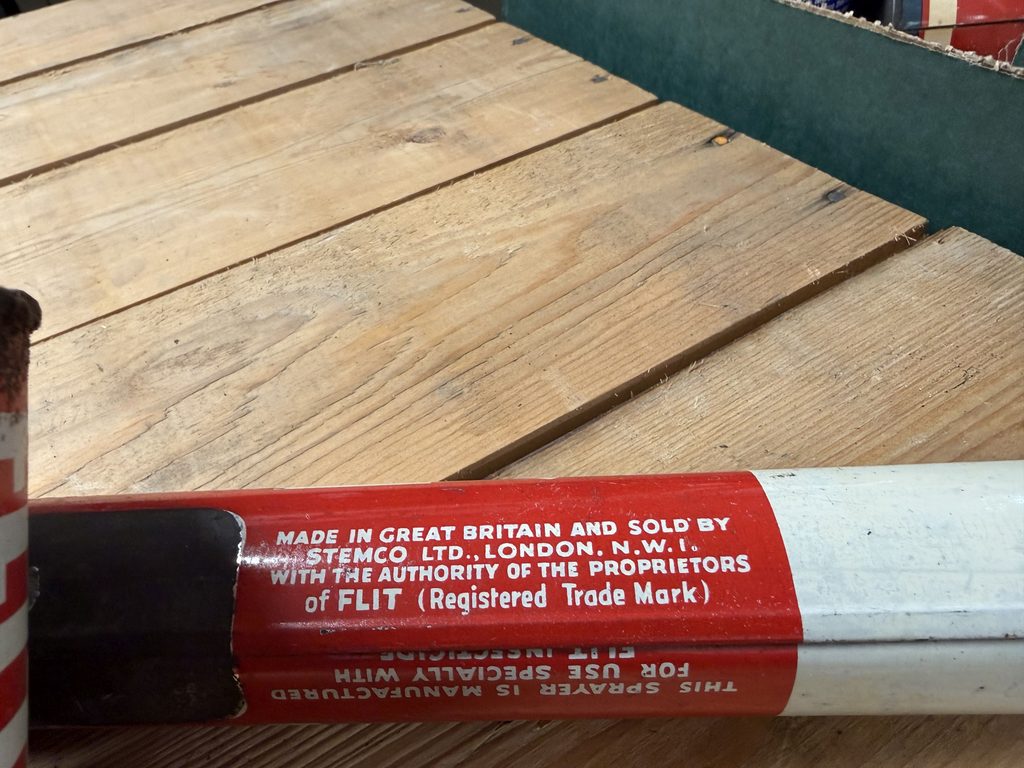
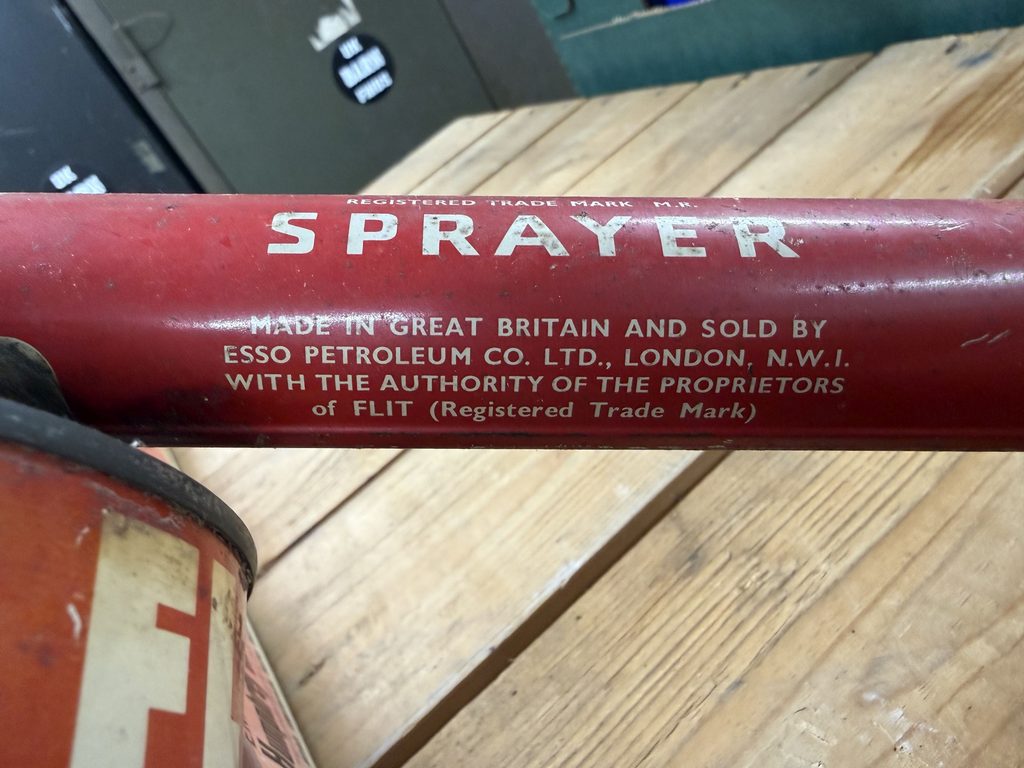
Both are marked as having been made in Great Britain.
Both give a London N.W.1 address.
But closer examination revealed something intriguing.
One names STEMCO Ltd. as the company selling the sprayer.
The other names Esso Petroleum Co. Ltd.
Both refer to the authority of the proprietors of the FLIT trademark.
Naturally, we wondered whether Esso had bought STEMCO, or perhaps replaced it as the British distributor.
The evidence suggests the relationship was more closely connected than that.
An advertisement in the July 1955 edition of Practical Mechanics promotes Esso Handy Oil, a general-purpose lubricant intended for jobs around the home.
It recommends the product for bicycles, prams, sewing machines, lawnmowers, hinges and other mechanisms.
And who was advertising it?
STEMCO Ltd., London N.W.1.
The advertisement even gives the prices: one shilling and threepence for a dispensing tin and one shilling for a refill bottle.
That establishes something important. STEMCO wasn’t merely associated with FLIT. It was also marketing other Esso-branded products for domestic use.
A historical corporate ownership schedule preserved in a United Nations archive also lists STEMCO Ltd. among international petroleum-company interests.
Our assumption is that STEMCO operated within the wider Standard Oil business network, rather than being an unrelated retailer that Esso subsequently acquired. But we haven’t established the precise ownership structure or the reason both names appeared on FLIT sprayers.
There’s another complication when trying to date them.
The Science Museum Group records that Anglo-American Oil Company changed its name to Esso Petroleum Co. Ltd. in 1951.
That suggests the Esso Petroleum-marked sprayer dates from 1951 or later.
However, STEMCO was still advertising Esso products in 1955, so we cannot automatically assume that the STEMCO sprayer is older.
If anyone has an old STEMCO catalogue, company document or further information about its relationship with Esso, we’d be delighted to hear from them.
It’s remarkable how much history can emerge from a few lines of lettering on an old household appliance.
Where Would You Have Bought FLIT?
This is the part of the story we’d particularly love readers to help with.
Our first instinct is that FLIT would have been a familiar product in traditional hardware shops and ironmongers, perhaps alongside household polishes, cleaning products and other pest-control supplies.
Chemists would also seem a natural possibility.
And there is contemporary evidence that FLIT was sold through ordinary shops.
It tells the story of a man who discovers that moths have damaged his clothes. He notices a FLIT advertisement, visits a shop and buys the product.
The film is a wonderful glimpse of how insecticides were marketed to households almost a century ago.
But it doesn’t tell us exactly what sort of shop the customer visited.
Then there’s another possibility.
Could you have bought FLIT from an Esso filling station?
We wouldn’t be at all surprised if some independent garages stocked it, particularly those that also sold paraffin, household oils and other useful goods.
But that’s an assumption, not something we’ve yet proved from a contemporary catalogue or advertisement.
Perhaps someone reading this worked in an Esso garage, a hardware shop or a chemist during the 1950s or 1960s.
Did you ever see FLIT on the shelves?
We’d genuinely love to know.
The Famous FLIT Advertising Campaigns
FLIT became an enormously recognisable product, helped by some remarkably inventive advertising.
Its most famous American campaign involved a young illustrator called Theodor Geisel.
You probably know him better as Dr Seuss.
Long before his children’s books made him internationally famous, Geisel spent years producing cartoons and advertisements for FLIT.
His drawings featured extraordinary insects, exaggerated situations and the sort of playful imagination that would later become his trademark.
Dartmouth College, where Geisel studied, preserves examples of his FLIT advertising work from 1929.
The British advertising was memorable too.
The FLIT soldier, prominently displayed on our sprayers, was part of a recognisable visual identity intended to make the product stand out.
The little figure looks almost comical today, but he was representing a serious household product at a time when controlling insects was regarded as an important part of domestic life.
And that’s worth remembering when looking at old advertisements.
They weren’t just selling a tin of liquid. They were selling the promise of a more comfortable, cleaner and better-protected home.
Esso Wasn’t Alone: Remember Shelltox?
If Esso selling insecticide sounds unusual, here’s another name to conjure with.
Shelltox.
Yes, Shell also sold insecticide.
The Wellcome Collection preserves historical advertising for Shelltox, complete with illustrations of insects and spraying equipment.
Like FLIT, Shelltox belonged to a world in which petroleum companies were involved in considerably more than filling motor cars.
Shell’s wider chemicals business eventually supplied products for agriculture, including pesticides and weedkillers.
The Museum of English Rural Life, part of the University of Reading, preserves a 1960s enamel sign advertising Shell Chemicals for Agriculture. It’s another reminder that the familiar Shell emblem appeared on products and advertising far beyond the petrol forecourt.
It might seem an unlikely connection today, but it made commercial sense.
Petroleum companies had access to chemical expertise, production facilities and established distribution businesses.
And as their names became increasingly familiar, those names could be used to promote a much wider range of goods.
Not every petrol company sold the same products, of course. But Esso and Shell provide clear examples of just how far these businesses extended beyond the forecourt.
Did People Really Spray DDT Around Their Homes?
Yes. Some later FLIT products contained DDT, the synthetic insecticide we mentioned earlier.
The Smithsonian Institution holds an American Esso FLIT aerosol dated to approximately 1952–1954.
Its recorded ingredients include DDT, pyrethrins and piperonyl butoxide.
We must stress that this is an American aerosol, not proof of the contents used in our British hand sprayers.
Nevertheless, it demonstrates how the FLIT product developed as insecticide chemistry changed.
DDT was initially celebrated for its effectiveness, particularly in combating insects associated with disease and agricultural damage.
Over time, its persistence in the environment and harmful effects on wildlife became major concerns.
The publication of Rachel Carson’s Silent Spring in 1962 helped bring those concerns to a much wider audience, and restrictions followed in many countries.
Looking back, the idea of spraying powerful insecticides around bedrooms and kitchens can seem extraordinary.
But we should be careful not to judge an entire generation solely through modern eyes.
Households were dealing with genuine problems, and these products were sold and advertised as practical solutions.
The fact that attitudes have changed so dramatically is part of what makes the history interesting.
Whatever Happened to the FLIT Sprayer?
The hand-operated insecticide sprayer eventually became a familiar object from an earlier age.
Pressurised aerosol cans offered an easier way to apply insecticides, while chemical formulations and safety standards continued to evolve.
But the FLIT name survived longer than some people might imagine.
The Garden Museum holds a British Esso FLIT insecticide tin dated to approximately 1970.
That tells us the product was still represented in British packaging long after its original introduction.
It would therefore be wrong to suggest that FLIT disappeared overnight, or that the introduction of DDT restrictions alone explains the decline of the old hand sprayer.
Consumer habits changed, technology moved on and products evolved.
Eventually, the metal hand-pump sprayer became something more likely to be discovered in an old shed or garage than used around the house.
Which is precisely where objects like ours now belong: as reminders of another era.
Petrol Companies Still Sell Unexpected Things
Before dismissing Esso’s insecticide business as a peculiar relic of the past, consider what some petroleum brands are doing today.
Take Gulf, for example.
The famous blue-and-orange brand has moved into fashion, with officially licensed clothing and watches carrying its distinctive identity.
Gulf Oil International is also involved in Reviva Coffee, a premium coffee business.
Now, coffee and designer jackets might seem a long way from petrol pumps and engine oil.
But perhaps the principle isn’t so different.
A familiar name, built up over decades, can have value far beyond the product that originally made it famous.
The business arrangements may have changed, and modern licensing is not the same thing as manufacturing petroleum-based insecticide.
Nevertheless, the underlying attraction of an established brand remains.
So if you’ve ever spotted a Gulf-branded watch or jacket and wondered what on earth it has to do with petrol, remember that Esso was putting its name on insecticide sprayers more than seventy years ago.
Perhaps the idea isn’t quite as modern as it first appears.
A Little Piece of a Forgotten World
There’s something rather wonderful about these two FLIT sprayers.
Their paintwork is scratched and worn. The metal has acquired the marks of decades of handling and storage. But the lettering remains clear enough to tell us where they were sold from, which businesses were involved and what they were intended to do.
They’re not particularly sophisticated objects.
They weren’t expensive luxury goods or great feats of engineering.
They were everyday household equipment.
And yet they can take us back to an entire world that has largely disappeared.
A world of ironmongers, chemists and small garages. Of wooden counters and shelves stacked with tins. Of shopkeepers who knew their regular customers, and household products whose names have faded from memory.
For somebody who grew up in that world, the sight of an old FLIT sprayer might bring back a childhood kitchen, a parent’s cupboard or a familiar local shop.
For a younger reader, the idea of manually pumping petroleum-based insecticide around the house, using a device carrying the name of a petrol company, may seem almost unbelievable.
That’s why we enjoy finding and researching objects like these.
They remind us that motoring history doesn’t begin and end with the vehicles themselves.
Sometimes the most interesting stories are found in the everyday products, advertisements, businesses and people that surrounded them.
And sometimes all it takes to bring those memories flooding back is an old tin sprayer.
Do You Remember FLIT?
We’d love to hear your memories.
Did your family have a FLIT sprayer? Where did they keep it? Can you remember the smell, or the sound of somebody working the plunger?
Perhaps you remember seeing FLIT for sale in a hardware shop, chemist or even a filling station.
We’re also interested in hearing from anyone who knows more about STEMCO Ltd. and its relationship with Esso.
And what other unusual products do you remember carrying the names of familiar petrol companies?
Sometimes readers’ recollections can fill gaps that even the historical archives leave unanswered.
Get the best barn finds, projects and classic temptations direct to your inbox.
Related Posts
Discover More Classic Car Stories
Stay updated with the latest barn finds, auction news, and classic car adventures in our 'News & Waffle' section. Dive into rare discoveries, behind-the-scenes stories, and expert insights into the world of classic cars. Whether you’re a seasoned enthusiast or simply intrigued by the tales behind these treasures, this is your hub for all things classic and captivating.
Mention the Morris Marina in a room full of classic car enthusiasts and you’re almost guaranteed a reaction. Some will remember them fondly. Others will recall their shortcomings. And there will inevitably be somebody ready with a joke about British Leyland. But show those same enthusiasts a Marina-based pick-up and something rather interesting happens. ...
Sometimes an auction result makes perfect sense. The car is desirable, the estimate looks sensible, the bidders know what they’re buying and the hammer falls somewhere around the expected figure. And sometimes you get an auction like this. A striking 1980 Triumph TR7 Convertible, professionally converted to V8 power, arrived at Anglia Car Auctions with [&...
Imagine driving from London to Edinburgh in 1911. The roads are rough, punctures are a constant possibility and motoring remains an expensive adventure rather than an everyday activity. Now imagine making that journey without changing gear. That’s precisely the sort of challenge Rolls-Royce undertook to demonstrate just how remarkable its motor cars had become. And [&...