From its origins on the Isle of Man to international auction prices, we explore the remarkable history of the Peel P50, its famous Top Gear appearance and an unrestored example we filmed at the NEC.
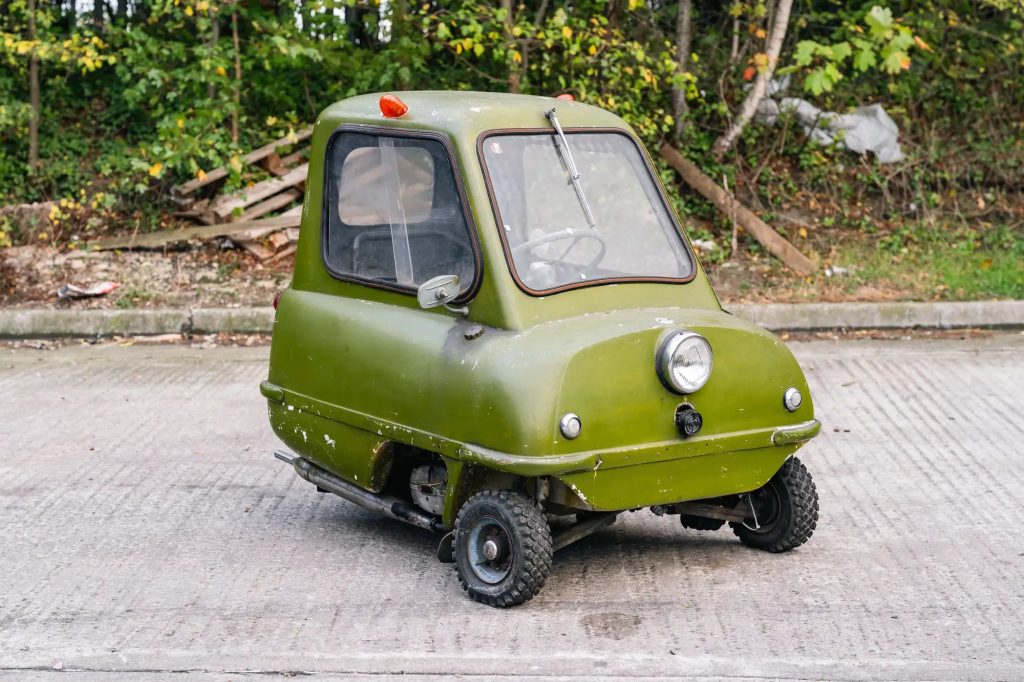
The Peel P50 is officially recognised as the world’s smallest production car, but its tiny dimensions are certainly no reflection of its value. When an original, unrestored 1964 example appeared at Iconic Auctioneers’ NEC Classic Motor Show sale in November 2026, we were there to film the auction and discover just how much somebody would pay for this extraordinary little vehicle.
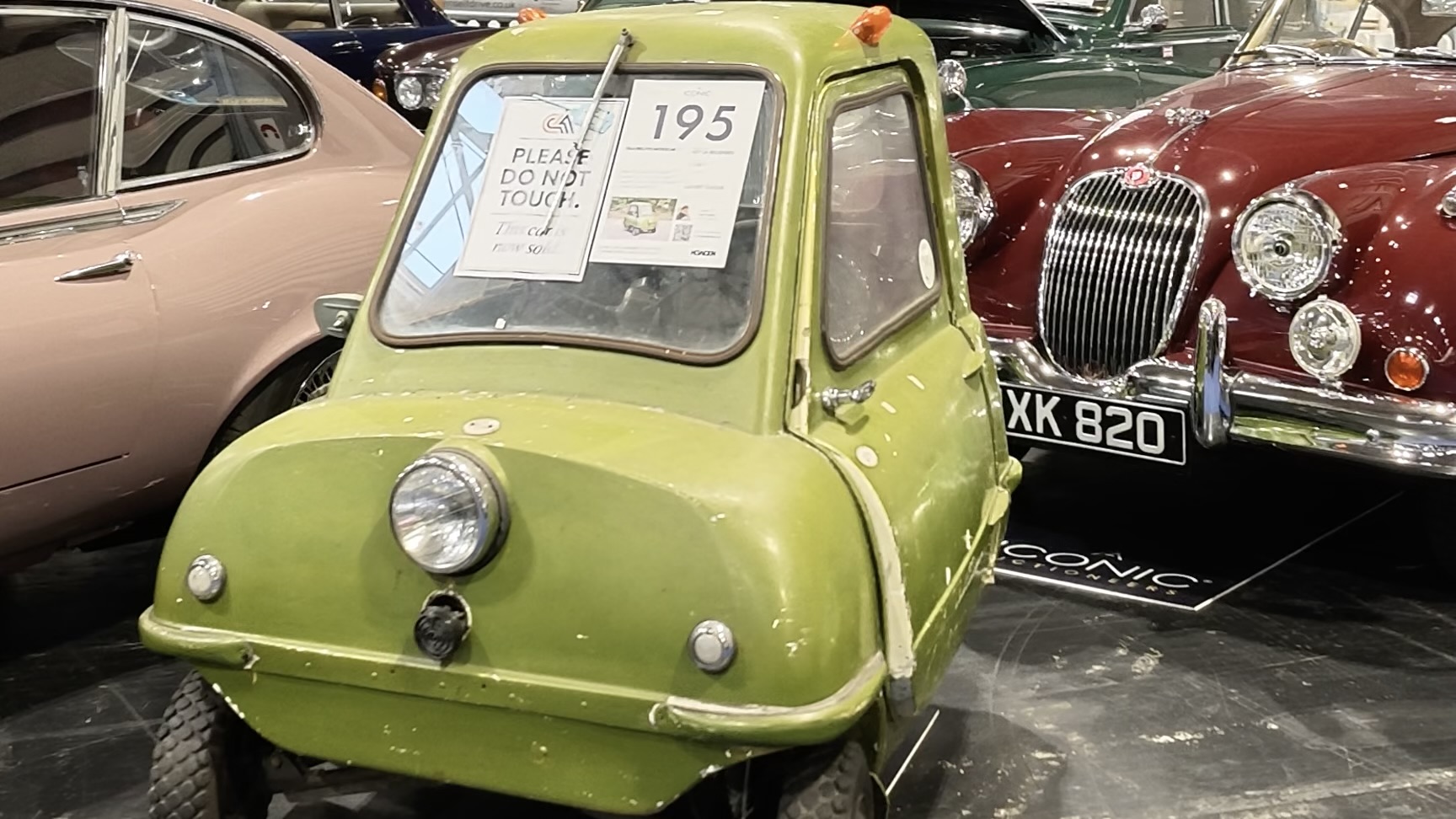
Standing beside the Peel P50 at the NEC, it was incredible to think that Jeremy Clarkson had somehow managed to squeeze into one for an episode of Top Gear.
There was a classic Mini parked next to it, which provided a wonderful illustration of just how small the Peel really is.
We’re accustomed to thinking of the original Mini as a small car, but alongside a Peel P50, it looks enormous!
As we remarked in our video, you’d almost think you could fit three Peel P50s inside a Mini.
But how did such an unusual vehicle come into existence, how many were made and why are original examples now so valuable?
The history of the Peel P50
The Peel P50 was developed by the Peel Engineering Company, based in the harbour town of Peel on the Isle of Man.
Founded by Cyril Cannell, the company had experience in glass-reinforced plastic (GRP), producing items such as motorcycle fairings and boat hulls before turning its attention to motor vehicles.
The idea behind the P50 was surprisingly sensible. Why use a conventional-sized car for short urban journeys when something considerably smaller, lighter and more economical could do the job?
The concept was unveiled at the 1962 Cycle and Motorcycle Show at Earls Court in London.
The prototype featured a single wheel at the front and two at the rear, although this arrangement was reversed for the production version, which followed in 1963.
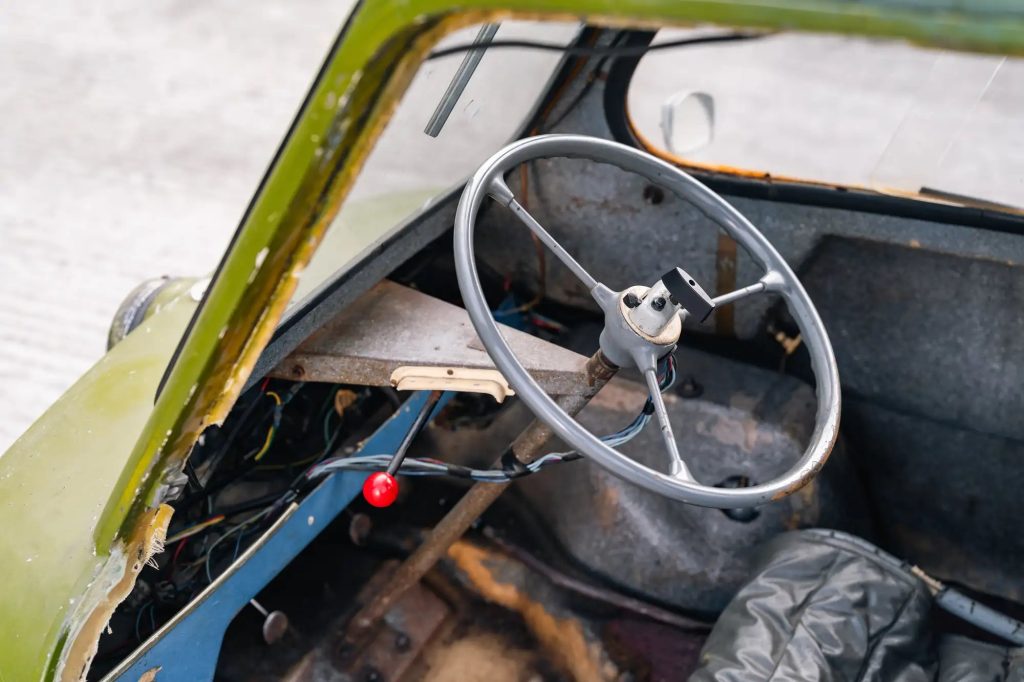
The resulting vehicle had a glass-fibre body, three wheels, a single seat, one door, one headlamp and one windscreen wiper.
There was just enough room for the driver and a little shopping.
At a time when many manufacturers were exploring affordable alternatives to conventional cars, Peel Engineering had taken the concept of the microcar to its logical conclusion.
How small is the Peel P50?
According to Peel Engineering, the P50 measures approximately 54 inches (1.37 metres) long and just 39 inches (99 centimetres) wide.
Perhaps even more remarkable is its weight.
At approximately 59kg (130lb), the entire vehicle weighs less than many of the adults who might drive it.
For comparison, an original Mini measures roughly three metres in length, making it more than twice as long as the Peel P50.
The Peel’s exceptionally narrow body also meant that it could fit through some doorways, something that would later be demonstrated to memorable effect on television.
Even knowing these measurements, it’s difficult to appreciate the scale of a Peel P50 until you’ve actually stood beside one.
What engine does a Peel P50 have?
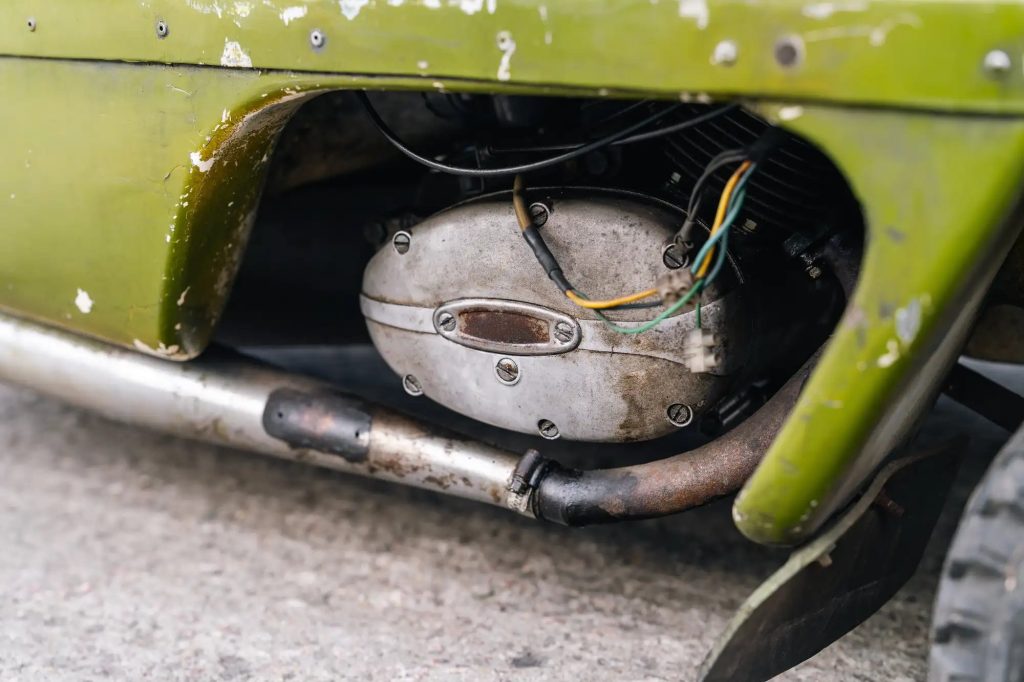
The original Peel P50 was powered by a German-made 49cc Zweirad Union/DKW single-cylinder, two-stroke motorcycle engine.
Producing a little over four horsepower, the engine drove the single rear wheel through a three-speed manual gearbox.
The P50 was intended for relatively short journeys rather than long-distance touring, although its quoted top speed of approximately 38–40mph suggests it was capable of travelling considerably faster than its appearance might lead you to expect.
Fuel economy approaching 100 miles per gallon was claimed in period.
Indeed, Peel Engineering advertised the P50 as being “almost cheaper than walking”.
One of the most unusual features of the Peel P50, however, was something it didn’t have.
A reverse gear.
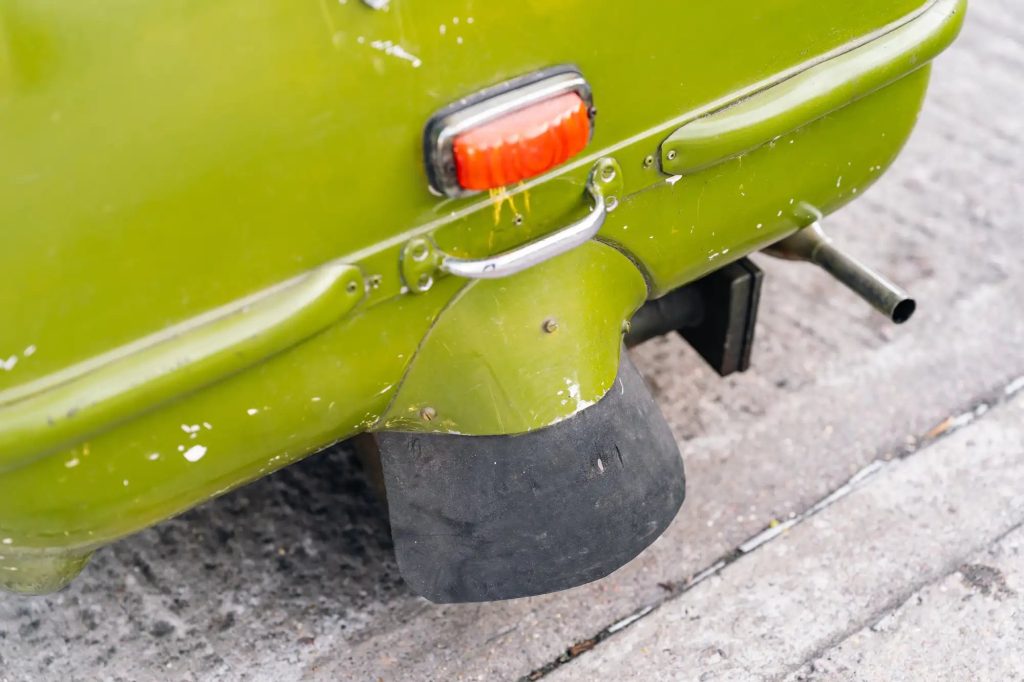
Instead, a handle at the back enabled the driver to get out, lift the rear of the vehicle and turn it around manually.
Given its incredibly low weight, this was a surprisingly practical solution that eliminated the need for a more complicated transmission.
Original Peel P50 specifications
Manufacturer: Peel Engineering Company
Place of manufacture: Peel, Isle of Man
Production era: 1962–1965
Body construction: Glass-fibre
Seating capacity: One
Number of wheels: Three
Engine: 49cc DKW single-cylinder two-stroke
Power output: Approximately 4.2–4.5hp
Transmission: Three-speed manual
Driven wheel: Rear
Reverse gear: None
Length: Approximately 1.37 metres
Width: Approximately 0.99 metres
Weight: Approximately 59kg
Top speed: Approximately 38–40mph
Claimed fuel economy: Around 100mpg
Original selling price: £199
Period specifications and published dimensions vary slightly between sources, but there’s no disputing the P50’s extraordinary compactness.
The Peel P50 was never manufactured in large numbers.
Approximately 50 original examples were produced, although some sources, including historic RM Sotheby’s auction catalogues, put the figure at 47.
Fewer than 30 original cars are generally believed to survive.
That makes an authentic 1960s Peel P50 considerably rarer than many of the exotic sports cars and supercars that regularly attract attention at classic car auctions.
Peel Engineering subsequently introduced the Peel Trident, another distinctive microcar, featuring a transparent bubble canopy and accommodation for two people.
Both vehicles remain fascinating examples of the imaginative approach to personal transport that emerged during the 1950s and 1960s.
Jeremy Clarkson and the Peel P50 on Top Gear
For many people, their first encounter with the Peel P50 came in 2007, when Jeremy Clarkson featured one on the BBC television programme Top Gear.
The sight of the famously tall presenter driving the tiny three-wheeler through London was entertaining enough.
But the segment became particularly memorable when Clarkson drove the P50 inside the BBC’s Television Centre, demonstrating that its modest dimensions allowed it to venture into places normally reserved for pedestrians.
It remains one of the programme’s most fondly remembered films.
The appearance introduced the Peel P50 to a much wider international audience, including an entire generation who hadn’t been born when the original cars were manufactured.
Even today, many people immediately associate the Peel P50 with Jeremy Clarkson.
We certainly did when standing next to this example at the NEC, and we mentioned him in our auction video.
The unrestored 1964 Peel P50 that spent decades in Finland
The olive green Peel P50 offered by Iconic Auctioneers on Saturday 14 November 2026 was particularly interesting because of its originality and surviving documentation.
Identified by chassis number D538, it was imported into Finland in 1964 by a company based in Turku.
According to the auction catalogue, its unusual design initially caused difficulties with Finnish officials, who classified it as a motorcycle and questioned its single headlamp.
The importer successfully appealed against the objection, and the relevant inspection certificate was issued in May 1964.
Surviving paperwork also recorded a subsequent owner, Mr Kesti, purchasing the Peel for 500 Finnish markka.
In 1986, the little car travelled by train to his home in Kerava. It was later loaned to a Finnish miniature car association and was believed to be the country’s only P50.
Correspondence from 1993 revealed that its chassis number had previously been missing from records held by the Register of Unusual Micro Cars.
The car remained with Mr Kesti and, following his death, his family, before eventually returning to the UK in 2026.
More than six decades after its manufacture, the Peel was presented at auction in unrestored, highly original condition.
For collectors, that combination of rarity, originality and documented history makes it an especially fascinating survivor.
Watch the 1964 Peel P50 auction at the NEC
It isn’t every day that we get the opportunity to film an original Peel P50 going under the hammer.
Iconic Auctioneers offered this example as Lot 195 at its November 2026 NEC Classic Motor Show sale.
While there were plenty of impressive and exotic vehicles on display throughout the weekend, this little three-wheeler was one of the most unusual.
In our video, we take a look at the car, compare its size with the neighbouring classic Mini and capture the auction as it happens.
The footage is part of our How Much?! Classics YouTube channel, where we document real classic car auction prices, bidding and results from across the UK.
How much would you pay for an original example of the world’s smallest production car?
Watch the auction below to discover the result.
How much did the Peel P50 sell for?
The unrestored 1964 Peel P50 sold for £44,000 at the hammer at Iconic Auctioneers on 14 November 2026.
With the buyer’s premium included, the published auction result was £49,500.
It was a substantial sum for a vehicle originally conceived as an inexpensive means of personal transport, but original Peel P50s have long since become internationally desirable collectors’ items.
There was an additional consideration for the purchaser of this particular example.
The auction catalogue explained that the vehicle had entered the UK under Temporary Admission arrangements. Should it remain in the UK, an additional 5% tax on the hammer price would be payable.
At the recorded hammer price, that would amount to a further £2,200, separate from the published auction result.
How much is an original Peel P50 worth?
Original Peel P50s appear at auction so infrequently that establishing a definitive market value is particularly difficult.
Nevertheless, previous international auction results provide some fascinating comparisons with the car we filmed at the NEC.
In February 2013, a restored 1964 Peel P50 from the Bruce Weiner Microcar Museum collection sold through RM Auctions in the United States for $120,750.
Just over three years later, in March 2016, the same car achieved $176,000 at RM Sotheby’s Amelia Island auction, setting a new auction record for the model at the time.
Another original 1964 example, finished in Daytona White, fetched $140,250 at RM Sotheby’s Monterey sale in August 2017.
In 2020, a 1965 Peel P50 with chassis number D506, offered from long-term enthusiast ownership, sold through RM Sotheby’s for €55,000.
Previous Peel P50 auction results
Auction date
Auction house
Vehicle
Published sale price
February 2013
RM Auctions
1964 Peel P50
$120,750
March 2016
RM Sotheby’s
1964 Peel P50
$176,000
August 2017
RM Sotheby’s
1964 Peel P50
$140,250
July 2020
RM Sotheby’s
1965 Peel P50
€55,000
November 2026
Iconic Auctioneers
1964 Peel P50
£49,500
These are published auction results rather than hammer prices, expressed in the original sale currencies.
Such a small number of transactions, involving cars in different conditions and with different histories, makes direct comparisons difficult.
However, they demonstrate that an authentic Peel P50 can command a remarkable price among international collectors.
Factors such as originality, restoration quality, provenance, documentation and the circumstances of an individual auction can all influence the result.
And, with so few surviving examples, somebody wanting to add an original Peel P50 to their collection may have to wait quite some time for another opportunity.
Can you still buy a new Peel P50?
If you’ve started looking for a Peel P50 for sale, you may discover examples advertised at considerably lower prices than those achieved by original 1960s cars.
That’s because the design has been revived.
Following renewed interest in the Peel marque, including an appearance on the television programme Dragons’ Den in 2010, modern versions of the P50 entered production.
Petrol and electric-powered versions have been offered, allowing enthusiasts to experience something of the extraordinary character of the original without necessarily spending the sort of money commanded by a genuine period example.
There are also independently produced recreations of the P50.
While these vehicles have their own appeal, it’s important to distinguish between an authentic Peel P50 manufactured on the Isle of Man during the 1960s and a more recently constructed version when comparing prices.
Should an original Peel P50 be restored or preserved?
One of the things we found particularly appealing about the olive green P50 at the NEC was its unrestored appearance.
This was a car that had survived for more than 60 years, spent much of its existence in Finland and returned with documentation recording some of the more unusual events in its history.
Its scuffs, marks and signs of age were part of that story.
With so few original Peel P50s surviving, its next owner faces an interesting decision.
Would you carefully preserve as much of its existing finish as possible, carrying out any mechanical work necessary to make it usable?
Or would you undertake a full restoration, returning it to something resembling its appearance when new?
Both approaches have their attractions, particularly with a vehicle as rare as this.
Whatever happens next, we’re delighted to have had the opportunity to see and film this remarkable example.
The Peel P50 may be the world’s smallest production car, but its place in motoring history is anything but small.
Original auction footage and commentary by UK Barn Finds, filmed at Iconic Auctioneers’ NEC Classic Motor Show sale on 14 November 2026. Additional catalogue photographs courtesy of Iconic Auctioneers, used with permission.
Join our newsletter
Get the best barn finds, projects and classic temptations direct to your inbox.
Related Posts
Discover More Classic Car Stories
Stay updated with the latest barn finds, auction news, and classic car adventures in our 'News & Waffle' section. Dive into rare discoveries, behind-the-scenes stories, and expert insights into the world of classic cars. Whether you’re a seasoned enthusiast or simply intrigued by the tales behind these treasures, this is your hub for all things classic and captivating.
We’ve filmed hundreds of cars going under the hammer, but occasionally an auction becomes much more personal. When this beautiful 1980 Ford Escort RS2000 appeared at the Classic Car Auctions sale at the NEC in November 2026, we knew somebody who desperately wanted to take it home. He was a UK Barn Finds follower who […]
Does originality really matter when it comes to enjoying a classic Ford Capri? A modified 1979 Ford Capri 3.0 attracted enthusiastic bidding at Anglia Car Auctions in November 2026, raising an interesting question about what buyers really value. For some enthusiasts, originality is everything. Matching specifications, factory colours and period-correct details can make a classic […]
An apparently unused 1972 Raleigh Chopper Mk1, complete with surviving original delivery packaging and paperwork, is heading to auction at Cheffins on Saturday 21 November 2026. Finished in blue and featuring the unmistakable high-rise handlebars, long saddle and frame-mounted gear selector, the bicycle is immediately recognisable as one of the great icons of 1970s childhood. […]