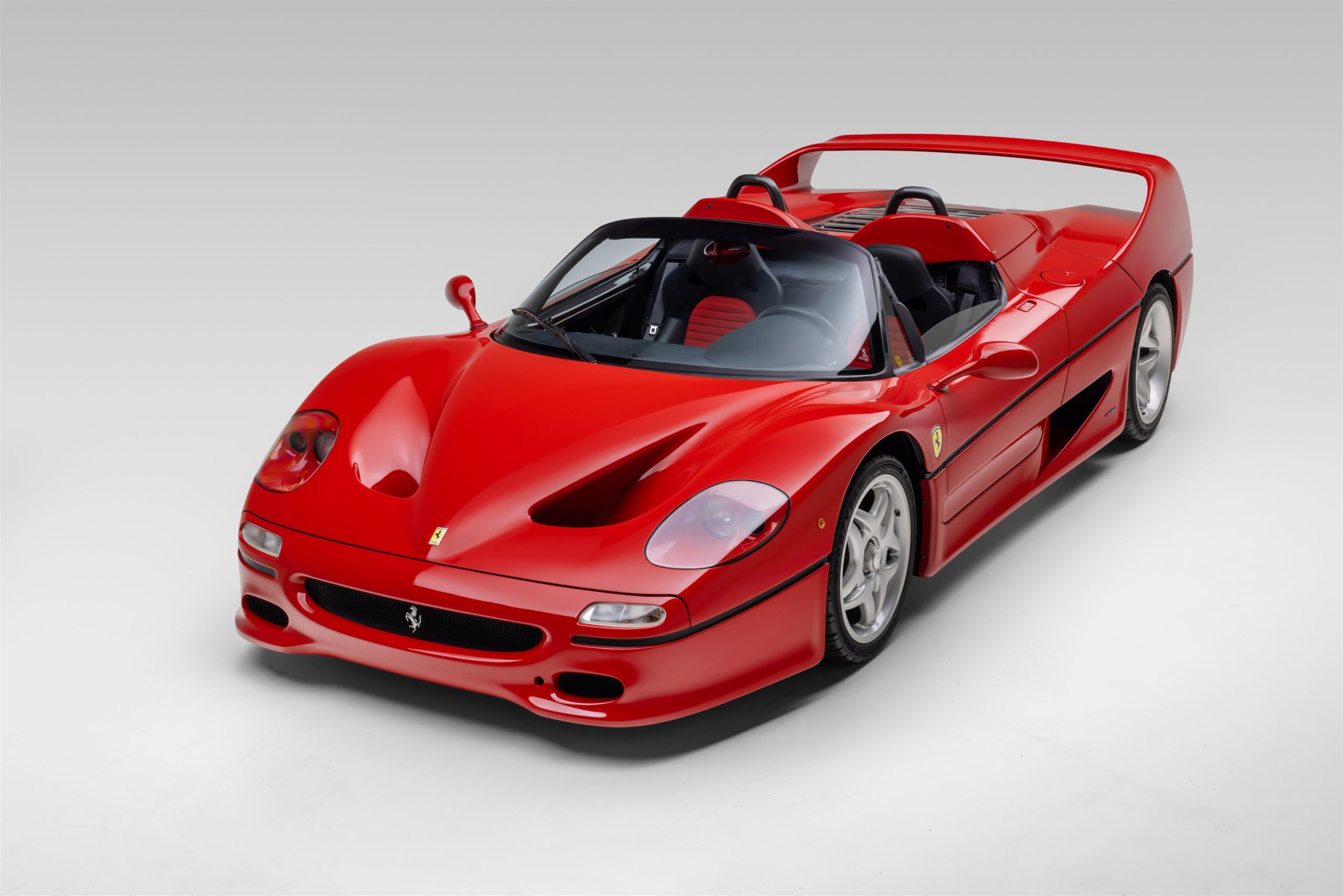
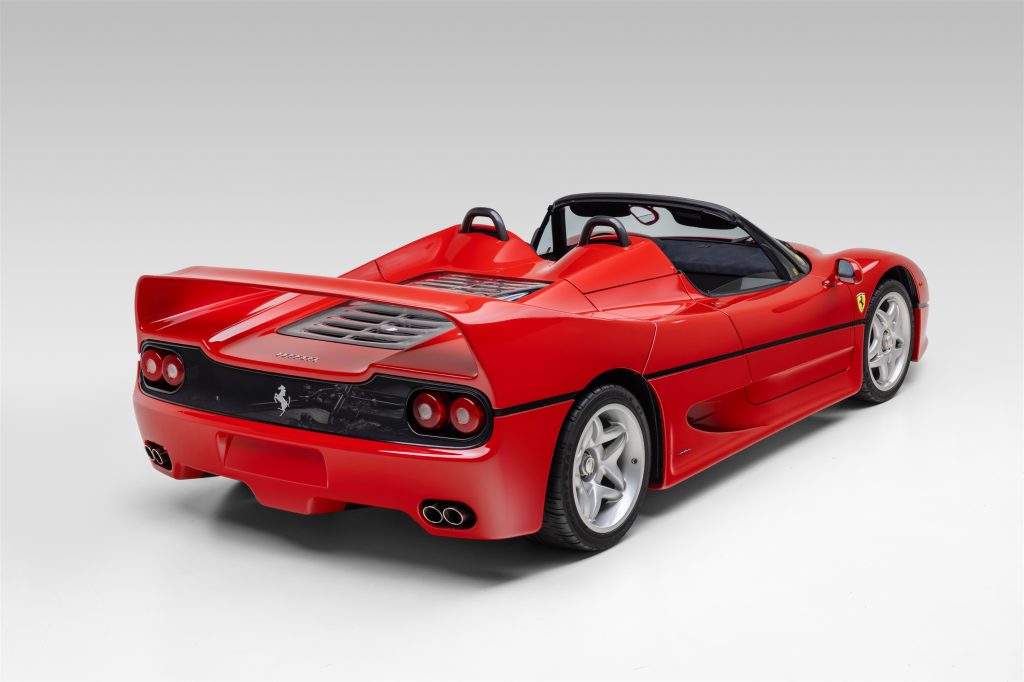
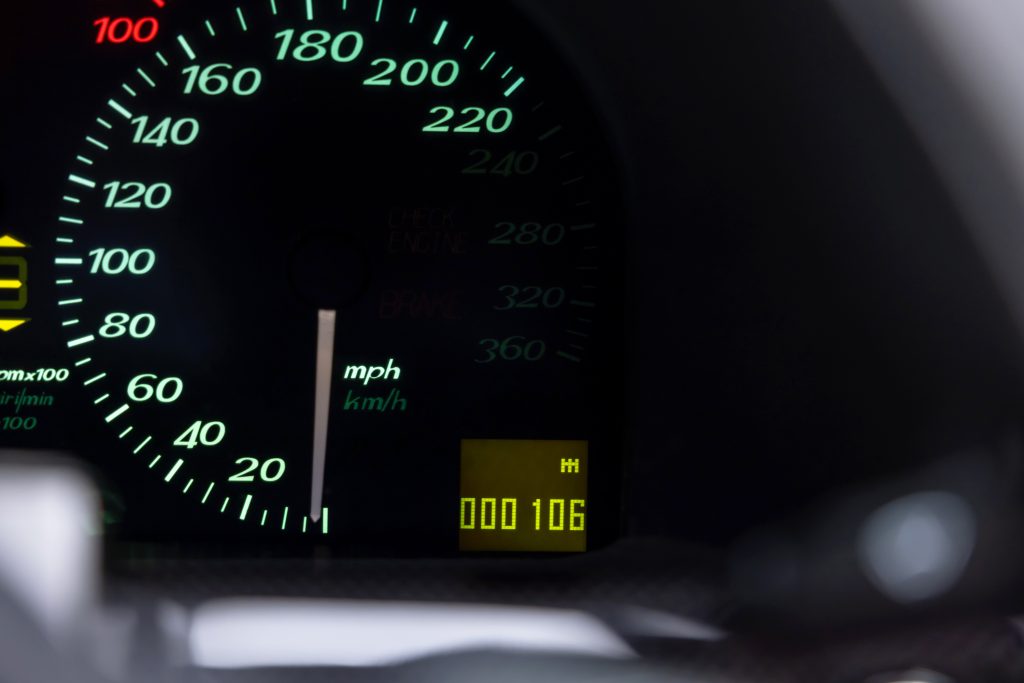
That’s the astonishing distance showing on the odometer of this 1997 Ferrari F50, one of the most celebrated supercars ever produced.
And now this remarkable example, originally delivered new in Britain, is preparing to cross the auction block in Las Vegas.
Broad Arrow Auctions expects it to achieve more than $20 million US dollars (USD) when it goes under the hammer on 31 October 2026.
That’s an extraordinary figure, even by Ferrari standards.
But this isn’t simply another rare Italian supercar with an impressive price tag.
It’s an exceptionally preserved example of one of Ferrari’s most ambitious creations, complete with its original accessories, distinctive British history and an engine with genuine Formula 1 connections.
And the story behind it is fascinating.
The Ferrari F50 – Something Very Special Indeed
When Ferrari unveiled the F50 in 1995, it was following one of the most famous supercars ever built.
The Ferrari F40.
That was quite an act to follow.
The F40 had become an icon, combining dramatic styling, a twin-turbocharged V8 and the sort of performance that seemed almost unbelievable during the late 1980s.
But Ferrari didn’t simply attempt to build another F40.
Instead, it took a different approach.
The F50 was intended to bring Formula 1 technology and engineering as close to the public road as possible.
The result was a car with a carbon-fibre chassis, a naturally aspirated V12 engine, sophisticated suspension and a six-speed gated manual gearbox.
It was exotic even by Ferrari’s standards.
And nearly three decades later, it’s still a remarkable piece of engineering.
A V12 With Formula 1 in Its DNA
At the heart of the Ferrari F50 is a 4.7-litre naturally aspirated V12 producing approximately 513 horsepower.
But there’s much more to this engine than its power output.
Its development can be traced back to Ferrari’s Formula 1 programme, specifically the V12 engine architecture used during the 1990 season.
For the F50, Ferrari extensively developed that technology into an engine suitable for road use.
The result combined the sound, response and high-revving character associated with Ferrari’s racing engines with the ability to be driven on public roads.
There was no automatic gearbox.
No turbocharger.
And none of the elaborate driver assistance systems that have since become common on modern supercars.
Instead, the F50 offered a direct mechanical connection between driver and machine.
Its six-speed gated manual gearbox became a defining feature of the driving experience.
And the engine itself formed part of the car’s structural design, another feature inspired by racing technology.
For Ferrari enthusiasts, this combination is one of the reasons the F50 occupies such a special place in the company’s history.
Photo: Ted7 / Courtesy of Broad Arrow Auctions
Just 349 Examples Were Built
Ferrari produced only 349 examples of the F50.
To put that into perspective, it was an exceptionally exclusive machine even when new.
And the example now heading to Las Vegas is particularly interesting.
Its chassis number is 107165.
According to Broad Arrow Auctions, it was the 334th F50 produced, making it one of the later examples to leave the factory.
Finished in its original Rosso Corsa red, with Nero leather upholstery and contrasting red seat inserts, it represents the quintessential image of a 1990s Ferrari supercar.
But its specification is only part of the story.
Because this particular F50 also has a rather interesting connection to Britain.
One of Approximately 25 Delivered New to the UK
Although the F50 was produced in Italy, this example was originally supplied through Maranello Sales Ltd of Egham, Surrey.
Broad Arrow reports that it was one of approximately 25 examples delivered new to the United Kingdom.
That makes it a particularly interesting car from a British perspective.
During the 1990s, Ferrari F50s were extraordinarily rare sights on our roads.
Even the familiar Ferrari models of the period were relatively uncommon outside major cities and motoring events.
An F50 was something else entirely.
With its enormous rear wing, low-slung bodywork, distinctive air intakes and unmistakable V12 soundtrack, it was the sort of car that could stop people in their tracks.
And to think that one of those original UK-delivered cars has survived with just 106 miles showing is quite remarkable.
106 Miles in Almost 29 Years
Of all the details surrounding this Ferrari, the odometer reading is perhaps the most extraordinary.
Just 106 miles from new.
Broad Arrow describes it as likely to be the lowest-mileage surviving example of the F50.
While that claim hasn’t been independently established across all surviving cars, it gives some indication of just how exceptional this example is considered to be.
The auction house is presenting it as something approaching a time capsule.
An opportunity for a collector to acquire an F50 that remains remarkably close to its original delivered condition.
Cars like this occupy a fascinating position in the collector market.
Their appeal extends beyond performance or driving enjoyment.
They also represent an opportunity to preserve and study the engineering, design and workmanship of a particular moment in automotive history.
In this case, that moment was the mid-1990s, when Ferrari was producing one of the most ambitious road cars in its history.
And the preservation of this example extends well beyond its unusually low mileage.
Even the Original Driving Shoes Are Included
One of the most delightful aspects of this Ferrari is the collection of original factory accessories that accompanies it.
Broad Arrow reports that the car retains its factory removable hardtop and the special flight case used to store it.
That hardtop allowed the F50 to be enjoyed in two configurations.
With the roof fitted, it became a closed berlinetta.
Remove it, and the F50 transformed into an open barchetta, allowing occupants to experience the V12 soundtrack with little between them and the outside world.
But there’s more.
The Ferrari is accompanied by its original three-piece Schedoni luggage set, complete with dust covers.
It also retains its toolkit, spare fuse and bulb equipment, belt kit, wheel socket and protective covers for the car, seats and steering wheel.
And then there’s something you don’t encounter with many ordinary cars.
A pair of J.P. Tod’s driving shoes.
Yes, Ferrari supplied dedicated driving shoes as part of the original F50 equipment.
It’s a wonderful detail.
And a reminder that Ferrari intended ownership of the F50 to be something considerably more special than simply possessing a very fast road car.
For collectors, the survival of such original equipment can be an important part of a vehicle’s history and appeal.
Particularly when it accompanies a car as rare as this.
Photo: Ted7 / Courtesy of Broad Arrow Auctions
A Supercar Designed for the Driving Experience
One of the fascinating things about the F50 is how differently it approaches performance compared with many modern supercars.
Today, extraordinary acceleration figures have become almost routine among high-performance cars.
Sophisticated electronics, advanced transmissions and enormous power outputs have transformed what’s possible.
But the Ferrari F50 represents a particular period in automotive development.
Its appeal comes from the combination of sophisticated racing-inspired engineering and an essentially mechanical driving experience.
The V12 engine, manual gearbox and lightweight carbon-fibre construction were all intended to create something exceptional.
Even the engine’s position and structural role reflected Ferrari’s competition experience.
And its dramatic Pininfarina-designed bodywork was unmistakably shaped by performance requirements.
The F50 wasn’t designed to be subtle.
It was designed to demonstrate what Ferrari could achieve when it brought some of its most advanced technology to a road-going supercar.
Nearly three decades later, that philosophy remains enormously appealing to enthusiasts.
Why Are Ferrari F50s So Collectable?
Rarity is clearly a major factor.
With just 349 examples produced, opportunities to acquire an F50 are always going to be limited.
But production numbers alone don’t explain its appeal.
The F50 arrived during a particularly interesting period in Ferrari’s history.
It followed the legendary F40 and preceded the Enzo, forming part of an extraordinary lineage of flagship supercars.
Each represented the pinnacle of Ferrari’s thinking at a particular moment.
The F50’s naturally aspirated V12 and manual gearbox also make it distinctive among those machines.
And with collectors increasingly interested in the mechanical character of 1980s and 1990s supercars, cars like the F50 have attracted considerable attention.
Broad Arrow points to growing collector demand for supercars from the 1980s, 1990s and 2000s.
The auction house also highlights the strong performance of Ferrari supercars within Hagerty’s collector-car market research.
Of course, collector-car values can fluctuate, and exceptional auction results don’t establish a guaranteed value for every example.
But there’s little doubt that the F50 has become one of the most closely watched Ferrari models in the international collector market.
And that brings us to the forthcoming auction.
More Than $20 Million US Dollars Expected
Broad Arrow Auctions has announced that this particular Ferrari F50 is expected to achieve more than $20,000,000 USD at its forthcoming Las Vegas sale.
That’s more than twenty million US dollars.
It’s important to distinguish that figure from a completed sale.
The car hasn’t yet gone under the hammer, and the amount represents the auction house’s expectation rather than an achieved selling price.
Nevertheless, it demonstrates the exceptional level of interest that a virtually unused F50 might attract.
The combination is certainly compelling.
One of just 349 built.
An original UK-delivered example.
Only 106 miles showing.
Original Rosso Corsa paint and Nero leather interior.
A remarkable collection of factory accessories.
And one of the most celebrated naturally aspirated V12 engines Ferrari ever installed in a road car.
For serious collectors, finding another example with a comparable combination of characteristics could prove extremely difficult.
Broad Arrow’s Alexander Weaver, Senior Car Specialist and Vice President, describes the car as offering collectors an experience remarkably close to taking delivery of a new F50.
And looking at the photographs, it’s easy to understand the appeal.
Heading to the Concours at Wynn Las Vegas
The Ferrari will be offered at Broad Arrow Auctions’ Las Vegas Auction on Saturday 31 October 2026.
The sale is being held in partnership with the Concours at Wynn Las Vegas, with Broad Arrow acting as the event’s official auction partner for the second consecutive year.
More than 75 collector cars are expected to feature in the single-day auction, including a selection of significant supercars and hypercars.
And this extraordinary Ferrari F50 looks certain to be one of the headline attractions.
For anyone interested in following the sale, further information is available through Broad Arrow Auctions.
Auction: Broad Arrow Las Vegas Auction Date: 31 October 2026 Location: Wynn Las Vegas, Nevada, USA Car: 1997 Ferrari F50, chassis 107165 Recorded mileage: 106 miles Auction expectation: In excess of $20,000,000 USD
What Would You Like to See Happen to This Ferrari?
There’s one final question we’d love to put to our readers.
This Ferrari F50 is approaching its 30th birthday with just 106 miles showing.
It’s an extraordinary survivor from an important period in Ferrari’s history.
And its next owner will be acquiring something very special indeed.
So imagine, for a moment, that money was no object.
Would you want to preserve this remarkable Ferrari exactly as it is, keeping it as a virtually untouched example for future generations to admire?
Or would you love to see its next owner take it out onto the open road and experience everything that magnificent V12 has to offer?
Perhaps there’s room for both approaches.
After all, the motoring world benefits from people who preserve important cars just as much as it benefits from those who keep them running and driving.
But here’s the question we’re particularly interested in.
What do you hope happens to this Ferrari F50 after the auction?
Whatever its future holds, we’ll be watching the bidding on 31 October with considerable interest.
And we’ll certainly be curious to see just how much this extraordinary Ferrari achieves.
Photography: Ted7 / Courtesy of Broad Arrow Auctions
Join our newsletter
Get the best barn finds, projects and classic temptations direct to your inbox.
Related Posts
Discover More Classic Car Stories
Stay updated with the latest barn finds, auction news, and classic car adventures in our 'News & Waffle' section. Dive into rare discoveries, behind-the-scenes stories, and expert insights into the world of classic cars. Whether you’re a seasoned enthusiast or simply intrigued by the tales behind these treasures, this is your hub for all things classic and captivating.
There was a time when you couldn’t travel very far on British roads without seeing a Ford Sierra. They were everywhere. On driveways. Outside schools. In supermarket car parks. And, of course, filling up the outside lane of the motorway. Company cars, family cars, everyday transport. But when did you last see a Sierra ...
There was a time when Japanese manufacturers were building some extraordinary performance cars. Turbochargers, four-wheel drive, sophisticated engineering and a determination to win on the world’s rally stages. Some became legends. The Subaru Impreza Turbo. The Mitsubishi Lancer Evolution. The Toyota Celica GT-Four. And then there was this. The Mazda 323 GT-R. Remember it? We [&...
We’re constantly being told that the market for older classic cars is changing. Traditional British classics are supposedly falling out of favour, while anything wearing a Ford badge seems to attract increasingly enthusiastic buyers. Especially if it’s a Mk1 Escort. But something happened at Cheffins on Saturday 17 October 2026 that left us scratching our [&...