There’s something irresistible about a tiny Japanese pick-up.
Perhaps it’s the wonderfully compact proportions, the cheerful styling or the idea of owning something that looks like a proper working truck but takes up barely more space than a small car.
Whatever the attraction, we’ve always had a soft spot for these little machines.
And when a 1988 Mitsubishi Minicab U14T appeared at Anglia Car Auctions in August 2026, we were particularly keen to see what happened when the bidding started.
Our opening commentary rather summed up our feelings.
Small, cheap and fun!
Well, we were right about two of those things.
Because what followed was a surprisingly determined bidding battle that raises an interesting question about the growing enthusiasm for Japanese kei vehicles in Britain.
What Exactly Is a Kei Truck?
To understand the appeal of the Mitsubishi Minicab, it’s worth looking at the world in which vehicles like this were created.
Japan’s kei vehicle category dates back to the years following the Second World War, when there was a need for affordable, economical transport suited to the country’s increasingly busy towns and cities.
The word kei comes from keijidōsha, meaning light automobile.
Rather than simply describing a small car, kei is a specific Japanese vehicle classification with limits on dimensions and engine capacity.
Those regulations have changed over the decades, encouraging manufacturers to make the most of the space and mechanical specifications permitted at the time.
By the late 1980s, the maximum engine capacity for the category was 550cc. The limit was subsequently increased to 660cc in 1990.
And while British enthusiasts might immediately think of quirky little city cars, kei vehicles also include vans and pick-ups designed for everyday commercial work.
These compact trucks became familiar sights in Japan, particularly in rural areas, where their small dimensions made them useful for farms, deliveries, maintenance work and navigating narrow roads.
Mitsubishi was one of several manufacturers producing such vehicles, alongside names including Suzuki, Daihatsu, Subaru and Honda.
The result was an entire class of practical little machines that approached the problem of moving people and goods in a very different way from the larger vehicles familiar to British motorists.
The 1988 Mitsubishi Minicab U14T
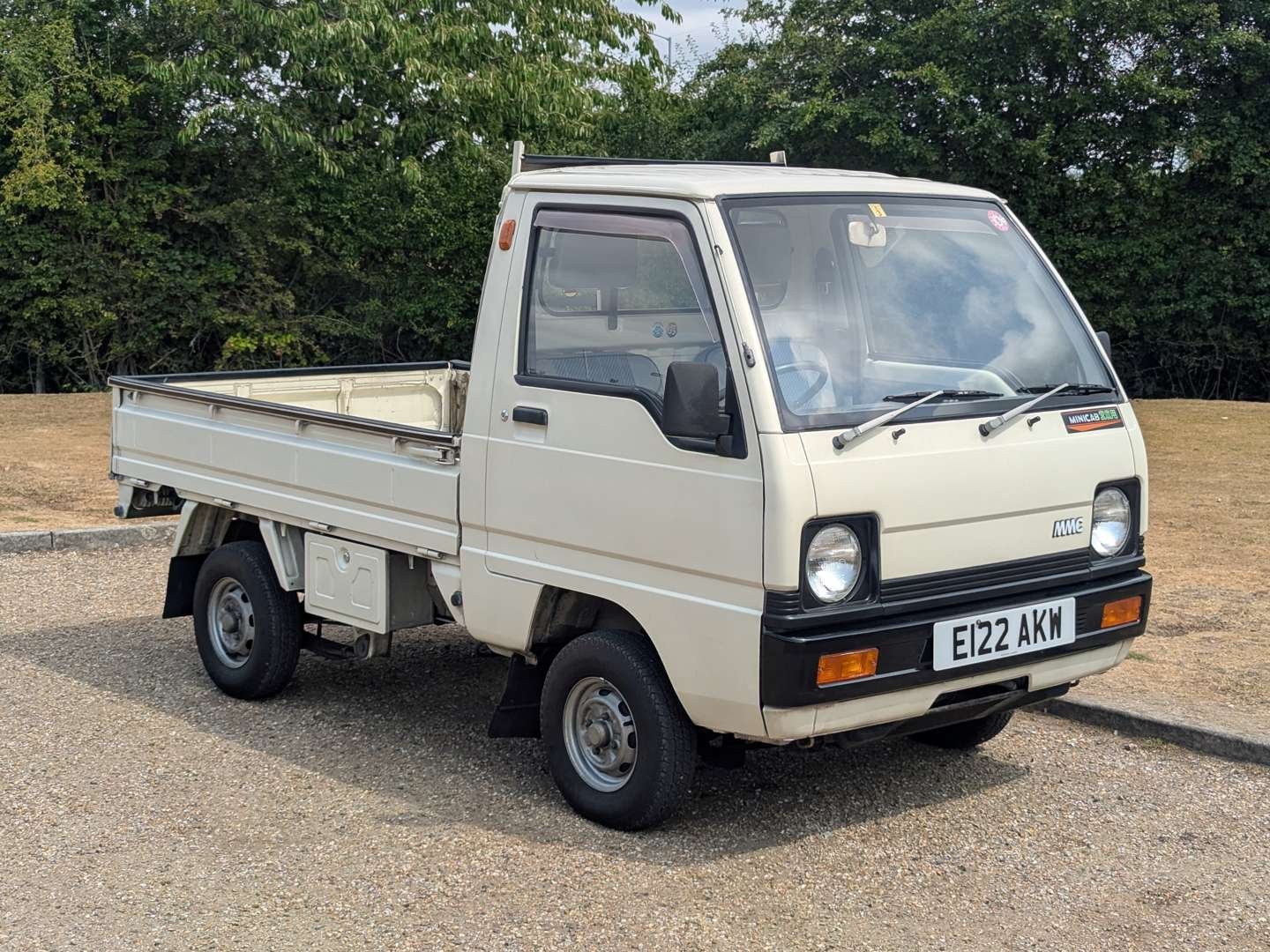
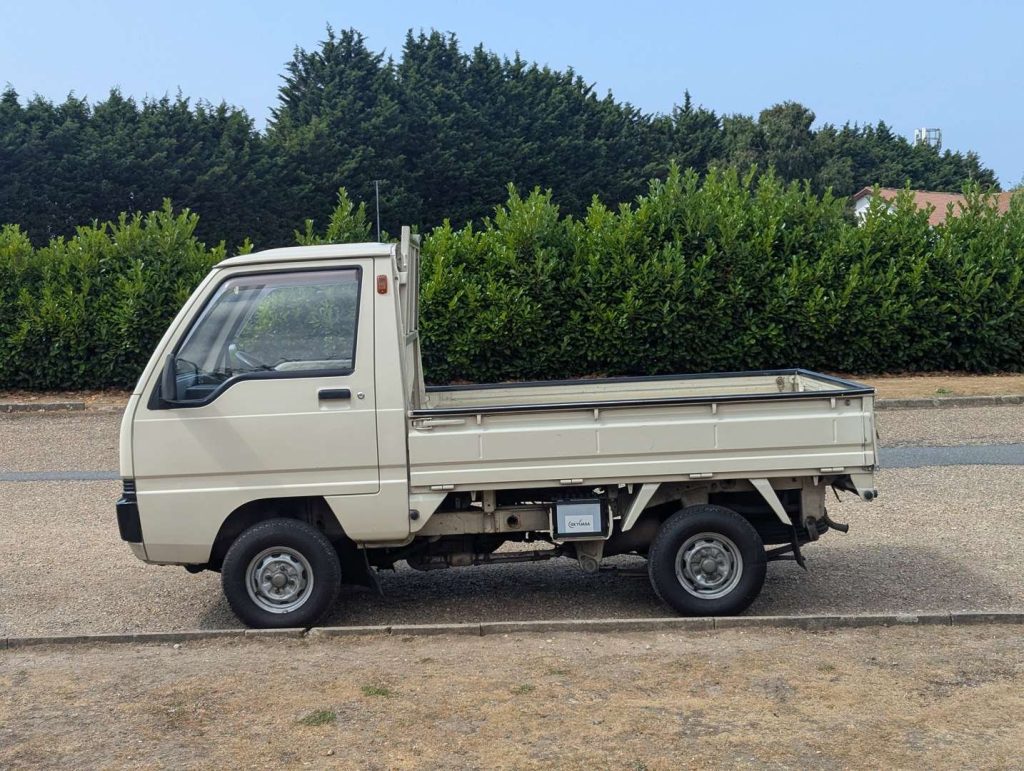
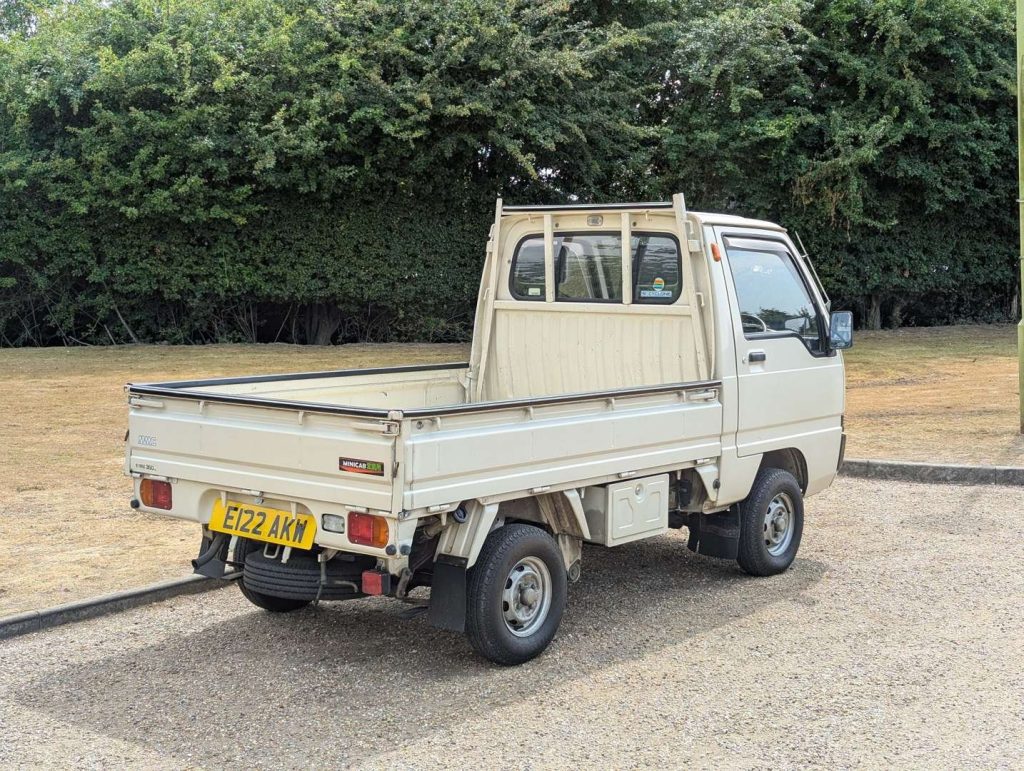
The vehicle offered at Anglia Car Auctions was a 1988 Mitsubishi Minicab U14T pick-up, fitted with a 540cc petrol engine and manual gearbox.
That tiny engine is a particularly interesting detail.
At a time when many British motorists were driving family cars with engines of 1.3, 1.6 or 2.0 litres, this little Mitsubishi had an engine smaller than those fitted to many motorcycles.
But outright performance was never the point.
These vehicles were designed around compact dimensions, modest running costs and usefulness in places where a larger commercial vehicle might be unnecessary or inconvenient.
This particular Minicab had only relatively recently arrived in Britain.
According to the auction catalogue, its vendor imported it from Japan in 2024 and registered it in the UK in early 2025.
The seller explained that he had deliberately searched for an exceptionally clean example and described the underside as being in excellent condition.
He also reported that the Mitsubishi ran and drove very well.
Those are the vendor’s assessments rather than independent findings, but the supporting information was encouraging.
The odometer displayed 44,700 kilometres, equivalent to approximately 27,775 miles. The catalogue didn’t establish this as a verified lifetime mileage.
The seller stated that the vehicle had been kept in a heated showroom and transported to shows and events on a trailer, helping to explain its limited use since arriving in Britain.
A Japanese Import With a Paper Trail
One concern sometimes raised about imported classics is the difficulty of establishing their history.
A vehicle may have spent decades overseas before appearing on British roads, and its UK registration documents cannot tell the whole story.
In this case, the Mitsubishi was accompanied by a useful collection of paperwork.
Anglia Car Auctions listed the Japanese export certificate, HMRC correspondence including its NOVA reference, MOT certificates, a receipt for the installation of a rear fog lamp and the UK V5C.
The V5C showed no former UK keepers.
Both MOT tests undertaken since its arrival had reportedly been passed without advisories, with the latest certificate valid until 12 July 2027.
That doesn’t guarantee the condition of a vehicle approaching forty years old, but it does provide useful information for anyone considering a Japanese import.
And it highlights an important point: buying an imported classic involves more than simply admiring its unusual appearance.
Registration, documentation, corrosion, parts availability and the vehicle’s previous life all deserve attention.
Why Are Kei Vehicles Appealing to British Enthusiasts?
The attraction of kei vehicles is easy to understand once you’ve seen one in person.
They’re different without necessarily being complicated.
A kei pick-up offers the basic appeal of a traditional commercial vehicle in an extraordinarily compact package.
There’s a cab, a load bed, a small engine and very little unnecessary extravagance.
For somebody accustomed to modern pick-ups that seem to grow larger with every generation, the proportions can be almost comical.
But there’s genuine practicality behind the novelty.
Their compact size can be useful for moving around private property, carrying light loads and accessing places where a larger vehicle would be awkward.
They also make entertaining vehicles for shows and enthusiast gatherings, where their unfamiliarity often attracts considerable attention.
Then there’s the wider appeal of Japanese domestic-market vehicles.
British enthusiasts have long been interested in cars originally intended for Japan, from performance models and luxury saloons to unusual MPVs and compact city cars.
Kei vehicles occupy a particularly charming corner of that world.
They offer something distinctive, often at a more approachable purchase price than celebrated Japanese performance cars.
Although, as our Mitsubishi was about to demonstrate, approachable doesn’t necessarily mean inexpensive.
Are Kei Cars Becoming More Popular in Britain?
There’s evidence that imports of small Japanese vehicles have been increasing, although kei cars remain a relatively small part of the overall Japanese used-car import market.
Figures compiled by JDM History from Japanese export statistics show 403 used petrol kei-category cars shipped to the UK in 2025, compared with 234 in 2024 and 84 in 2022.
By September 2026, the equivalent figure for the first nine months of the year had reached 491.
These figures cover the relevant engine-capacity category rather than specifically counting classic kei pick-ups, so they shouldn’t be treated as a direct measure of demand for vehicles like this Mitsubishi.
Nevertheless, they suggest that Britain’s appetite for very small Japanese imports has been growing.
There are several possible attractions.
Some buyers appreciate their unusual character. Others enjoy the engineering and packaging solutions that Japanese manufacturers developed to work within kei regulations.
For classic vehicle enthusiasts, older examples also offer nostalgia of a rather different kind.
A 1980s Minicab might not remind a British motorist of the family car parked outside their childhood home, but it evokes a period when vehicles were often simpler, lighter and more compact.
And, perhaps most importantly, they’re fun.
Not necessarily fast, luxurious or sophisticated.
Just fun.
Fast and Furious – The Bidding, Not the Pick-up!
Anglia Car Auctions offered the Mitsubishi as Lot 661 at its August 2026 classic sale, with an estimate of £3,500 to £4,500.
We were filming as the auctioneer opened the bidding to the room at around £3,400.
Initially, a bidder in the room was competing with somebody online.
But when the room bidder withdrew, the contest didn’t end.
Instead, it developed into a determined online bidding battle.
The price continued to climb in £100 increments, with neither side apparently keen to give way.
Watching the little Mitsubishi attract so much attention, we couldn’t resist describing the action as fast and furious.
The bidding, that is.
Certainly not the pick-up!
Our original footage captures the contest, including the moment we began to question our assumption that this was going to be a cheap little classic.
Watch the auction unfold below.
What Did the Mitsubishi Minicab Sell For?
The hammer eventually fell at £5,500.
With the buyer’s premium included, the total reached £5,940.
That was £1,000 above the top of Anglia Car Auctions’ £3,500–£4,500 estimate.
For a 540cc Japanese pick-up approaching forty years old, it was certainly an interesting result.
Of course, the condition and presentation of this particular vehicle may have contributed to its appeal.
It had been imported relatively recently, its seller described it as exceptionally clean, and the documentation included evidence of UK registration and recent MOT tests.
And the bidding itself demonstrated that more than one person was prepared to pay a substantial sum to secure it.
It’s important not to draw sweeping conclusions from one auction.
An unrestored kei truck requiring extensive work would be a very different proposition from a carefully presented example with supporting paperwork.
Nevertheless, this result illustrates why buyers shouldn’t automatically assume that a tiny engine and compact dimensions mean a tiny price.
Sometimes, the smallest vehicles attract some of the biggest enthusiasm.
Small Vehicles, Big Personalities
We regularly film valuable classics, rare sports cars and vehicles with impressive performance figures.
But there’s something particularly enjoyable about watching a modest little machine become the centre of attention.
The Mitsubishi Minicab doesn’t need a powerful engine, expensive badge or dramatic styling to be interesting.
Its appeal lies in the fact that it was designed to do a simple job, in a country where compactness was a virtue, and has now found an appreciative audience thousands of miles from home.
Whether you regard it as a useful miniature commercial vehicle, a quirky classic or simply something that makes you smile, it’s difficult to deny its character.
And judging by the bidding at Anglia Car Auctions, we’re certainly not alone in appreciating these little machines.
Would you consider importing a Japanese kei car or pick-up?
Or, if you already own one, we’d love to hear what it’s like to live with on British roads.
And perhaps the biggest question of all: would you have paid £5,500 for this Mitsubishi?
Join our newsletter
Get the best barn finds, projects and classic temptations direct to your inbox.
Related Posts
Discover More Classic Car Stories
Stay updated with the latest barn finds, auction news, and classic car adventures in our 'News & Waffle' section. Dive into rare discoveries, behind-the-scenes stories, and expert insights into the world of classic cars. Whether you’re a seasoned enthusiast or simply intrigued by the tales behind these treasures, this is your hub for all things classic and captivating.
A family-run garage in North Wales has celebrated 50 years with Mitsubishi Motors, marking a remarkable partnership that stretches back almost to the beginning of the Japanese manufacturer’s history in Britain. Smithy Garage, based in Dyffryn Ardudwy, Gwynedd, within Eryri (Snowdonia) National Park, has received a special award from Mitsubishi Motors in the UK to [&...
There’s something wonderfully nostalgic about a Mk1 Ford Escort van. Once a familiar sight outside shops, garages and small businesses throughout Britain, these modest commercial vehicles worked for their living, often covering thousands of miles carrying tools, parcels and everything else their owners needed to transport. Unlike the sporting Escorts that would go on ...
Four very different cars, four sets of bidders and not a reserve price between them. But what happens when a classic car goes under the hammer with no minimum selling price? From a low-mileage Ford Sierra estate to a Peugeot 206 GTi project, our latest How Much?! Classics compilation brings together four no-reserve vehicles filmed […]