Some old cars arrive at auction looking battered because they have spent decades slowly deteriorating.
This one is rather different.
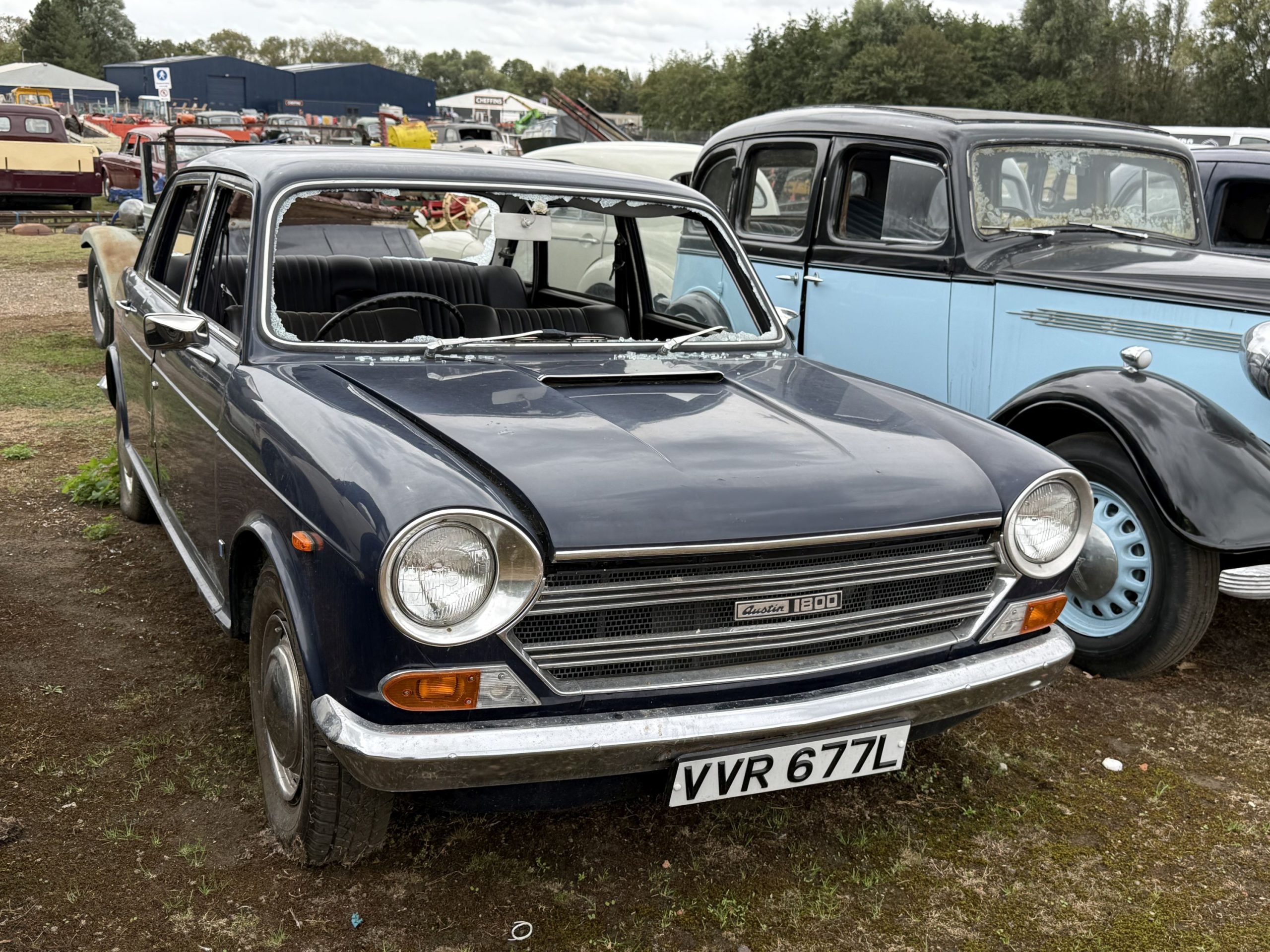
VVR 677L is a 1972 Austin 1800, better known to generations of enthusiasts as the “Landcrab”.
Its last recorded MOT was in 2018.
But that doesn’t necessarily mean it disappeared from the road eight years ago.
At more than 40 years old, the Austin is now old enough to qualify for MOT exemption as a historic vehicle, provided it meets the relevant criteria.
More intriguingly, DVLA currently shows VVR 677L as TAXED, with the current tax period running until 1 July 2027.
Historic vehicles may qualify for zero-rate road tax, but they still have to be taxed for road use.
That does not prove this Austin has actually been driven during 2026.
But it certainly raises the possibility that it was in use far more recently than its battered appearance might suggest.
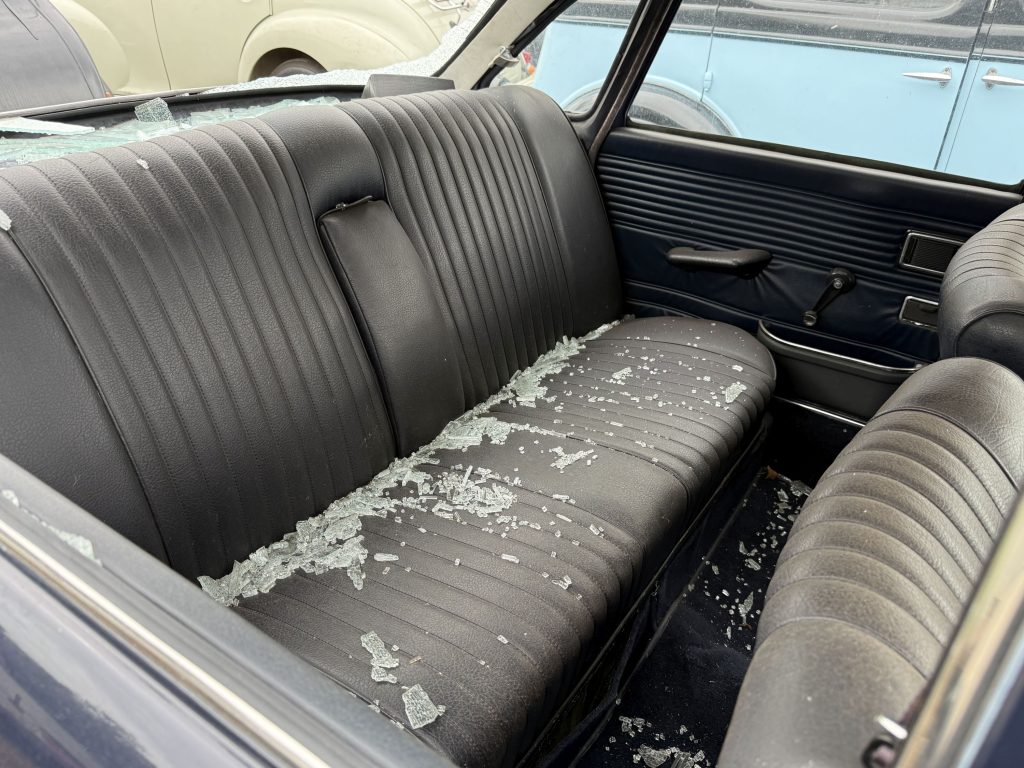
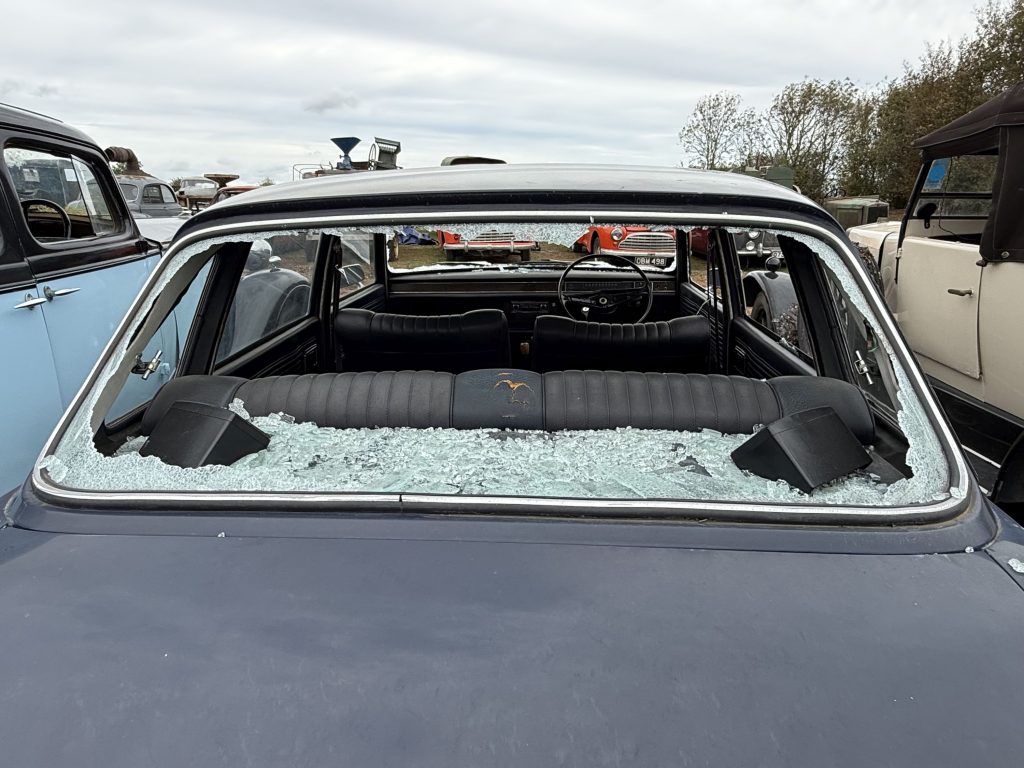
And then you see the smashed glass.
The Damage Happened Before It Reached Cheffins
Before we go any further, there is one point we want to make absolutely clear.
The vandalism happened at the vendor’s property BEFORE the car was transported to Cheffins.
The Austin arrived at the Cheffins saleground in this condition.
The damage did not happen while it was in Cheffins’ care.
Sadly, VVR 677L was not the only car in this enormous deceased-estate collection to suffer similar damage before the vehicles were moved to the auction site.
A 1972 Austin 1800 Landcrab
DVLA records VVR 677L as an Austin 1800, first registered on 1 November 1972.
It is still recorded as blue and petrol-powered, with an engine capacity of 1798cc.
That places it in the later years of the remarkable ADO17 story.
The Austin 1800 had originally arrived in 1964 as BMC’s new large front-wheel-drive saloon.
Its engineering followed the same basic thinking that had already transformed the Mini and 1100: a transverse engine driving the front wheels, with clever packaging intended to give passengers as much room as possible within a relatively compact overall length.
It also used interconnected Hydrolastic suspension.
For a large British family saloon of the 1960s, it was anything but conventional.
It Was European Car Of The Year
The Austin 1800’s engineering was sufficiently impressive for it to win the European Car of the Year award for 1965.
The award highlighted its front-wheel-drive layout, transverse engine, independent Hydrolastic suspension and the amount of passenger and luggage space packed into a relatively modest footprint.
Today, the car is perhaps better remembered by its nickname.
Landcrab.
It was never an official Austin model name, but the nickname suited the car’s unusually wide stance and distinctive proportions so well that it stuck.
Decades later, enthusiasts still routinely refer to the whole ADO17 family as Landcrabs.
Tougher Than It Looked
The Landcrab also earned a reputation for toughness.
One of its greatest moments came in the 1968 London-Sydney Marathon.
Four works-prepared Austin 1800s were entered in the gruelling event.
All four finished.
The 1800 driven by Paddy Hopkirk, Tony Nash and Alec Poole went considerably further than simply surviving, finishing second overall.
For a car whose normal life was more likely to involve commuting, shopping and family holidays, that was a remarkable demonstration of the strength of the basic design.
Which makes the condition of VVR 677L particularly frustrating.
This One Was Still Being Tested In 2018
The official history shows that this was not simply a Landcrab parked up and forgotten decades ago.
VVR 677L passed an MOT on 30 July 2018.
The recorded odometer reading was 60,251 miles and the test certificate ran until 12 August 2019.
We are not claiming that 60,251 represents its verified mileage from new. An MOT reading alone cannot establish that.
But the wider MOT record is interesting.
The Austin was also being presented for tests in 2017, 2016, 2015, 2014, 2013 and 2012.
The most recent V5C issue date shown in the record is 1 July 2019.
After that, the absence of further MOT tests does not automatically tell us the car stopped being used.
Vehicles more than 40 years old can qualify for MOT exemption provided they meet the historic-vehicle rules and have not been substantially changed.
And VVR 677L is currently recorded as taxed.
Again, that is not proof that someone was driving it around this year.
But it does make this a rather different proposition from an Austin that had simply disappeared from use in the 1980s or 1990s.
Then Somebody Smashed The Glass
Unfortunately, the photographs tell us what happened next far more clearly than the paperwork does.
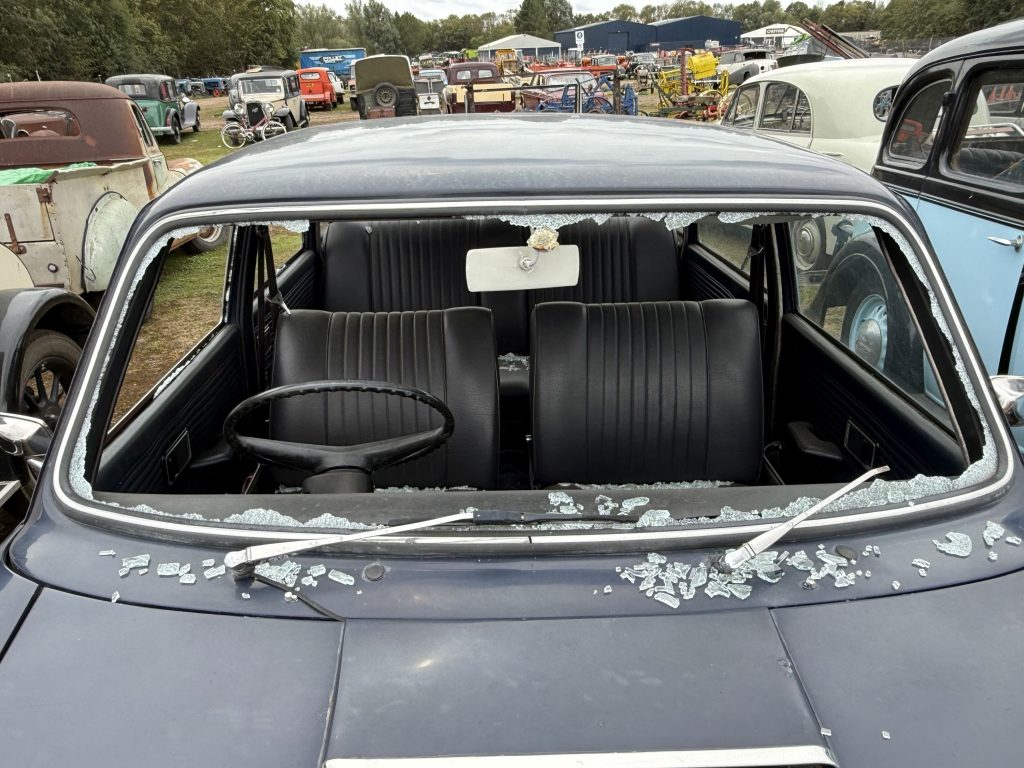
The windscreen has been smashed.
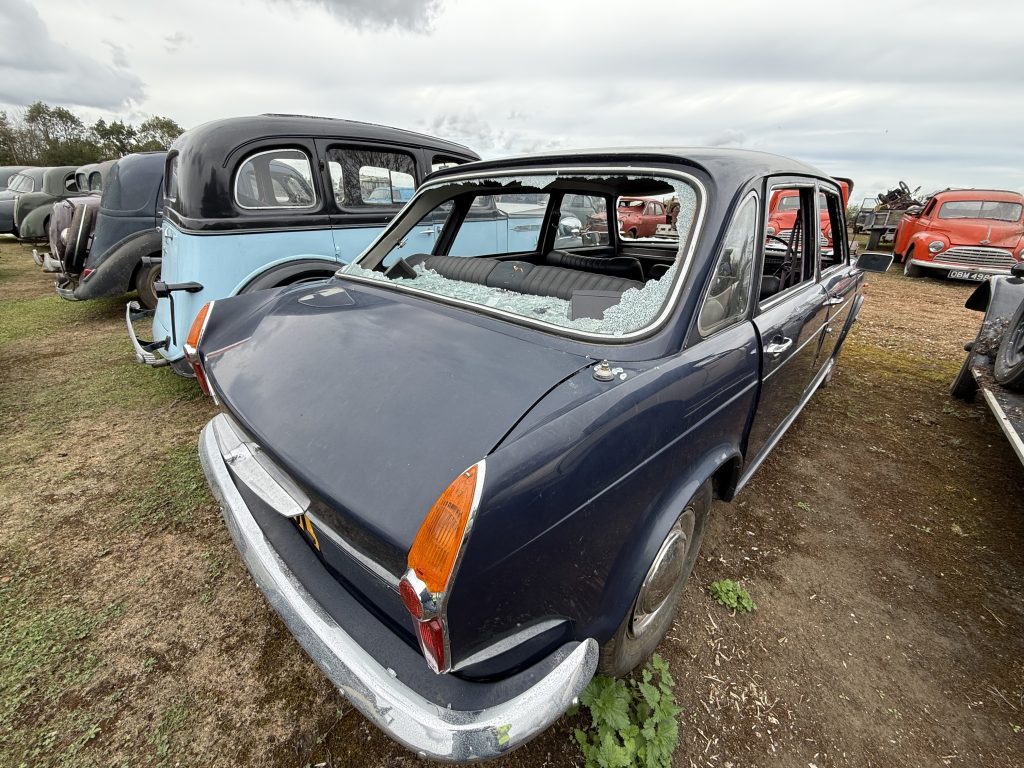
The rear screen has been smashed.
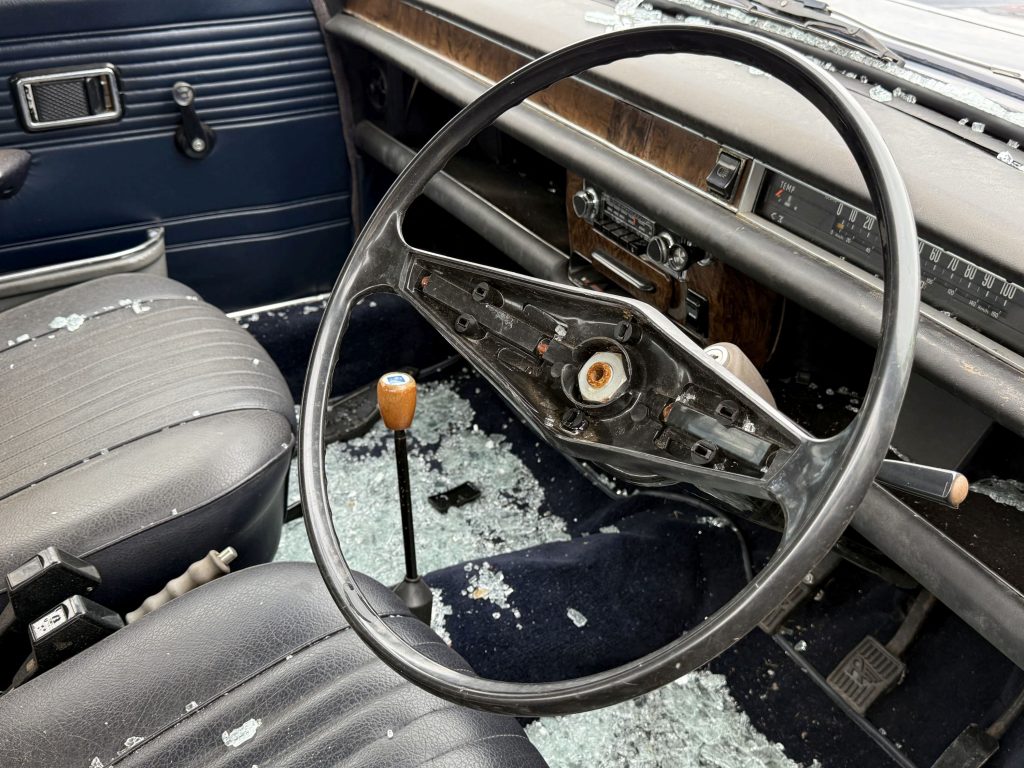
Broken toughened glass is scattered across the seats, carpets, dashboard and parcel shelf.
Look through what remains of the windscreen and the contrast is striking.
The dashboard is still there.
The period radio remains in place.
The wood-effect fascia survives.
The blue door cards look remarkably respectable.
The seats appear far better than you might expect.
There is even something rather appealing about the cabin underneath all the debris.
Then there is glass everywhere.
It is pointless, frustrating damage to a car that appears to have survived remarkably complete.
Cheffins Received It Like This
Because our photographs were taken at the Cheffins saleground, this deserves repeating.
The vandalism did NOT happen at Cheffins.
VVR 677L and other affected vehicles were damaged at the vendor’s property before they were transported to the saleground.
Cheffins received the Austin with the windows already smashed.
We do not know who was responsible, exactly when it happened or why.
We are not going to guess.
What matters for anyone considering the car is the condition in which it now survives.
Is The Damage Worse Than The Car?
The broken windows make VVR 677L look dreadful at first glance.
But look beyond them and there may be a more interesting project here than the photographs initially suggest.
We haven’t inspected the Austin mechanically, underneath or structurally, so this should not be mistaken for an assessment of its overall condition.
It is a project.
But a surprisingly large amount of the car appears to remain intact.
That matters.
For someone who knows ADO17s, has access to used parts or simply knows where a Landcrab windscreen and rear screen are hiding, the smashed glass could be a much less frightening problem than it appears to everyone else.
Glass can be replaced.
Finding complete interiors, model-specific trim and the right small details can sometimes be considerably harder.
A 1972 Mk III Landcrab
VVR 677L was first registered on 1 November 1972, placing it in the final Mk III phase of Austin 1800 production.
The Mk III appeared during 1972 as the ADO17 entered the final years of its life.
The familiar 1798cc B-Series four-cylinder engine continued in the 1800, while the range was joined by the larger six-cylinder 2200 models.
The 1798cc capacity recorded by DVLA for VVR 677L is therefore exactly what we would expect.
Production of the ADO17 family finally ended in 1975.
Its replacement was the dramatically different 18-22 Series, which soon became better known simply as the Princess.
So this 1972 Austin belongs to the closing chapter of the Landcrab story.
Almost 70 Cars And Around 70 Tractors
VVR 677L forms part of the remarkable deceased-estate collection Cheffins invited UK Barn Finds to see before the auction catalogue went live.
We have already shown you some extraordinary vehicles from it.
There is the March 1968 Mk1 Ford Escort.
The Bedford HA van.
The stretched Austin Metro pick-up whose Perkins apprentice history we subsequently managed to confirm.
The extraordinary 1959 Morris articulated tractor unit.
And there is much more still to come.
In total, the collection includes almost 70 cars and other vehicles, alongside around 70 tractors.
They are being offered without reserve as part of Cheffins’ Cambridge Vintage Sale at Sutton in Cambridgeshire on 16 and 17 October 2026.
The cars go through on Saturday 17 October.
Could The Broken Glass Actually Put Buyers Off?
This is where the no-reserve aspect becomes particularly interesting.
How many potential buyers will look at the missing windows, see glass covering the interior and move straight on to something easier?
Because underneath it is a 1972 Austin 1800 with a remarkably complete-looking cabin, documented MOT activity into 2018 and a current taxed status which at least suggests someone has continued to keep its road-use paperwork alive.
That doesn’t tell us whether the engine runs.
It doesn’t tell us whether the Hydrolastic suspension is healthy.
It doesn’t tell us what condition the structure, brakes or transmission are in.
But it gives a prospective buyer plenty to investigate.
And with no reserve, there is no predetermined minimum price below which it cannot sell.
For somebody who can source the glass, that could make VVR 677L a genuinely interesting opportunity.
Surely This One Deserves Another Chance
It is easy to look at vandalism like this and see only the damage.
Look a little harder and there is still a Landcrab underneath it.
One of Britain’s most technically interesting family saloons.
A European Car of the Year winner.
A design tough enough to achieve extraordinary results in the London-Sydney Marathon.
And, in the case of VVR 677L, a car that was still passing MOT tests in 2018 and remains recorded as taxed today.
We cannot say when it last turned a wheel on the public road.
But this certainly doesn’t look like a classic whose story had naturally ended decades ago.
Someone did their best to spoil it.
Hopefully, the next owner will decide that isn’t where the story ends.
Join our newsletter
Get the best barn finds, projects and classic temptations direct to your inbox.
Related Posts
Discover More Classic Car Stories
Stay updated with the latest barn finds, auction news, and classic car adventures in our 'News & Waffle' section. Dive into rare discoveries, behind-the-scenes stories, and expert insights into the world of classic cars. Whether you’re a seasoned enthusiast or simply intrigued by the tales behind these treasures, this is your hub for all things classic and captivating.
It looks like somebody has been playing with the scale settings. Parked together at Bentley’s headquarters in Crewe are four versions of one of the most famous racing cars ever built. There’s the genuine 1929 Bentley Blower, an enormously important survivor from the Bentley Boys era. Beside it is a slightly smaller interpretation that ...
This Quantum Xtreme auction result left us asking two questions. What exactly is a Quantum Xtreme? And why were so many people bidding on it? Because when this rather unusual-looking little sports car appeared at Anglia Car Auctions, the bidding was already getting lively before the auctioneer even turned his attention to the room. By [&...
Asking prices are one thing, but what are people actually prepared to pay for classic cars? Spend any time browsing classic car adverts and you’ll find some ambitious prices. But it’s when the bidding starts at auction that things can get particularly interesting. We’ve seen immaculate-looking classics struggle to attract buyers, while ...