Some links in this article are affiliate links and may earn UK Barn Finds a commission.
If you’ve ever stood in a workshop holding a mystery nut or bolt and thought, “What bloody size is this?”, this is one of the most useful tools you can own.
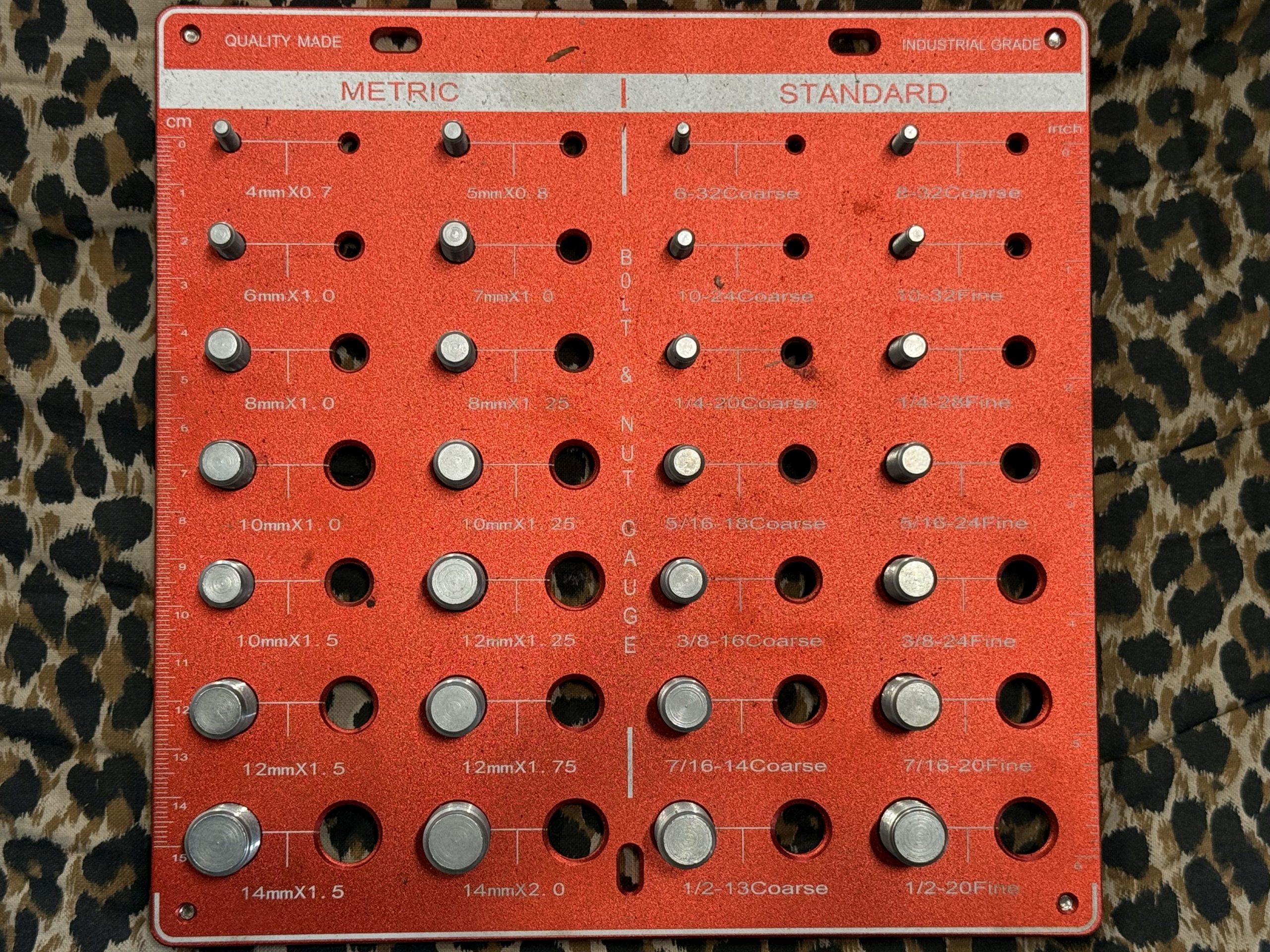
We use one of these simple nut and bolt thread checker boards, and it saves an enormous amount of messing around.
No guessing.
No trying three different nuts until one seems to fit.
No wondering whether that bolt is metric, UNC or UNF.
You simply screw the unknown bolt into the matching threaded hole, or screw the unknown nut onto one of the studs.
When you find the one that fits properly, the size is written next to it.
That’s it.
And if you regularly work on old cars, motorcycles, machinery or anything else that has acquired 50 years’ worth of replacement fasteners, it’s an absolute godsend.
What Is A Nut And Bolt Thread Checker?
A nut and bolt thread checker is exactly what the name suggests.
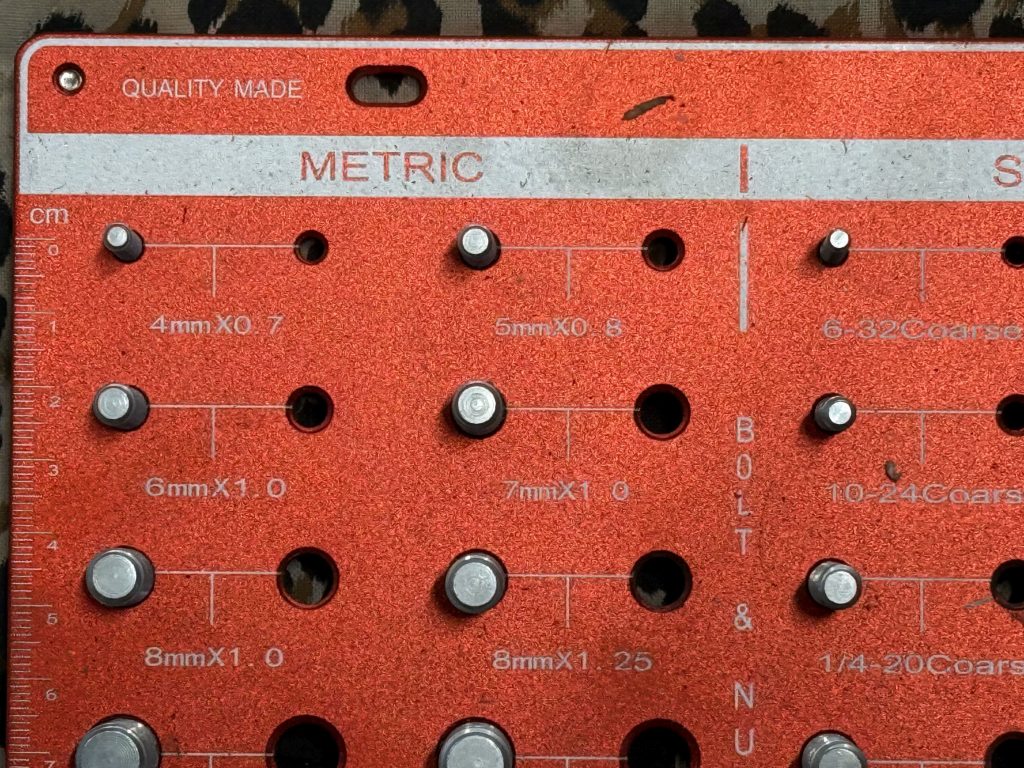
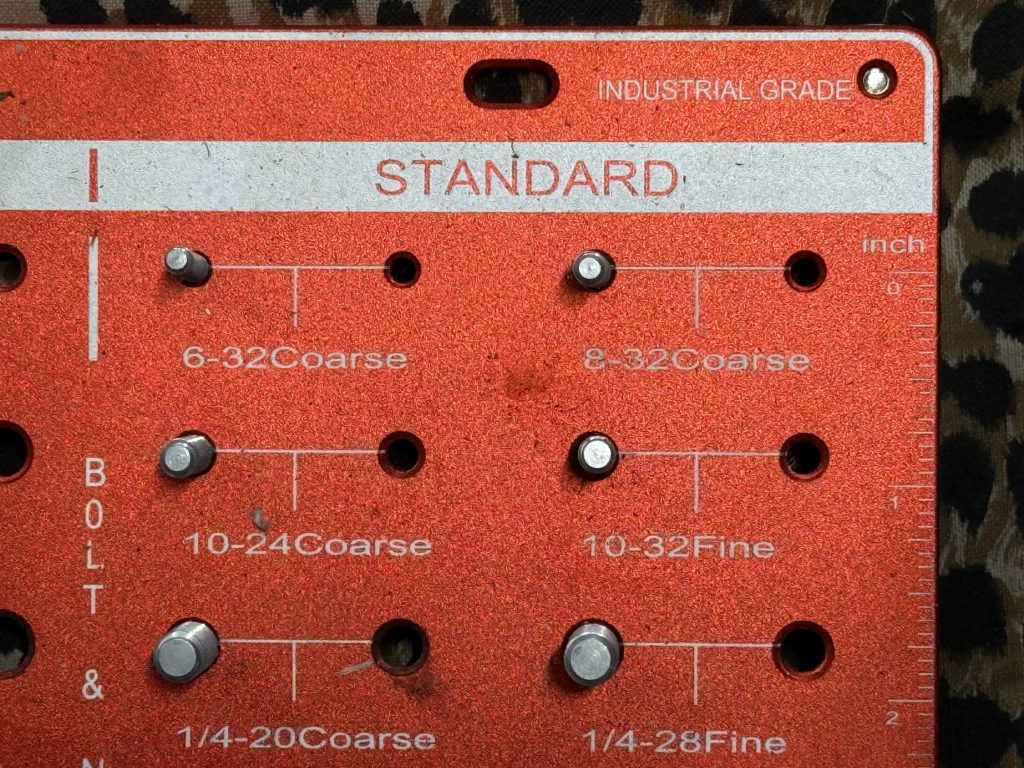
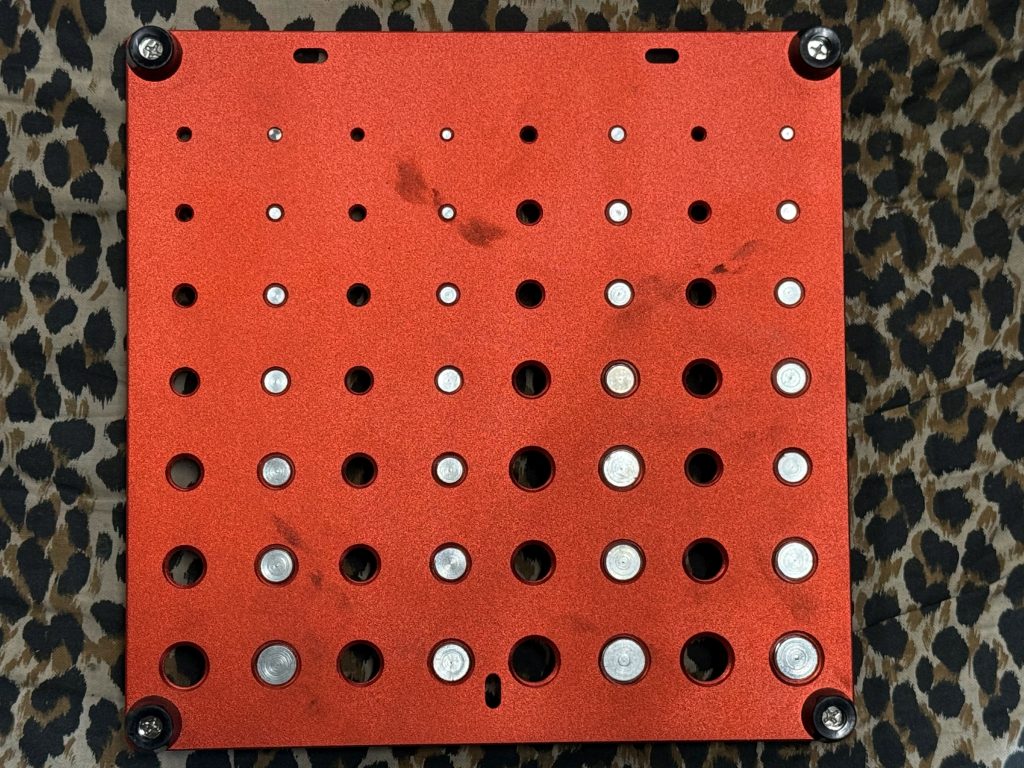
Ours is a flat metal board with a range of threaded studs and matching threaded holes.
One half covers common metric sizes.
The other covers common imperial Unified threads, including coarse and fine pitches.
So if you’ve got a bolt in your hand and don’t know what it is, you try it gently in the correctly sized holes until you find the one that screws in smoothly.
If you’ve got a nut, you do the opposite and try it on the studs.
The markings then tell you the thread size and pitch.
How To Find Out What Size A Bolt Is
For a bolt, the process couldn’t really be simpler.
Start by looking at whether it appears to be metric or imperial, if you have any clue from the vehicle or component it came from.
Then:
Try the bolt in the likely threaded holes.
Never force it.
The correct hole should screw on smoothly with no binding or excessive looseness.
Read the size printed next to that hole.
For example, a metric bolt might turn out to be:
M8 x 1.25
That means it has a nominal diameter of 8mm and a thread pitch of 1.25mm.
Metric thread sizes are described using the diameter and the distance between adjacent threads.
How To Find Out What Size A Nut Is
For a nut, use the male studs on the board.
Again, don’t force anything.
Try the nut on the appropriate studs until it runs down cleanly.
If it binds after half a turn, feels gritty or seems as though it “nearly” fits, stop.
A thread that almost fits is often the dangerous one.
It can be very easy to start a metric nut on a similar-looking imperial thread, or vice versa, and damage both in the process.
When the nut screws on naturally, simply read the identification beside the stud.
That’s the bit we love.
What could otherwise turn into ten minutes with calipers, charts and increasingly colourful language can take seconds.
What Do UNC And UNF Mean?
This is where a lot of people understandably get confused.
UNC means Unified National Coarse.
UNF means Unified National Fine.
Two bolts can have the same nominal diameter but different thread pitches.
For example:
1/4″-20 UNC has 20 threads per inch.
1/4″-28 UNF has 28 threads per inch.
The UNF thread is finer because more threads fit into the same inch.
That is the opposite way of thinking to metric pitch, where a smaller pitch number means a finer thread.
A metric M8 x 1.0 thread, for example, is finer than M8 x 1.25 because the threads are only 1.0mm apart rather than 1.25mm.
Metric Or Imperial?
This is probably the question most people are actually trying to answer.
Sometimes the vehicle gives you a clue.
A relatively modern European or Japanese car is likely to contain plenty of metric fasteners.
An older British or American vehicle may contain imperial threads.
But with classics, assumptions can get you into trouble.
Cars get repaired.
Engines get changed.
Owners fit replacement brackets.
Somebody in 1987 may have used whichever bolt was lying closest to the vice.
So rather than assuming, test it.
That’s why a physical thread checker is so useful.
It tells you what is actually in your hand rather than what the workshop manual says ought to be there.
Why Measuring The Head Isn’t Enough
One common mistake is identifying a bolt by the spanner that fits its head.
That doesn’t reliably tell you the thread size.
The thread diameter, pitch and head dimensions are separate things, and different standards can use different head sizes.
If you’re trying to identify the thread itself, you need to establish the actual thread diameter and pitch.
A proper thread checker does both by showing you exactly which thread the fastener mates with.
If you don’t have one, the more traditional method is to measure the outside diameter of the bolt with calipers and then measure its thread pitch with a thread pitch gauge, or count threads per inch for imperial threads.
Why This Is So Useful On Classic Cars
Working on old cars makes this especially valuable.
You take something apart and find:
three bolts that look metric
one that definitely isn’t
another with damaged threads
and a mystery nut that’s been living in a tobacco tin since 1974.
We’ve all been there.
The problem is that classic vehicles often contain a mixture of standards depending on their age, origin and what has happened to them over the decades.
UNF became extremely common in British car restoration and was used across many familiar marques, while earlier cars can also contain BSF and BSW/Whitworth threads.
And that’s where an important limitation of our board comes in.
It Doesn’t Identify Every Thread Ever Made
This particular checker covers the common metric and Unified sizes shown on the board.
That makes it hugely useful, but it does not mean every unidentified thread on an old British car will fit somewhere on it.
Older vehicles can use:
BSF
BSW/Whitworth
BA
BSP
specialist or manufacturer-specific threads
So if a bolt genuinely doesn’t fit any of the gauges, don’t assume the bolt is damaged or that you simply need to push harder.
You may be dealing with a completely different thread standard.
British Standard Whitworth and British Standard Fine, for example, are distinct thread systems and are not directly interchangeable with UNC or UNF simply because the nominal diameters look similar.
That caveat matters on genuinely old machinery and classics.
What If You Don’t Have A Thread Checker?
You can still identify a mystery bolt without one.
The usual process is:
Measure the outside diameter of the threaded section using a vernier or digital caliper.
Then determine the pitch.
For metric threads, pitch is measured in millimetres from one thread crest to the next.
For Unified threads, you normally identify the number of threads per inch.
Once you have both numbers, compare them with a thread-size chart.
That works perfectly well.
But if you’re doing it regularly, we’d much rather have the board.
It turns a measurement exercise into a five-second job.
One Of Those Tools You Don’t Know You Need
That’s really why we’re writing about it.
This isn’t an expensive diagnostic machine.
It doesn’t have batteries.
It doesn’t connect to your phone.
And it isn’t particularly exciting to look at.
But once you’ve got one mounted on the workshop wall, you start using it constantly.
Mystery bolt?
Check it.
Loose nut in the bottom of a parts box?
Check it.
Need to order a replacement fastener?
Check it first and know what you’re buying.
Sorting through a box of old fixings?
Suddenly the whole job gets easier.
It’s one of those workshop tools that a surprising number of home mechanics don’t seem to know exists.
We certainly wouldn’t want to be without ours now.
What Should You Search For?
If you’re trying to buy one, the useful search terms are:
nut and bolt thread checker
nut bolt size gauge
metric imperial thread checker
UNC UNF metric thread gauge
There are boards like ours, smaller handheld gauges and wire-mounted sets.
For somebody who tinkers with old cars, motorcycles or machinery, we’d put one surprisingly high on the list of cheap workshop tools worth owning.
Got A Workshop Full Of Old Car Bits?
While we’re talking about mystery nuts, bolts and parts boxes, we’re always interested in the things people uncover when clearing old garages and workshops.
If you’re clearing a garage, shed, workshop or collection and have old car or motorcycle parts, tools, new old stock, manuals, signs or other motoring items you’re thinking of selling, we’d love to hear from you.
It doesn’t all have to be identified first.
A few photographs are usually enough to get the conversation started.
Sometimes the thing sitting forgotten at the back of the workshop is exactly the sort of thing that interests us.
Affiliate Disclosure
When you click on links to various merchants on this site and make a purchase, we may earn a commission. Our affiliate partnerships include, but are not limited to, the eBay Partner Network and Amazon.
Join our newsletter
Get the best barn finds, projects and classic temptations direct to your inbox.
Related Posts
Discover More Classic Car Stories
Stay updated with the latest barn finds, auction news, and classic car adventures in our 'News & Waffle' section. Dive into rare discoveries, behind-the-scenes stories, and expert insights into the world of classic cars. Whether you’re a seasoned enthusiast or simply intrigued by the tales behind these treasures, this is your hub for all things classic and captivating.
This VW Golf Cabriolet auction result comes with a little bit of history attached to it. Not because the car once belonged to somebody famous. Not because it’s incredibly rare. And not because it broke any auction records. Quite simply, this was: Lot 1. The very first car through the very first Anglia Car Auctions [&...
This Ford Fiesta auction result raises a question we’ve been thinking about quite a lot recently. Do quality classic cars still sell well? There’s no shortage of gloomy talk around the classic-car market. Prices are down. Projects are harder to sell. Some cars that would once have attracted a queue of bidders are ...
This Citroën Saxo VTR auction result sent us into a part of the modern-classic world we’re still learning about. Because I’ll admit it. This era is slightly outside my comfort zone. Give me an old Ford, a British Leyland product or something that’s spent 30 years disappearing into a hedge and I’...