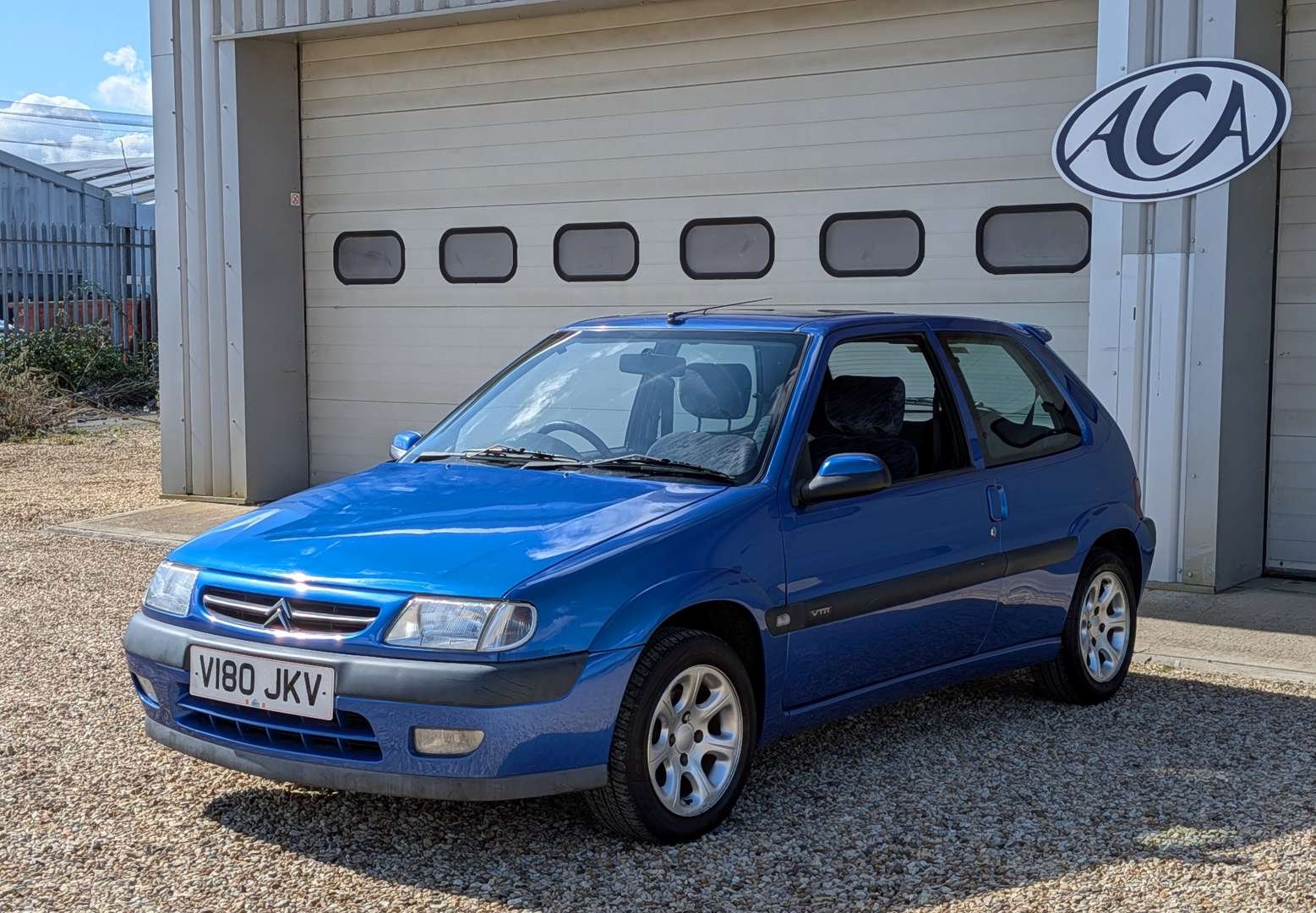
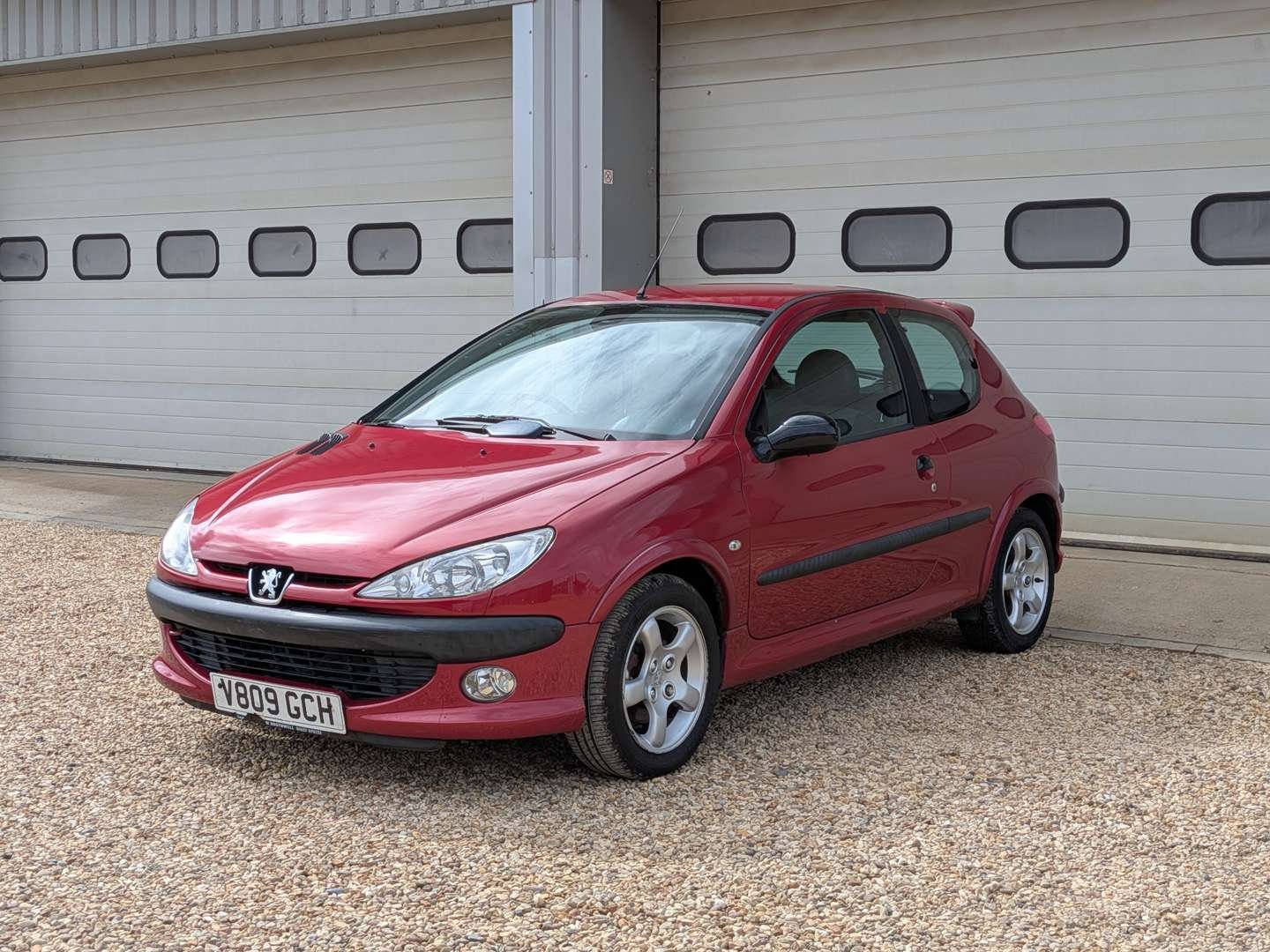
This Citroën Saxo VTR auction result sent us into a part of the modern-classic world we’re still learning about.
Because I’ll admit it.
This era is slightly outside my comfort zone.
Give me an old Ford, a British Leyland product or something that’s spent 30 years disappearing into a hedge and I’m quite happy.
A 1999 Citroën Saxo VTR?
That’s where I need some help from those of you who were there.
I’ve been told these were little pocket rockets.
So were they?
The Saxo Generation
There comes a slightly alarming point in life when cars you still think of as relatively modern start appearing in classic-car auctions.
We’re there with the Saxo.
This one was registered in 1999.
That’s 27 years ago.
For a whole generation of enthusiasts, the Citroën Saxo wasn’t an old car at all.
It was one of the cars you wanted when you were young.
And if the insurance company wasn’t feeling quite so generous, it was probably one of the cars you wanted to make your 1.1 look like.
The VTR and VTS sat right at the heart of late-1990s and early-2000s hot-hatch culture.
This Was the VTR
There is an important distinction to make.
The VTR wasn’t the fastest Saxo.
That honour belonged to the VTS.
The original VTR used a 1.6-litre eight-valve engine producing around 90bhp, while the VTS received a much more serious 1.6-litre 16-valve engine with 120bhp.
On paper, 90bhp doesn’t sound remotely like pocket-rocket territory today.
There are family SUVs with well over twice that.
But that rather misses the point.
The Saxo was small.
Very small.
And light.
Really light.
It came from an era when you didn’t need 200bhp, huge tyres and a complicated selection of electronic driving modes to have fun.
Light Weight Was the Secret
This is one of the things that makes small French performance cars of this period so interesting.
The numbers don’t necessarily tell the whole story.
The recipe was simple.
Small car.
Naturally aspirated engine.
Manual gearbox.
Front-wheel drive.
Not much weight.
And a chassis designed at a time when French manufacturers seemed particularly good at making ordinary hatchbacks entertaining.
You didn’t need outrageous straight-line performance.
You needed a road with some bends in it.
VTR Versus VTS
Naturally, the VTS has become the version enthusiasts tend to talk about most.
Its 120bhp 16-valve engine gave it substantially stronger performance and made it the obvious flagship.
Citroën itself now describes the VTS as the spiritual successor to the AX GTi.
But the VTR arguably had an important advantage when these cars were new.
It was more accessible.
For younger drivers in particular, insurance could make the difference between the car you wanted and the car you could actually afford to own.
The VTR delivered the sporty looks and much of the character without going quite as far as the VTS.
And plenty of people clearly loved them.
Britain Loved the Hot Saxo
These weren’t obscure performance derivatives that nobody noticed at the time.
Far from it.
In 1997, Citroën said the VTR and VTS together accounted for a quarter of UK sales in the high-performance supermini sector.
More than 6,000 hot Saxos were sold in Britain that year alone.
That puts the car’s popularity into perspective.
They were a genuine part of British car culture.
And that’s probably why so many people of a certain age immediately have a Saxo story.
And Then We Modified Them
Of course we did.
This was the late 1990s and early 2000s.
The modified-car scene was enormous.
Wheels got bigger.
Suspension got lower.
Exhausts got louder.
Standard stereos disappeared.
Boots filled with amplifiers and subwoofers.
Bodykits became increasingly ambitious.
And plenty of small French hatchbacks were modified to within an inch of their lives.
The Saxo was absolutely in the thick of it.
Which makes a relatively unmolested example rather more interesting today.
A 66,827-Mile Example
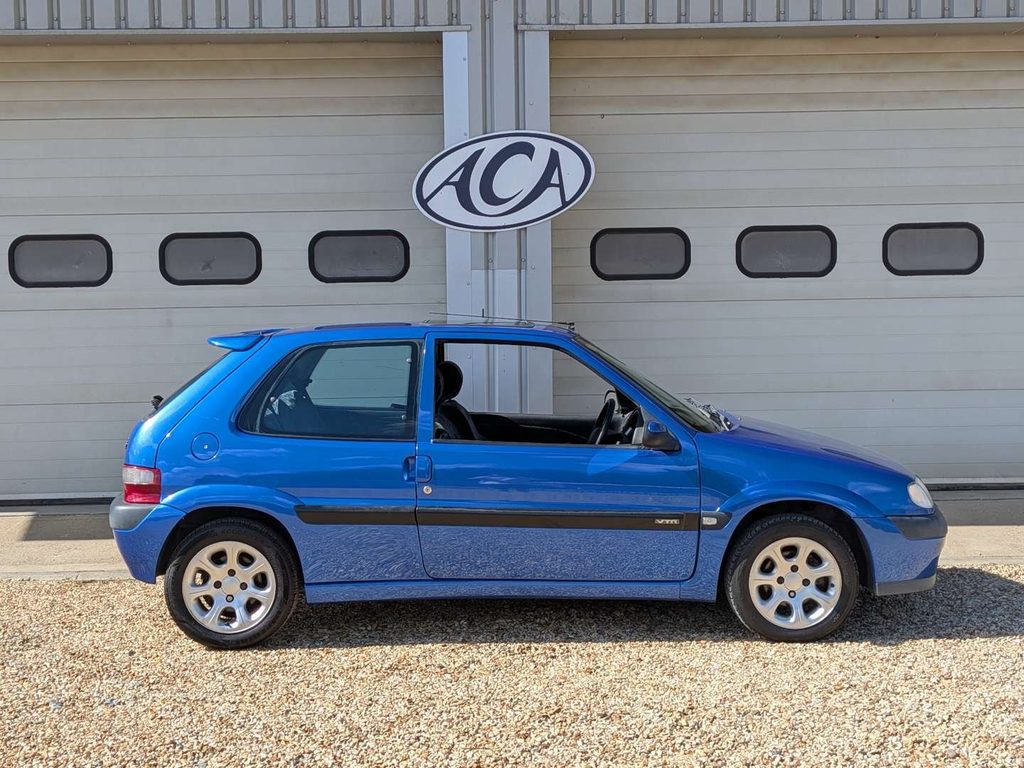
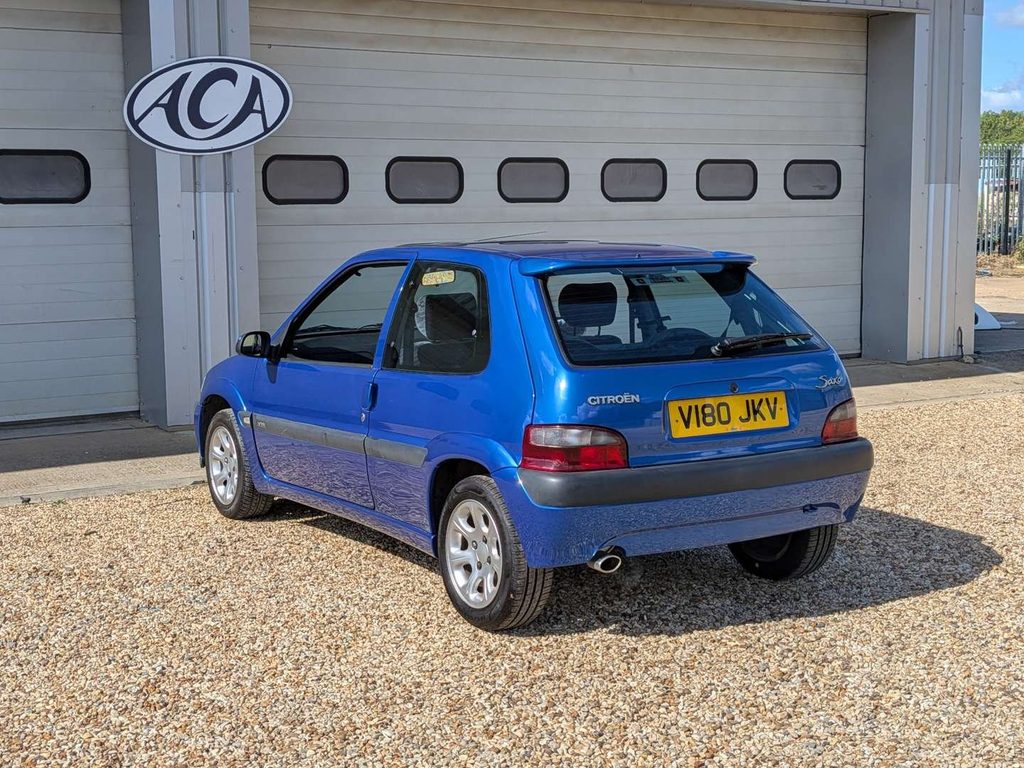
The car at Anglia Car Auctions’ first Marketplace Classics sale was a 1999 Saxo VTR finished in Poseidon Blue.
Its mileage was warranted at 66,827.
ACA recorded four owners from new.
Inside was the coordinating fabric interior, which the auction house described as remaining very clean.
There was also a useful history file.
MoT certificates went back to the car’s first test in 2002.
The handbook pack and spare keys were present.
And the service book contained six stamps, although ACA noted that the final stamp didn’t include any details.
The previous recorded service was at 49,452 miles in 2004.
Five Years in Dry Storage
There’s another interesting part to this car’s story.
Its owner had bought it five years earlier and put it straight into dry storage.
It had only recently emerged again in preparation for the auction.
That’s always the point where we’d want to start looking carefully.
Long-term dry storage can be extremely kind to a car cosmetically and structurally.
Mechanically, though, cars generally prefer being used.
Brakes, tyres, fluids, seals, hoses and other age-related components all deserve attention after a lengthy period standing.
There was, however, some reassuring news.
A Fresh MoT With No Advisories
Before the auction, the Saxo was presented for an MoT.
It passed.
Better still, it passed without advisories.
The certificate runs until 21 January 2027.
There was also a receipt in the history file for a timing-belt and coolant-pump kit from 2021.
None of that means you buy a 27-year-old car without inspecting it properly.
But it certainly makes for a more appealing starting point than something dragged out of storage with no test and no recent indication of its condition.
Is the VTR a Proper Hot Hatch?
This is where I’m throwing the question back to you.
Because definitions get surprisingly heated.
Was the VTR genuinely a hot hatch?
Or was it a warm hatch with the VTS doing the proper hot-hatch duties?
I’d probably lean towards the latter on the figures alone.
But cars aren’t driven on spreadsheets.
A light car with a modest amount of power can be far more entertaining than something much faster.
And if you’ve owned one, you’ll know considerably more about that than somebody simply looking at the power figure.
So tell us.
What was a Saxo VTR actually like to drive?
The Peugeot 106 Connection
The Saxo didn’t exist in isolation either.
Underneath, it shared much with the Peugeot 106.
And that immediately puts it into some very good company.
The Peugeot 106 Rallye and GTI have developed serious enthusiast followings of their own.
Both the 106 and Saxo belong to a generation of small French cars that now feels very different from what manufacturers build today.
They were compact in the literal sense.
They didn’t weigh very much.
They didn’t isolate you from everything happening underneath.
And the sporty versions were about making the most of relatively modest power rather than simply adding enormous horsepower.
From AX to Saxo
There was pedigree behind the idea too.
Before the Saxo came the Citroën AX.
The AX Sport and AX GTi had already demonstrated what Citroën could do with a very light small car.
When the Saxo arrived in 1996, it took over as Citroën’s entry-level model.
The sporting versions followed quickly.
The VTR brought the 1.6-litre eight-valve engine, while the VTS took things considerably further with its 16-valve unit.
That lineage is now old enough for Citroën itself to be celebrating it.
Which feels strange when many of us can still remember Saxos sitting in every supermarket car park in Britain.
So Why Have They Become Collectable?
Scarcity helps.
Not necessarily scarcity when new.
Scarcity now.
Cars like this went through a long period when they weren’t worth very much.
And that’s often the most dangerous point in the life of any future classic.
Repairs become difficult to justify.
Accident damage writes cars off.
Modified examples get broken for parts.
Rust takes others.
A mechanical failure that would be repaired without hesitation on a valuable classic can send a cheap old hatchback straight to the scrapyard.
Then one day everybody looks around and asks:
Where did they all go?
Originality Starts to Matter
That’s why cars like this become interesting.
Not because they’re exotic.
Because they’re recognisable.
The closer they are to the cars people remember, the stronger the nostalgia tends to be.
A standard-looking Saxo VTR in a proper period colour has an appeal that a heavily modified example might not.
Twenty years ago, modifications were often part of the attraction.
Today, finding one that hasn’t been completely transformed can be the attraction.
Funny how that happens.
The Marketplace Classics Sale Suited It
This was exactly the sort of car Anglia Car Auctions’ new Marketplace Classics sale was created to handle.
The first sale took place on 26 September and was aimed at affordable classics, modern classics and cars with future potential.
We’ve already featured everything from a Mercedes SL500 to a Ford Puma, Toyota Corolla and Peugeot 206 GTI from the same sale.
The Saxo fits the brief beautifully.
It isn’t an old-fashioned classic.
But it absolutely means something to a generation of enthusiasts.
The Estimate Was £4,000 to £6,000
ACA placed an estimate of £4,000 to £6,000 on the VTR.
That’s quite an interesting figure in itself.
For anyone who remembers these as cheap used cars, several thousand pounds for a Saxo VTR may take a little getting used to.
But that’s what happens when ordinary performance cars survive long enough to become nostalgic.
Condition matters.
Mileage matters.
History matters.
Originality matters.
And buyers start competing for the good survivors rather than simply buying whichever one happens to be in the local classifieds.
Then It Went Under the Hammer
The bidding didn’t quite reach the bottom of the estimate.
It reached £3,700.
And on the day, that’s where things became slightly more interesting.
The car was provisional.
In other words, the bidding had stopped below the vendor’s reserve and a sale hadn’t automatically been concluded when the hammer fell.
That doesn’t necessarily mean the story is over.
After an auction, the auction house can speak to the vendor and highest bidder and see whether a deal can be agreed.
So what happened here?
Watch the Auction First
Before we give you the answer, watch the Saxo go through the sale.
And while you’re watching, tell us what you’d have done.
Would you have kept bidding?
Was £3,700 already enough?
Or would you have been happy to pay more for a warranted 66,827-mile VTR with a fresh advisory-free MoT?
It Sold at £3,700
The ACA listing has subsequently been updated.
The Saxo is now marked:
Sold.
And the recorded hammer price is:
£3,700.
So it appears the provisional bid was ultimately enough to get a deal done at the same figure.
With the introductory Marketplace Classics buyer’s premium added, that works out at approximately £4,055 including fees.
That puts the eventual hammer price £300 below the bottom of ACA’s £4,000 to £6,000 estimate.
Was That Good Value?
This is where I’d particularly like to hear from Saxo owners.
Because from where I’m sitting, there are two ways to look at it.
£3,700 for a 1999 Citroën Saxo might initially sound like a lot of money if your mental picture of these cars is still rooted in the period when they were cheap secondhand transport.
But that’s no longer really the car being bought.
The buyer has got a VTR with warranted mileage below 67,000, a decent collection of old MoTs, handbook pack, spare keys, some service history and a fresh advisory-free MoT after several years in dry storage.
If you specifically want a Saxo VTR, finding another one with that combination might not be as easy as remembering how common they used to be.
The VTS Will Always Be the Headline Car
We suspect the VTS will continue to sit above the VTR in the pecking order.
It’s faster.
It’s the 16-valve car.
It’s the version with the more serious performance credentials.
That’s entirely understandable.
But classic-car markets have a habit of eventually dragging the next model along with them.
When the ultimate version becomes expensive or difficult to find, enthusiasts start looking at the car immediately below it.
And sometimes they discover that the slightly less powerful version has charms of its own.
Perhaps 90bhp Isn’t the Point
That’s probably the biggest thing I’ve taken away from looking into the VTR.
Calling it a pocket rocket and then discovering it had around 90bhp initially sounds slightly optimistic.
But judged by modern power figures, almost every genuinely entertaining older hot hatch looks underpowered.
That isn’t why people love them.
They love the size.
The weight.
The steering.
The gearbox.
The way the chassis feels.
The fact you can actually use the performance without immediately finding yourself travelling at ridiculous speeds.
Fun and fast aren’t necessarily the same thing.
This Is Where You Lot Come In
And that’s why this article isn’t ending with us pretending to be the world’s leading authority on Saxo VTRs.
I’m not.
Plenty of you reading this will have owned them.
Some of you probably still do.
Some will have started with a VTR and moved to a VTS.
Others will tell us the Peugeot 106 was the one to have.
And I suspect a few of you have stories involving modified Saxos that are probably best left until after the watershed.
So educate us.
Was the Saxo VTR really a pocket rocket?
Was the VTS massively better?
What went wrong with them?
What should somebody buying one today look for?
And, perhaps most importantly:
Would you have paid £3,700 for this one?
Because cars from this generation are now arriving in the classic world whether the rest of us are ready for it or not.
And judging by this Saxo, the market has already started taking them seriously.
Join our newsletter
Get the best barn finds, projects and classic temptations direct to your inbox.
Related Posts
Discover More Classic Car Stories
Stay updated with the latest barn finds, auction news, and classic car adventures in our 'News & Waffle' section. Dive into rare discoveries, behind-the-scenes stories, and expert insights into the world of classic cars. Whether you’re a seasoned enthusiast or simply intrigued by the tales behind these treasures, this is your hub for all things classic and captivating.
This Ford Fiesta auction result raises a question we’ve been thinking about quite a lot recently. Do quality classic cars still sell well? There’s no shortage of gloomy talk around the classic-car market. Prices are down. Projects are harder to sell. Some cars that would once have attracted a queue of bidders are ...
This Peugeot 206 GTI auction result started with a very simple question. How much do you think this will sell for? Because this wasn’t an immaculate, low-mileage collector’s car. It wasn’t the later GTI 180. And it wasn’t being presented as something you could necessarily jump straight into and drive home. This was ...
I was today years old when I discovered that Esso once sold spark plugs. We’ve been working on our 1956 Ford Popular and, after removing the four plugs from its little sidevalve engine, something caught our eye. ESSO. Printed clearly around the white ceramic insulators. We’re used to seeing names such as Champion, Lodge, ...