There’s something about the MG RV8 that we’ve always liked.
Perhaps it’s the familiar MGB-inspired styling.
Perhaps it’s the combination of traditional British roadster character and a wonderfully uncomplicated Rover V8.
Or perhaps it’s simply that the RV8 represents a particularly interesting chapter in MG’s history.
But when this 1993 example appeared at Anglia Car Auctions, there was something else that immediately caught our attention.
The colour.
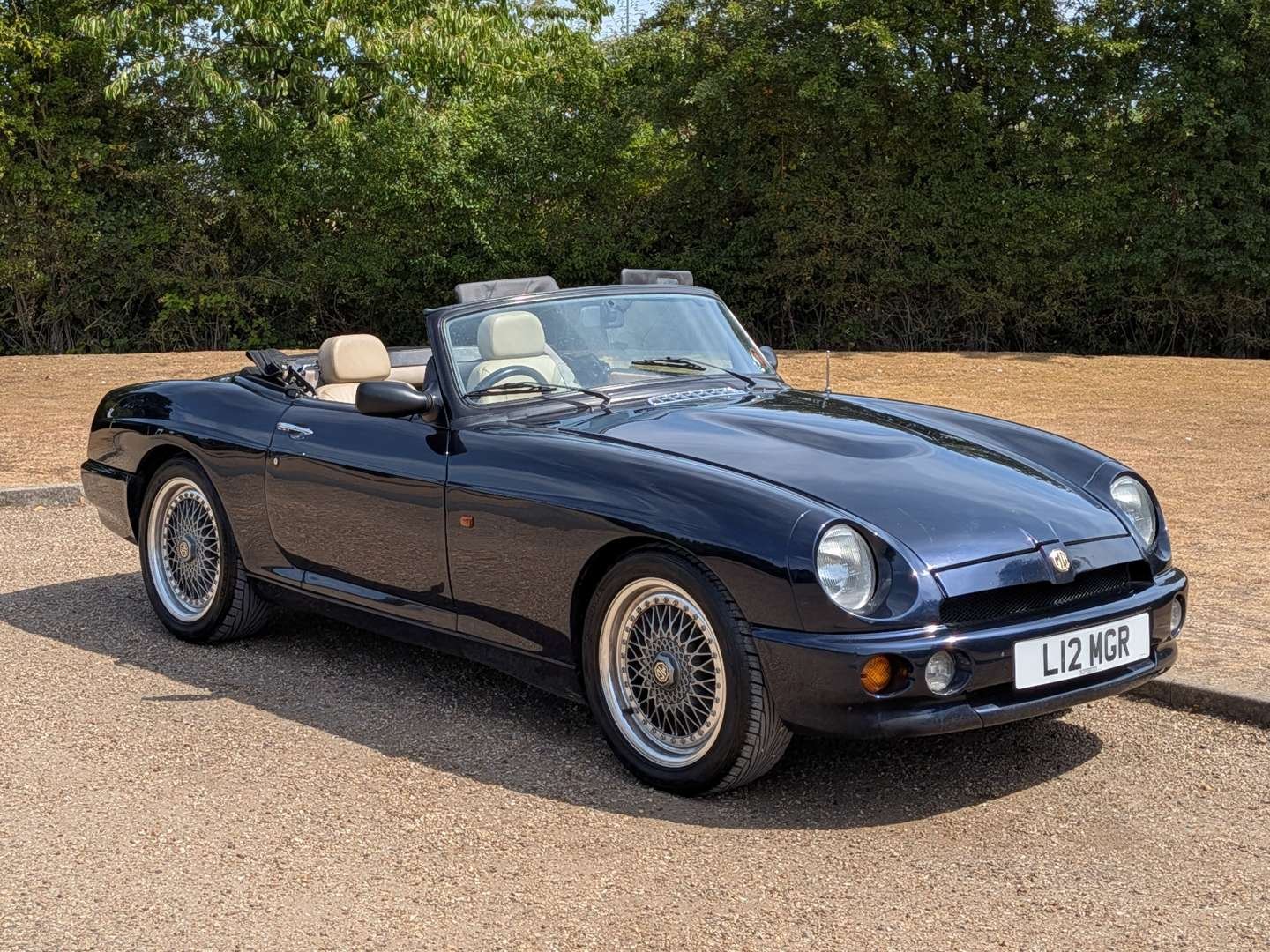
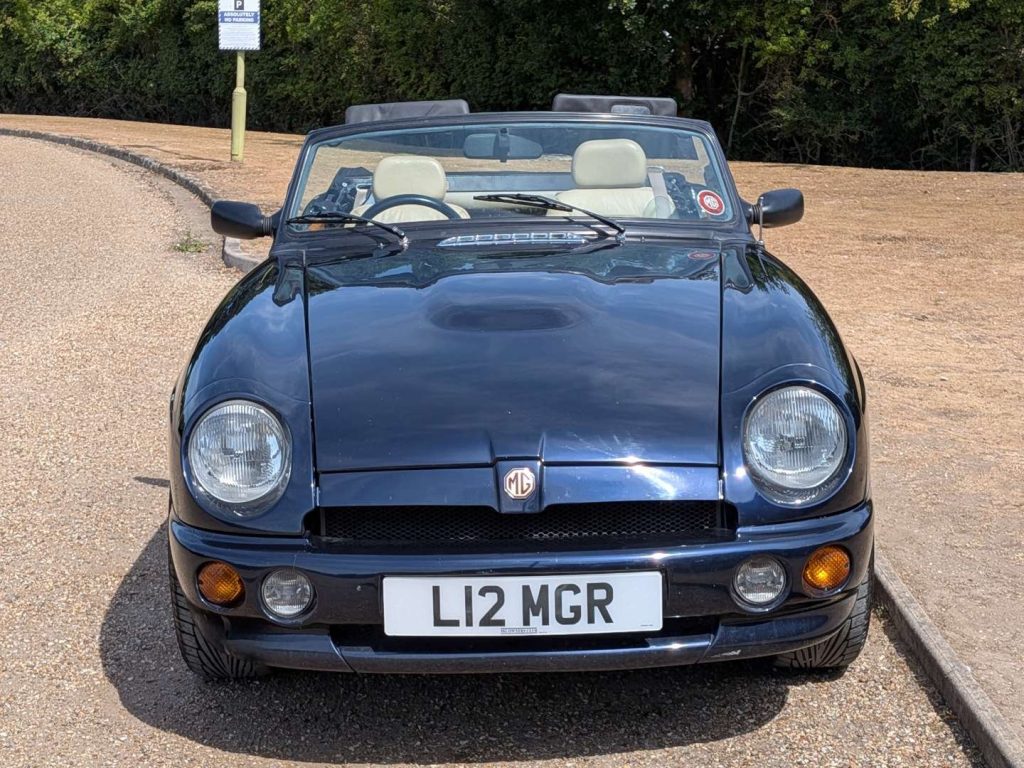
We’re accustomed to seeing MG RV8s finished in Woodcote Green, but this one was a rather attractive shade of Oxford Blue.
And as it turns out, that’s a relatively unusual colour for the model.
Just 258 were reportedly produced in this shade, with only 36 originally allocated to the UK market.
But the colour wasn’t the only interesting thing about this particular MG.
It had an unusual history, a few worthwhile modifications and some substantial work carried out earlier in its life.
And when it eventually went under the hammer, the bidding gave us another interesting result to consider.
The MG That Brought the V8 Roadster Back
To understand the RV8, we need to go back to the end of MGB production.
The final MGBs left Abingdon in 1980, bringing to an end one of Britain’s most successful sports car stories.
The MGB had been in production since 1962.
It was affordable, attractive, relatively straightforward to maintain and enormously successful both at home and overseas.
For many enthusiasts, it represented everything appealing about a traditional British sports car.
But by the early 1980s, the motoring world had changed.
And MG no longer had a new two-seater roadster in production.
That situation continued for more than a decade.
Then, in the early 1990s, Rover decided to revive the idea.
The result was the MG RV8.
A Familiar Shape With a Different Character
The RV8 was unveiled in October 1992.
At first glance, its relationship with the MGB was obvious.
The long bonnet.
The compact two-seat cockpit.
The familiar proportions.
And the traditional open-top driving experience.
But the RV8 wasn’t simply an old MGB with a larger engine fitted.
Although its basic architecture drew heavily on the earlier car, the bodywork was extensively revised.
The front and rear wings were wider.
The headlamps were different.
The interior was transformed.
And beneath the bonnet sat an engine that gave the car a rather different personality.
A 3.9-litre Rover V8.
It was a combination that brought together much of the charm of a traditional MG with the sort of effortless performance that had become increasingly desirable by the 1990s.
A 3.9-Litre Rover V8
The RV8’s 3,947cc V8 produced around 190PS, equivalent to approximately 187bhp.
Power was delivered to the rear wheels through a five-speed manual gearbox.
In a relatively compact two-seat roadster, that made for an appealing combination.
The RV8 wasn’t intended to compete with the increasingly sophisticated sports cars arriving from Japan and Germany purely on technical specification.
It offered something different.
A traditional British roadster experience, but with the unmistakable sound and character of a Rover V8.
Performance was certainly respectable.
The RV8 could reach around 60mph in approximately six seconds and had a quoted top speed of about 135mph.
But outright performance figures only tell part of the story.
There was also the appeal of the engine’s sound, the manual gearbox and the open-air driving experience.
And for anybody who already loved the MGB, the RV8 was a particularly interesting evolution of a familiar idea.
The MG RV8 Wasn’t Built in Huge Numbers
One of the things that makes the RV8 so interesting today is its relatively limited production.
Just 1,983 production examples were built between 1993 and 1995.
That’s a small number for a major British manufacturer.
And perhaps surprisingly, most of them weren’t sold in Britain.
The Japanese market became enormously important to the RV8.
MG had a strong following in Japan, and the new roadster generated considerable interest when it was exhibited there.
Ultimately, around 1,500 examples were exported to Japan.
Many have since returned to Britain as imports.
Which helps explain something you may have noticed.
Although the RV8 is a British sports car, a substantial proportion of the examples appearing for sale here today were originally supplied to Japanese customers.
This particular 1993 car, however, was originally supplied in the UK.
And its colour makes that especially interesting.
Just 36 Oxford Blue Cars Allocated to Britain
The colour most people associate with the MG RV8 is Woodcote Green.
And there’s a good reason for that.
According to specialist MG production records, approximately 1,269 examples were finished in Woodcote Green.
That’s well over half the production run.
By comparison, just 258 were finished in Oxford Blue.
Of those, only 36 were originally allocated to the UK market.
Another eight went to European markets, with the remaining 214 allocated to Japan.
That doesn’t necessarily mean only 36 Oxford Blue RV8s are now in Britain.
Cars have moved between countries over the years, and numerous Japanese-market examples have subsequently been imported.
But it does demonstrate just how uncommon the colour was among cars originally supplied here.
And we have to say, we rather like it.
The dark blue paintwork gives the RV8 a different appearance from the more familiar green cars.
It looks understated, elegant and particularly well suited to the model’s traditional British roadster styling.
But this example’s history is at least as interesting as its colour.
Originally Registered to the MG Owners Club
The car offered at Anglia Car Auctions was a 1993 MG RV8, chassis number SARRAWBMBMG000314.
That’s a particularly early chassis number, given that production began at number 251.
According to the auction catalogue, it was originally registered to the MG Owners Club.
That’s an appealing detail for a car with such a strong enthusiast following.
The catalogue also reported that it had remained in the ownership of the same company and associated family members from new, recording four registered keepers.
Such a connection doesn’t necessarily guarantee anything about the condition of a vehicle.
But it does provide an interesting element of continuity in the car’s history.
The odometer showed 57,198 miles.
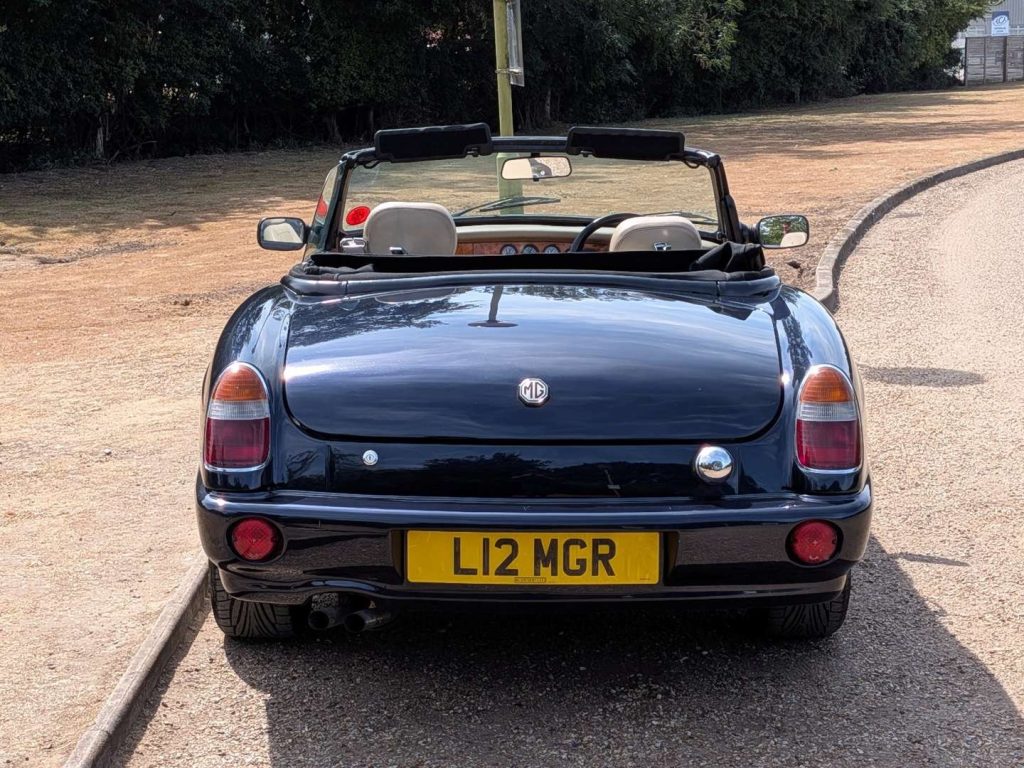
And the car was described as being in strong overall condition, with a Stone Beige Connolly leather interior.
That colour combination is particularly attractive.
Oxford Blue paintwork.
Light beige leather.
Traditional wood trim.
And a V8 beneath the bonnet.
It’s easy to understand why cars like this have developed a loyal following.
A Replacement Bodyshell in 2005
There’s another important part of this car’s history.
According to the vendor, the RV8 received a replacement bodyshell in 2005.
The auction catalogue explained that this work had been carried out privately and that the vehicle had never been registered as damaged.
The supporting paperwork included a printed list of work undertaken since 2000, with more than £12,000 reportedly spent during 2005.
That’s a substantial amount of money, particularly at the time.
And it’s something prospective buyers would understandably want to investigate carefully.
A replacement bodyshell is a significant piece of work, and the quality of the installation, associated repairs and surviving documentation all matter.
But it also means that this particular RV8 has an interesting history beyond its relatively low mileage and unusual colour.
It’s a detail that shouldn’t be overlooked when assessing the car or comparing it with other examples.
Some Interesting Mechanical Upgrades
This RV8 wasn’t entirely standard, either.
One of the most notable modifications was the fitment of Hoyle independent rear suspension.
The original RV8 retained a live rear axle, so this represents a significant change to the car’s suspension arrangement.
Independent rear suspension can offer advantages in wheel control and ride characteristics, depending on the installation and setup.
For an enthusiast intending to use the car regularly, such a modification might be particularly appealing.
The MG was also fitted with larger 17-inch alloy wheels.
Again, that’s something likely to divide opinion.
Some buyers prefer specialist classics to remain as close as possible to factory specification.
Others appreciate carefully chosen improvements that might make the car more enjoyable to drive.
There’s no universally correct answer.
But the important thing is that buyers understand what they’re purchasing.
And in this case, Anglia Car Auctions clearly identified the modifications in its catalogue.
An MoT Until March 2027
The catalogue included some other encouraging information.
The RV8 had an MoT certificate valid until 3 March 2027.
According to ACA, the car had been tested annually and its current MoT had no advisories.
A new battery had also recently been fitted.
The vendor reported that the car ran and drove well, with no known issues.
As always, those are seller-reported details rather than a substitute for an independent inspection.
But they’re certainly useful information for anybody considering a car of this age.
The MG was accompanied by its original handbook, several previous MoT certificates, the list of work carried out since 2000 and its V5C registration document.
All useful things to have with an unusual specialist car.
And with that background in mind, it was time to see what somebody would actually pay for it.
£12,000–£14,000 Estimate
Anglia Car Auctions gave the RV8 a pre-sale estimate of £12,000 to £14,000.
That seemed a reasonable range to consider for a car with its particular history, specification and modifications.
The Oxford Blue paintwork was a notable attraction.
So was its early chassis number and original UK supply.
But the replacement bodyshell and non-standard suspension would also be factors for prospective buyers to weigh up.
We were interested to see where the bidding would finish.
And we’d made an assumption about the reserve.
Given the £12,000–£14,000 estimate, we thought the seller’s reserve might be around £13,000.
As it turned out, we were wrong.
The Bidding Started at £8,000
We filmed the RV8 going through Anglia Car Auctions.
Before the auctioneer opened bidding to the room, the internet bids had already taken the price to £8,000.
From there, the bidding continued in £200 increments.
At first, the competition was coming entirely from internet bidders.
Another £200.
Then another.
And another.
The price gradually climbed towards the lower end of the estimate.
One of the interesting things about watching auctions is seeing how the competition develops.
Sometimes a car attracts immediate enthusiasm in the room.
Other times, the bidders aren’t physically present at all.
And occasionally, a telephone bidder joins the action.
That’s exactly what happened with this MG.
A Telephone Bidder Joins the Competition
As the bidding progressed, a telephone bidder entered the contest.
By this point, the MG was approaching the sort of figure we’d expected to see.
But there was another interesting detail.
The car was declared on sale at £12,000.
That meant the reserve had been reached and the highest bidder would be buying it.
We’d assumed the reserve might be £13,000.
Instead, the car was available to sell at the bottom of its £12,000–£14,000 estimate.
That changes the atmosphere of an auction.
Once a car is on sale, there’s no longer any uncertainty about whether the bidding has reached the seller’s minimum.
Somebody is going to take it home.
The only question is who, and how much they’ll pay.
And with the internet and telephone bidding still active, the MG wasn’t quite finished.
Watch the Full Auction Play Out Below:
Here’s our footage of the 1993 MG RV8 going under the hammer at Anglia Car Auctions.
Before watching, have a guess.
Would the rare Oxford Blue paintwork and interesting history help it towards the top of the estimate?
Or would the bidding finish closer to £12,000?
And would you have been tempted to join in?
£12,400 Hammer!
The bidding eventually stopped at £12,400.
And it was the telephone bidder who secured the car.
That placed the result towards the lower end of the £12,000–£14,000 estimate.
With the buyer’s premium included, Anglia Car Auctions recorded the final price as £13,392.
So, despite the unusual colour, early chassis number and original UK connection, the MG sold for a relatively modest figure within its guide.
Of course, the result needs to be considered alongside the car’s history and specification.
The replacement bodyshell and mechanical modifications may have appealed to some buyers while making others more cautious.
And auction results are always influenced by who is prepared to bid on the day.
But we thought the result was interesting.
Particularly for an MG RV8 in such an uncommon colour.
Was £13,392 Good Value?
That’s a question for prospective buyers and MG enthusiasts.
At £13,392 including premium, the successful bidder acquired an early UK-supplied RV8 finished in a comparatively rare colour.
It had an MoT until March 2027, just over 57,000 miles showing and an interesting ownership history.
It also had a substantial history of work, including the replacement bodyshell in 2005 and the installation of independent rear suspension.
Those modifications and repairs make it difficult to compare directly with a completely original example.
And, as with any specialist classic, the quality of the work is important.
But there’s certainly something appealing about the combination of an Oxford Blue RV8 and a naturally aspirated Rover V8.
Especially at a price that remains within reach of enthusiasts considering a more unusual British roadster.
Why the MG RV8 Deserves More Recognition
We think the RV8 occupies an interesting position in MG history.
It’s sometimes overshadowed by the MGB that inspired it and the MGF that followed.
But it deserves recognition for helping to revive the MG roadster tradition during the early 1990s.
It demonstrated that there was still enthusiasm for traditional open-top British sports cars.
And it brought the Rover V8 engine into a beautifully finished two-seat roadster with genuine historical connections to one of Britain’s best-loved sports cars.
With fewer than 2,000 production examples built, the RV8 was never going to become a common sight.
And that relative rarity is part of its appeal today.
It also means that seeing one in a less familiar colour can be a pleasant surprise.
Which brings us back to the example we watched at Anglia Car Auctions.
Oxford Blue or Woodcote Green?
We started by saying how much we liked this particular MG.
And the Oxford Blue paintwork was certainly one of the reasons.
There’s nothing wrong with Woodcote Green, of course.
It’s the colour most closely associated with the model, and it suits the RV8 beautifully.
But the darker blue gives the car a rather different character.
And with just 258 reportedly produced in Oxford Blue, it’s not a colour you’re likely to encounter particularly often.
So we’d be interested to hear what MG enthusiasts think.
Would you choose an RV8 in traditional Woodcote Green?
Or would you prefer something a little less familiar, like this Oxford Blue example?
And what do you make of the £12,400 hammer price?
Would you have been tempted to keep bidding?
Looking to Sell a Classic MG?
At UK Barn Finds, we’re always interested in hearing about classic MGs and other British sports cars.
From MGBs and MG Midgets to V8 roadsters, unusual survivors and long-forgotten restoration projects, we’re keen to hear about vehicles that might be available to buy.
If you’re thinking of selling a classic MG, get in touch with UK Barn Finds and tell us what you’ve got.
Join our newsletter
Get the best barn finds, projects and classic temptations direct to your inbox.
Related Posts
Discover More Classic Car Stories
Stay updated with the latest barn finds, auction news, and classic car adventures in our 'News & Waffle' section. Dive into rare discoveries, behind-the-scenes stories, and expert insights into the world of classic cars. Whether you’re a seasoned enthusiast or simply intrigued by the tales behind these treasures, this is your hub for all things classic and captivating.
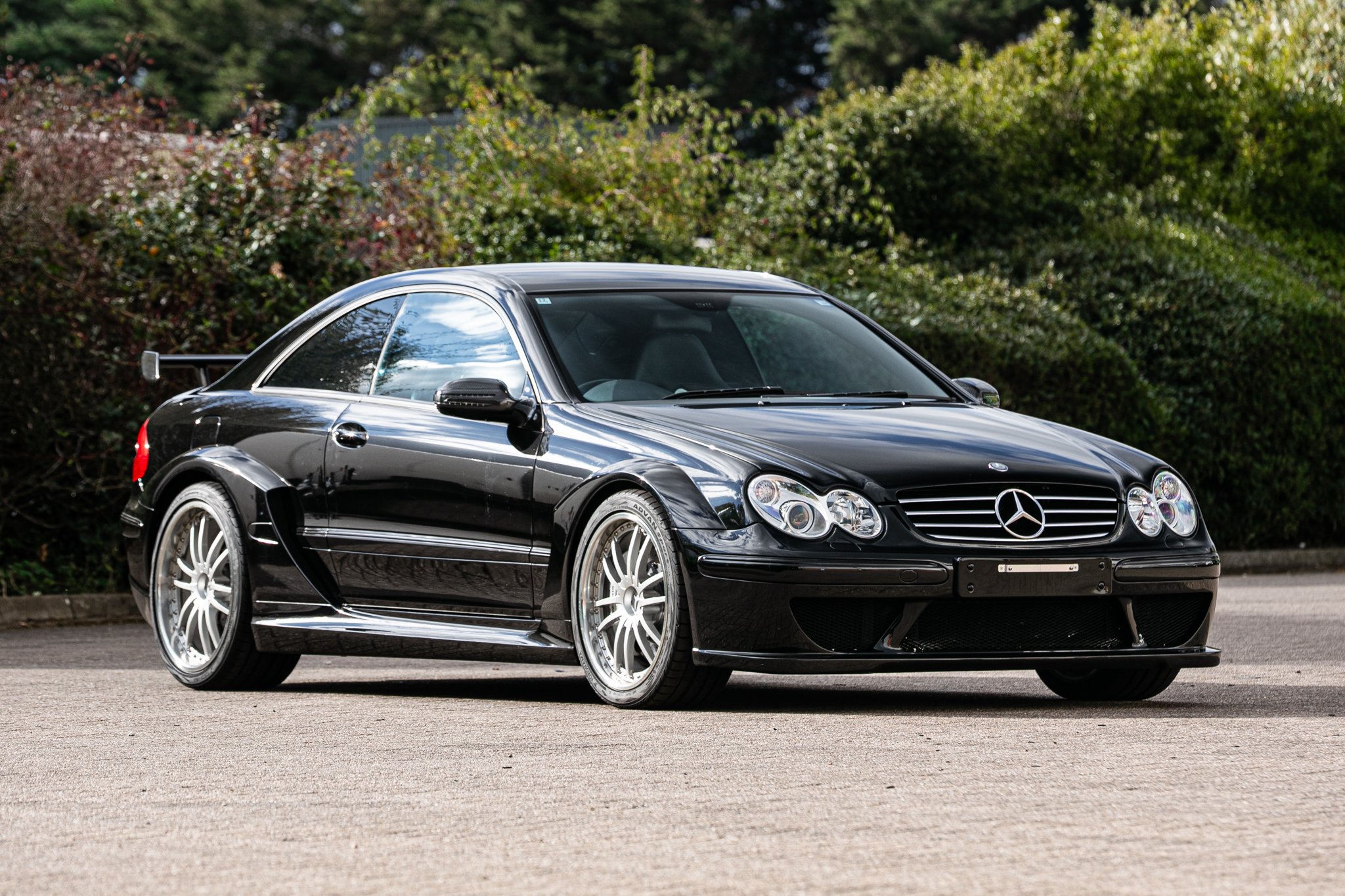
Every now and then, a car appears in an auction catalogue that makes us stop scrolling. And this is definitely one of them. A 2004 Mercedes-Benz CLK DTM AMG. One of just 100 coupés ever built. A supercharged 5.4-litre V8 producing 582bhp. And an original owner who happens to be a Formula One World Champion. […]
There was a time when you couldn’t travel very far on British roads without seeing a Ford Sierra. They were everywhere. On driveways. Outside schools. In supermarket car parks. And, of course, filling up the outside lane of the motorway. Company cars, family cars, everyday transport. But when did you last see a Sierra ...
Just 106 miles. That’s the astonishing distance showing on the odometer of this 1997 Ferrari F50, one of the most celebrated supercars ever produced. And now this remarkable example, originally delivered new in Britain, is preparing to cross the auction block in Las Vegas. Broad Arrow Auctions expects it to achieve more than $20 million […]